
“Sequencing”, what on earth is that? Well you see, certain PCNY Pokémon “go together”. Not in the sense of evolutionary lines or boudoir compatibility, but in that they were distributed from one of the PC New York’s four “Gotta Catch ‘Em All” (GCEA) stations during a particular, retraceable timeframe. Through sequencing, we try and work out what was distributed when.
Think of it like this. Your workplace probably has a coffeemaker, right? That’s our GCEA station. During, say, the fourth week of October 2003 (Ghost Week), it was able to randomly dispense four different flavours of coffee (four Pokémon). Sometime during that week, a hypothetical Joe filled up a whole tray with back-to-back coffees. Meryl did the same, as did Harry. Now, the magic of the sequencing technique is that by parsing coffee grounds scraps of Pokémon data, we can learn how many minutes, hours or even days apart Joe, Meryl and Harry used the coffee machine. In turn, this provides us with clues how long a particular combination of flavours (a campaign) was active. It may even, under certain conditions, help us to identify the exact day some 20 years ago that each got their coffees. And if the coffees (Pokémon) handed down by Joe, Meryl and Harry don’t match up at all, this suggests that same flavour combination (campaign) was put back on on another occasion. Neat, huh?
Now, the goal of the sequencing effort is to aid in the reconstruction of a fine-grained GCEA campaign timeline. Official sources are scant, and distribution windows derived from memory card campaign data tell us only what was intended, not what transpired. For example, sequencing has borne out that July 2004’s Pokémon Box distribution continued (far) longer than official sources would have it. But I’m getting ahead or myself. To better understand the sequencing tools at our disposal, and why – despite our best efforts – there is yet a divide between the practical outcomes and theoretical potential of sequencing, let’s start by taking a short primer on the inner workings of the friendly-looking GCEA “machines”.
If one were to strip away the custom facade of any of the Center’s four GCEA stations, one would find concealed several pieces of electronics. Most noticeably, each of the stations housed a TV attached to an archetypal turquoise “NR Reader” GameCube DevConsole, which acted as the beating heart that facilitated PCNY distributions. Each GameCube took a disc containing the distribution software as well as two memory cards: one in slot B with system data (“machine information”) required to make the system tick, and one with campaign data in slot A instructing the station what Pokémon to provide during what timeframe. Connected to controller port 4 was a rectangular metal box containing a “cart writer” circuit board that interfaced between the Cubes and players’ copies of Ruby or Sapphire. A cartridge slot poked out from the concealed writer; guests would insert their RS game directly into it and have a Pokémon uploaded straight to their in-game party without further input. The software played back (on the TV) a floating Pokéball animation whenever a station was idling; it switched to classic Pokémon transfer visuals when a Pokémon was being redeemed. A Gameboy Advance hooked up to Gamecube port 3 acted as a superfluous controller and verification handshake for the whole system. Intelligent Systems (of Fire Emblem fame) developed this intricate multi-part setup specifically for the PC New York, initially to service the GSC games of Gen2 and later, in early to mid 2003, modified it for use with Ruby & Sapphire. Words can only describe so much, and for a visual demonstration of the hardware in action, check out Hard4Games’ video on the subject.
Now, each time the cart writer successfully scanned an inserted gamecart, a Pokémon and its slew of unique characteristics like nature, individual values (IVs) and a vitally important hidden identifier called PID were determined pseudo-randomly there and then. The GCEA also conferred two other pieces of Pokémon data critical to constructing a timeline: Original Trainer Name (or OTN) and Trainer ID (TID). Let’s start with the Trainer Name. As is the standard for event Pokémon, the OTN reflected a key piece of information about the distribution, in this case which of four GCEA stations it was derived from: PCNYa, PCNYb, PCNYc, or PCNYd. Or more accurately, which of the four slot B “machine info” memory cards had been plugged into which station. PCNY letter designations were not determined by some immutable station identifier (as was long thought), but dependent entirely on the inserted memory card.
Four stations, four slot B memory cards, so therefore four separate letter designations per campaign, right? Ah. Would that it ’twere so simple! For starters, not all of the GCEA stations actively pushed campaigns all of the time. They could run demos, or simply be shut off. Sources indicate that out of four total booths, at most two operated concurrently during Generation III. This was (initially) not a matter of convenience or power-savings; rather, it had to do with the Center’s floorplan. Located on the second (US) floor, the positioning of the two GCEA stations nearest the front-facing windows created an insurveyable little corner sheltered from watchful eye of PCNY staff and the Center’s security cameras. This was a problem: schoolkids dropped their backpacks there as they explored the Center, only to – on multiple occasions – report theft of personal items. To prevent this from happening, the corner was closed and its two stations shut off. Technical analysis rhymes with this anecdotal insight: both the 2003 and 2004 campaigns blocs only ever had two unique letter designations: PCNYb+PCNYc for 2003, and PCNYc+PCNYd for 2004. Sources further suggest that between December 2003 and March 2004, all four machines were disabled as management lost confidence in their crowd-pleasing usefulness, not to be powered back up until April 2004 – with the intriguing exception of one singular day over Christmas.1When an irate visitor demanded that the GCEA stations be powered up for their kid to redeem Pokémon! No unallocated campaigns that would fill this void are known, with the possible exception of BC (or CD) Dragons.2Source for these insights is former PCNY staffer Aurora.
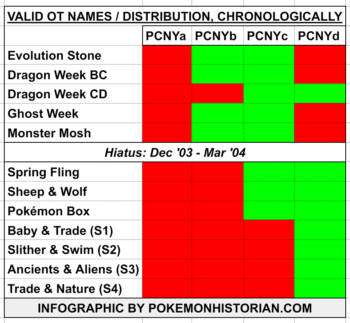
Also intriguing is how out of four potential PCNY OTN, only three – B, C and D – exist in the wild. The 2003 and 2004 campaign blocs both include PCNYc, yet neither features PCNYa. For years, the absence of OT “PCNYa” fed the popular belief that one of the stations (commonly dubbed “machine A”) had irreparably malfunctioned early in its lifecycle. Yet staff recall no permanent technical GCEA station failures, even the if the two unfortunately situated ones were commonly offline, and overheated NR units needed replacement from time to time.3Source for this latter tidbit is an anonymous employee close to the situation. We now understand that the explanation for the missing-in-action PCNYa lies elsewhere: the memory card labelled “A” in fact produced OT PCNYc. The sequencing implication is that we needn’t look for Pokémon marked “PCNYa” because they cannot logically exist, just like campaigns cannot exceed the practical maximum of two unique letter designations (it’s either B & C, or C & D).4Most campaigns have a relative overabundance of Pokémon branded PCNYc compared to B and D. Why this is so is not entirely clear – it may relate to GCEA station positioning.
Right. Now for that second piece of pertinent information the GCEA stations bestowed upon their Pokémon: Trainer IDs (TID). Gen3 event Pokémon TID often point to the starting date of a particular event. The 2004 Tanabata Jirachi for example had a TID of “40707” for July 7, 2004 the first day of the Star Festival on the Gregorian Calendar. Alternatively TIDs might be set to some commemorative number, like “00010” for Pokemon’s Tenth Anniversary “Journey Across America” event series. Unusually, PCNY Pokémon were numbered sequentially. Until a GCEA station was reset, every new Pokémon it produced had its TID incremented by +1 compared to the previous. Meaning, for instance, that the first Pokémon of the day spat out by “machine” B would always be numbered PCNYb 00001, the second PCNYb 00002, the third PCNYb 00003, and so on, up to a theoretical maximum of 65535. By simply surveying the highest TIDs of preserved PCNY Pokémon, we can begin to make guesstimations about the popularity of any given campaign. It’s brilliant.
Seems straightforward, right? Combine OTN with TID and you have your sequence right there! Why bother with technical analysis? Ah. Distro reruns. Reruns? Yes. PC New York staff could reinstate any given campaign at any time by reverting a GameCube’s internal clock to its appropriate programmed distribution window, provided they had the right memory cards on hand, of course. (Reprogramming of which was done at Japan HQ.) Take “Dragon Week”, for example. It’s fair to assume a powerful dragon distribution was popular with visitors to the Center. So did it truly run only once, for a week in early October 2003? Or was it put back on for Christmas, perhaps, as sources tenuously suggest? Did it make a wholly unaccounted for reappearance somewhere in late Spring 2004? Theoretically, anything is possible, limited only by the (unknowable) actions of PCNY staff. As such, even if no machine resets occurred in the midst of a campaign, and no machine hiccups took place that could splice perfectly good Pokémon chains, any campaign can theoretically have multiple distinct sequences. And many do: there isn’t a single distribution bar May 2004’s “Sheep & Wolf” of which we don’t have multiple. Surface-level analysis has difficulty dealing with TID/OTN overlap between sequences, and when used in isolation may cause false positives (Dragon Week’s PCNYc 00021-00026 really look like they ought to fit together, but they don’t!) Similarly, OT/TID “blocs” can often be shuffled to connect up in any number of ways – but which is the correct one? To say nothing of working out the timegaps between them.
Timegaps. What TID/OTN analysis alone cannot tell us at all is timegaps. The OTN/TID combinations of, say, PCNYb 00100 and 00101 could have been generated 10 seconds, 10 minutes, or 10 hours apart – and there is simply no way to tell off surface-level information. Redeeming a GCEA Pokémon was quick: a speedy customer could generate one every 10-15 seconds, so timegaps could be tiny, or huge, if nobody was using a particular machine (or if it was left on overnight)!
This is where we must dig deeper. Technical sequencing picks up where common logic leaves off. Happily, the output of GCEA stations followed predictable pseudo-random patterns. Unseen by the end user, while active a GCEA station its pseudo-random number generator (PRNG) advanced with every frame for a total of 60 RNG calls per second. PCNY Pokémon their natures and IV spreads are derived from this PNRG state, and critically, so are their 8-digit hexadecimal Pokémon Identifiers (or PID).5Fun fact, species determination is done separately, and uses a modified version of Pokémon Stadium RNG, which is itself legacy from Gen2 PCNY. Why is this information useful to us? Well, because in a stroke of great fortune, we came to know the precise algorithmic variant. Normally unknowable to players, the discovery of DanTrain’s monolithic PCNY stash allowed Project Pokémon wizards to find and reverse-engineer the PID relationship between his Pokémon and thus crack the algorithm.
Algorithm in hand, we are able to group preserved PCNY into accurate, distinct sequences. We can assert with confidence, for example, that “CD Dragons” had a minimum of five unique C sequences, which is a lot, hinting at redistribution(s). And since we know that the GCEA station RNG advanced 60x/second, timegaps between Pokémon in a single chain emerge naturally.6False positives are rare. A full algorithmic cycle takes a theoretical 828.5 days to complete – that’s some ~4.3 billion unique PRNG states! Staying with Dragon Week, more than five hours separate PCNYc 149 Flygon from PCNYc 791 Seadra (~1.1 million frames). Such time intervals reveal how pressured a user was (or wasn’t) in their redeems, which provides clues to the popularity of a campaign at any given time. Inkydog’s hugely impressive 80d-190d Spring Fling sequence is a great example: a mere 78 minutes elapsed from start to finish, suggesting a constant tempo indicative of having had the place mostly to himself. Remarkable chains such as these allow us to speculate on the timing of particular sequences within a campaign (long chains on weekends); sequences that, in some instances, we’re able to retrace to specific dates. The aforementioned Dragon Week and Monster Mosh may both have comprised Day 1 of their respective distributions. And in what is perhaps sequencing’s greatest success, we were able to string together 2004 Box Pokémon from many different owners and prove conclusively distribution overshoot, thus confirming what scraps of anecdotal evidence had long indicated. In this manner, technical sequencing is the gateway to a veritable treasure trove of insights. Its potential only increases with more data points. (So please, if you own original PCNY, donate them for research!)
Finally, there’s another helpful dimension to sequencing: Pokémon authenticity. I’ve commented elsewhere how publication of the PCNY algorithm, the possible release of modified distribution software, or even the simple monetisation of existing equipment makes possible the full reproduction of PCNY Pokémon exactly as distributed all these years ago. However, armed with an exhaustive dictionary of historical PCNY sequences, we are able to identify even replicas that otherwise pass all checks. This is critical to the ultimate goal of maintaining an accurate historical record.
Now for the data itself. Each bloc between triple dashes (—) makes for a distinct chain. Where significant or notable timegaps exist between two surviving PCNY of a single sequence, these are given. As you will see, we don’t have very many examples of a sequence spanning multiple days, which could mean any number of things. It could mean the distribution hardware was manually reset more frequently than our information suggests – perhaps as a matter of routine maintenance, or to resolve software errors. It could also mean that the chief donators of our small sample size – GoldUrsaring, DanTrain, and Inkydog – liked to visit the Center on specific days only due to real-life commitments. Saturday shortly after a reset or a Sunday seem like good candidates. We also have a number of sequences of one, ie. Pokémon that don’t chain with anything else, which would be inherently suspect hadn’t they come from reliable sources before the PCNY algorithm was cracked.
Pokémon have been colour-coded by original owner. Key:
Inkydog26 (227 Pokémon)
DanTrain (141 Pokémon)
Aurora (64 Pokémon)
GoldUrsaring (18 Pokémon)
LL (13 Pokémon)
Reisora (10 Pokémon)
Chaos#### (6 Pokémon)
Remote-Canary-2676 (5 Pokémon)
Kris (5 Pokémon)
Alchem1stX (2 Pokémon)
EXEC (2 Pokémon)
Unknown OG Owner (16 + 2 Pokémon)
Exception: Aurora > DanTrain (trade) ca. 2004 (4 Pokémon)
TOTAL: 515 PCNY POKÉMON
Evolution Stone Promotion
Official: August 30 – September 4, 2003
Nominal: August 30 – late September, 2003
DISTRIBUTION DETAILS
OTs: PCNYb, PCNYc
– Pikachu: 25%
– Staryu: 25%
– Gloom (Sun Stone): 25%
– Gloom (Leaf Stone): 25%
CONTRIBUTORS
DanTrain (25)
LL (2)
Aurora (1)
PCNYb
00003b Gloom
00004b Gloom
00009b Gloom
00018b Staryu
—
00216b Staryu
00217b Gloom
—
Likely mid-late September, 2003
Dragon Week BC (see below) wasn’t slated to start until September 29, so it’s probable that Evolution Stone was permitted to run long to have at least some distribution going on the GCEA machines. This sequence’s relatively high TIDs coupled with slow redeem pace (>6 hours between 00866 Gloom and 01035 Pikachu) suggests a multi-day affair well past the peak of opening weekend.
00865b Pikachu
00866b Gloom
01035b Pikachu [+6h 31m]
PCNYc
00024c Staryu
00025c Staryu
00045c Pikachu
00052c Pikachu
00053c Gloom
—
00062c Gloom
00063c Gloom
00064c Pikachu
00123c Gloom
00128c Gloom
00138c Gloom
00216c Pikachu
00217c Gloom
00218c Pikachu
00224c Staryu
00225c Gloom
00238c Pikachu
00274c Pikachu
00276c Gloom
00297c Pikachu
00310c Gloom
00323c Staryu
—
00652c Pikachu
—
01068c Pikachu
Dragon Week – Variant BC
September 29 – October 3, 2003 (?)
DISTRIBUTION DETAILS
OTs: PCNYb, PCNYc
– Salamence (Scary Face): 25%
– Flygon (Screech): 25%
– Altaria (Refresh): 25%
– Seadra [Lv.32] (Leer): 25%
CONTRIBUTORS
Aurora (13)
Aurora > DanTrain (trade) (4)
LL (2)
PCNYb
Sometime in 2004
Meet one of this document’s most peculiar sequences. As explained in a footnote here, DanTrain likely traded PCNY staffer Aurora for a set of “BC Dragon” re-run Pokémon sometime in 2004. The key pieces of information: The dragons’ female OT gender as distinct from Dan’s own male Trainer, plus the discovery of DanTrain’s trading fodder (OT: Dan) on Aurora’s carts.
00001b Seadra – OTG ♀
00036b Flygon – OTG ♀ [+2hrs 3min]
00048b Salamence – OTG ♀ [+38min]
—
00052b Altaria – OTG ♀
—
00071b Flygon
—
00097b Salamence
00120b Altaria [+7m 25s]
00121b Flygon
00122b Altaria
00123b Altaria
PCNYc
00014c Altaria
00016c Flygon
00017c Flygon
00018c Flygon
00030c Flygon [+6m 10s]
00033c Flygon
00034c Flygon
—
00073c Seadra – OTG ♀
00104c Kingdra [Seadra] – OTG ♂ [+21m]
Dragon Week – Variant CD
Official: September 29 – October 3, 2003
Nominal: September 29 – October 17, 2003 (likely)
DISTRIBUTION DETAILS
OTs: PCNYc, PCNYd
– Salamence: 25%
– Flygon: 25%
– Altaria (Ice Beam): 12.5%
– Altaria (Flamethrower): 12.5%
– Seadra (Ice Beam): 12.5%
– Seadra (Leer): 12.5%
CONTRIBUTORS
DanTrain (23)
GoldUrsaring (10)
Inkydog26 (1)
Unknown OG Owner (1)
You! What evidence have you that Dragon Week ran long, bridging the gap all the way to Ghost Week in mid-October? None, except that the PC New York was a flashy, state-of-the-art facility, and it’s borderline unimaginable that the eye-catching, heavily promoted GCEA stations would simply have nothing on to impress visitors (and thus disappoint those seeking the exclusive Pokémon it sometimes advertised). DanTrain’s many sequences are illustrative in this regard. As the Center’s most fanatical GCEA enthusiast bar Inkydog26, Dan stopped by the PC New York again and again, visiting in mornings before school or in afternoons after school, testing the GCEA machines for new Pokémon each time and grabbing a few more when finding Dragon “Week” still on.
PCNYc
00002c Seadra (Leer) [3min from start]
00004c Salamence (Thrash)
00011c Seadra (Ice Beam) [+3min]
00012c Flygon (Flamethrower)
00013c Seadra (Leer)
00021c Seadra (Ice Beam)
00022c Flygon (Flamethrower)
00024c Altaria (Ice Beam)
00025c Salamence (Thrash) [Lonely]
—
00023c Salamence (Thrash) [16min from start]
00025c Salamence (Thrash) [Rash] [+31sec]
00026c Salamance (Thrash)
00141c Altaria (Flamethrower) [+2h 30min]
00142c Altaria (Ice Beam)
00144c Flygon (Flamethrower)
—
00108c Salamence (?)
00110c Seadra (Ice Beam)
00114c Salamence (Thrash)
00115c Seadra (Ice Beam)
00116c Salamence (Thrash)
—
September 30 or October 3, 2003
If there’s a candidate for opening day sequence, September 30, this one is it. With the Dragons’ TID running up to almost 800 in a matter of hours, the Center must’ve been crazy packed with prepared fans putting the machines through their paces knowing that they’d spit out something(s) special. But equally… It could have been October 3: A busy Friday that was moreover the event’s nominal closing night.7The PC New York was open till 9PM Fridays. Which one is true is anyone’s guess at the moment.
00148c Altaria (Flamethrower)
00149c Flygon (Flamethrower)
00791c Seadra (Leer) [+5.2hrs]
00798c Salamence (?)
—
Unknown (???)
Here’s the distribution’s most problematic sequence. A 98-hour (or 4+ day) gap separates GU’s 00067c Altaria and Inkydog’s 00212c Altaria. This suggests continuous GCEA machine operation without resets but surprisingly few redeems. So when did this happen? Surely not starting opening day, September 30. But it also cannot include the presumed frenzy of closing day, October 3. Might this sequence then be evidence that the distribution ran long? Ah… No. You see, GoldUrsaring’s adamantly recalls to have claimed his CD Dragons during the week they were originally advertised. Which, assuming this whole four-day connection isn’t spurious, leaves nowhere to place this slow-as-molasses sequence. Puzzling.
00061c Salamence (Thrash)
00062c Seadra (Ice Beam)
00067c Altaria (Ice Beam)
00212c Altaria (Ice Beam) [+98hrs?]
PCNYd
00067d Seadra (Leer)
00068d Flygon (Flamethrower)
00069d Seadra (Ice Beam)
00071d Altaria (Flamethrower)
00072d Salamence (Thrash)
00077d Flygon (Flamethrower)
00079d Salamence (Thrash)
—
00089d Altaria Flamethrower)
00091d Seadra (Leer)
00094d Altaria (Flamethrower)
—
00210d Seadra (Leer)
00211d Flygon (Flamethrower)
00366d Altaria (Flamethrower) [+1h 48min]
00368d Flygon (Flamethrower)
00369d Altaria (Flamethrower)
Ghost Week
October 18 – 24, 2003
DISTRIBUTION DETAILS
OTs: PCNYb, PCNYc
– Duskull (25%)
– Shuppet (25%)
– Cacturne (25%)
– Shedinja (25%)
CONTRIBUTORS
PCNYb
00266b Duskull
00267b Cacturne
00268b Cacturne
00269b Shuppet
—
00913b Cacturne
—
Three-day sequence through Friday October 24, 2003 (?)
This is an interesting sequence. For one, it’s (at least) three days long, being suggestive of a weekday chain where the PCNYb machine was left to operate continually without daily resets. It’s also apparent that towards the chain’s end, the downloads came thick and fast. What compelled DanTrain and Aurora to team up and camp station B to pull in what looks like a lifetime supply of ghosts? Was it perhaps the night before the Halloween Bash, with both cognisant that the GCEA Pokémon would roll over the following morning? And Dan’s lone 01148b Shuppet, was that a “never mind, I have plenty” goodbye-kiss to Ghost Week? Your guess is as good as mine.
00996b Duskull
00997b Cacturne
00998b Cacturne
00999b Cacturne
01034b Duskull [+3hrs]
01035b Shuppet
01037b Shuppet
01039b Shuppet
01113b Duskull [+25hrs]
01114b Shedinja
01115b Cacturne
01116b Duskull
01118b Shedinja
01119b Shuppet
01120b Cacturne
01121b Shedinja
01122b Shuppet
01124b Shuppet
01125b Shuppet
01126b Shuppet
01127b Shuppet
01129b Cacturne
01130b Cacturne
01131b Cacturne
01132b Shedinja
01133b Shuppet
01134b Shuppet
01135b Cacturne
01137b Duskull
01139b Shuppet
01140b Shuppet
01141b Cacturne
01142b Shuppet
01144b Shedinja
01145b Cacturne
01147b Shedinja
01148b Shuppet
01151b Cacturne
PCNYc
00006c Duskull
00007c Shuppet
00008c Cacturne
00009c Shuppet
00010c Shedinja
—
00079c Duskull
00080c Shedinja
00081c Cacturne
00089c Shedinja
00090c Cacturne
00091c Cacturne
00092c Shedinja
00093c Duskull
00095c Duskull
00096c Shedinja
—
00462c Cacturne
—
00745c Shedinja
Monster Mosh
October 25 – 31, 2003
DISTRIBUTION DETAILS
OTs: PCNYb, PCNYc
– Exploud Lv50 (12.5%)
– Exploud Lv100 (12.5%)
– Aggron Lv50 (12.5%)
– Aggron Lv100 (12.5%)
– Crawdaunt Lv50 (12.5%)
– Crawdaunt Lv100 (12.5%)
– Wailord Lv50 (12.5%)
– Wailord Lv100 (12.5%)
CONTRIBUTORS
DanTrain (26)
Aurora (17)
Reisora (8)
GoldUrsaring (8)
Unknown OG Owner (3)
LL (2)
PCNYb
Halloween Bash: Saturday October 25, 2003
00105b Exploud Lv50
00106b Crawdaunt Lv100
00109b Crawdaunt Lv50
00369b Aggron Lv100 [+?]
00370b Crawdaunt Lv100
00371b Exploud Lv100
00372b Aggron Lv50
00377b Wailord Lv100
[NB: PCNYb 369-372 generated around ~2PM, October 25, 2003]
—
00072b Exploud Lv50
00079b Exploud Lv100
00080b Wailord Lv50
00081b Wailord Lv50
PCNYc
Halloween Bash: Saturday October 25, 2003
This one’s a little tricky. We know from Reisora’s recollections that her downloads stem from around 2:30PM the Saturday that PC New York threw its annual Halloween Bash, October 25, 2003 (leaflet). This means that any Pokémon that sequences with Reisora’s octet must ipso facto also be from that day. The only trouble is, we don’t have access to Reisora’s PIDs as she – understandably – worries about the sanctity of her PCNY Pokémon. The sequences as presented here therefore rest on a degree of inference. The main question is: Which chain is Saturday’s, the 00085c Crawdaunt sequence with chiefly DanTrain Pokémon, or the smaller line with LL’s Pokémon? It’s difficult to know with certainty, but surveying both chains, the blistering pace of the former sequence stands out: From 00238c Crawdaunt to 00734c Aggron, nearly 500 Pokémon were downloaded in the space of four hours. That’s one Pokémon every ~30 seconds! If we assume that the Center was packed with Halloween Bash revellers looking for something to occupy themselves with before and after contest judging, swarming the freshly-stocked GCEA stations sure seems to fit the bill.
One more note regarding this sequence: Inkydog’s 00906c Exploud looks like a peculiar outlier. This Pokémon aside, Inky shows up in the PCNY record only with the Spring 2004 distributions, and once he did, he immediately proceeded to farm every new distribution in force. It makes intuitive sense, then, that Inky didn’t redeem this singular Exploud personally but rather traded for it, perhaps in an exchange with another Center regular whose collection is yet undocumented.
00085c Crawdaunt Lv100
00087c Wailord Lv50
00095c Aggron Lv100 [+5m]
00096c Aggron Lv50
00098c Aggron Lv100
00101c Aggron Lv50
00104c Wailord Lv50
00107c Crawdaunt Lv50
00108c Exploud Lv50
00112c Crawdaunt Lv50
00114c Crawdaunt Lv100
00115c Exploud Lv100
00116c Exploud Lv100
00118c Aggron Lv50
00236c Wailord Lv50 [+1hr]
00237c Aggron Lv100
00238c Crawdaunt Lv50
00373c Crawdaunt Lv100
00374c Exploud Lv100
00375c Exploud Lv100
00376c Aggron Lv50
00734c Aggron Lv50 [+4hrs to 00238c Crawdaunt]
00906c Exploud Lv100 [+2.5hrs]
Note: PCNYc 373-376 generated ~2PM, October 25, 2003 (Reisora).
—
Sunday October 26, 2003 (?)
00024c Crawdaunt Lv100
00032c Aggron Lv50
00095c Aggron Lv50
00107c Wailord Lv50
00397c Wailord Lv50
00398c Exploud Lv100
00588c Wailord Lv100 [+6h 16m to 00032c Aggron]
00598c Exploud Lv100
—
00099c Aggron Lv50 – OTG ♂
00521c Aggron Lv50 – OTG ♀ [+81hours]
00600c Crawdaunt Lv 100 [+3hr 42min]
00601c Aggron Lv 50 [+29sec]
00602c Crawdaunt Lv 50
00603c Aggron Lv 50
00605c Exploud Lv 50
00609c Crawdaunt Lv 50
00610c Wailord Lv 50
00611c Wailord Lv 50
—
00006c Wailord Lv100
00007c Exploud Lv 50
00008c Wailord Lv 50
00009c Exploud Lv 50
00010c Exploud Lv 100
00016c Wailord Lv 100
00018c Aggron Lv50
00019c Exploud Lv50
00020c Crawdaunt Lv50
00034c Exploud Lv50
00035c Exploud Lv50
00036c Crawdaunt Lv50
Spring Fling
April 19 – 25, 2004 (?)
DISTRIBUTION DETAILS
OTs: PCNYc, PCNYd
– Gardevoir (50%)
– Tropius (25%)
– Salamence (25%)
CONTRIBUTORS
Inkydog26 (55)
DanTrain (8)
Unknown OG Owner (3)
PCNYc
00135c Gardevoir
—
00136c Gardevoir
PCNYd
00006d Salamence
00010d Salamence
—
00016d Tropius
00017d Gardevoir
00018d Salamence
00111d Salamence [+3.5hrs]
—
00029d Gardevoir
00039d Tropius
00102d Salamence [+3.7hrs]
—
00080d Gardevoir
00082d Salamence
00083d Salamence
00084d Tropius
00100d Gardevoir [+8m]
00101d Tropius
00103d Gardevoir
00105d Tropius
00106d Gardevoir
00108d Tropius [+5m]
00109d Gardevoir
00110d Salamence
00111d Tropius
00112d Gardevoir
00113d Tropius
00114d Gardevoir
00115d Tropius
00116d Gardevoir
00117d Gardevoir
00123d Gardevoir [+3m]
00125d Gardevoir
00127d Salamence
00132d Gardevoir [+11m]
00133d Gardevoir
00134d Salamence
00135d Salamence
00136d Tropius
00157d Salamence [+15.5m]
00158d Gardevoir
00159d Gardevoir
00160d Salamence
00162d Gardevoir [+5m]
00163d Gardevoir
00164d Tropius
00165d Gardevoir
00166d Gardevoir
00167d Tropius
00168d Salamence
00169d Tropius
00170d Salamence
00171d Tropius
00172d Gardevoir
00173d Gardevoir
00174d Gardevoir
00175d Tropius
00176d Gardevoir
00177d Gardevoir
00178d Tropius
00180d Tropius [+1m]
00181d Gardevoir
00186d Tropius
00187d Tropius
00188d Gardevoir
00189d Gardevoir
00190d Tropius [78m total]
Sheep & Wolf
May 15 – 22, 2004
DISTRIBUTION DETAILS
OTs: PCNYc, PCNYd
– Mareep (50%)
– Houndour (50%)
CONTRIBUTORS
Inkydog26 (8)
DanTrain (2)
Reisora (2)
PCNYc
Colosseum Party: May 15, 2004
00065c Mareep
00125c Houndour [+57m]
00259c Mareep [F] [+?]
00260c Houndour [M]
00330c Houndour [+?]
00344c Mareep
00357c Houndour
00358c Houndour
00059c Mareep
Note: PCNYc 259-260 redemption estimated at ~2:30PM, May 15, 2004.
PCNYd
00007d Mareep
00447d Mareep [+4h 18min]
00495d Houndour
Pokémon Box Promotion
July 10 – 16, 2004
DISTRIBUTION DETAILS
OTs: PCNYc, PCNYd
– Spite Absol (25%)
– Wish Absol (25%)
– Seviper (25%)
– Flygon (25%)
CONTRIBUTORS
Inkydog26 (20)
Chaos#### (6)
Kris (5)
Remote-Canary-2676 (5)
DanTrain (4)
Alchem1stX (2)
LL (2)
Unknown OG Owner (1)
The Box Promotion is a shining example of sequencing’s power. Thanks to Pokémon from seven unique identified contributors, a timeline unfolds that gives us a strong read of the distribution goings-on that weekend of July 10-11, 2004. Drawn to the PC New York by online and physical (leaflet) advertising, many faciliar faces stopped by to purchase a copy of Pokémon Box and claim a few bonus creatures – save for GoldUrsaring, who alleged showed up but “did not go upstairs” to where a Box Demo and movie preview played on window-facing stations “A/B”, and Pokémon were dispensed on stations “C/D”. These GCEA machines, for their part, operated uninterrupted throughout the weekend as evident from the sequence timegaps between what can only have been Saturday afternoon and Sunday evening. Lastly, thanks to Kris’ recollections, we know exactly when she downloaded her Pokémon: on Monday morning, July 12, and Tuesday/Wednesday, July 13 or 14.
PCNYc
Saturday-Sunday, July 10-11
00041c Seviper
00043c Absol (?)
00281c Flygon [+2.5hrs]
00282c Seviper
00458c Absol Spite [+2.3hrs]
00459c Seviper
00460c Absol Spite
00461c Absol Wish
00656c Flygon [+20hrs]
00657c Seviper
00658c Seviper
Tuesday, July 13 (?)
00161c Flygon
00167c Absol Spite
00169c Seviper
PCNYd
Saturday-Sunday, July 10-11
00012d Seviper
00013d Wish Wish
00103d Spite Absol
00106d Wish Absol
00108d Flygon
00111d Absol Spite
00113d Seviper
00199d Seviper [+3h 16m to 00013d Absol]
00200d Absol Wish
00201d Seviper
00202d Absol Spite
00203d Flygon
00217d Seviper [+15m]
00271d Seviper [+1h 4m]
00272d Absol Wish
00274d Absol Wish
00275d Seviper
00287d Absol Wish
00288d Absol Spite
00291d Absol Spite
00292d Seviper
00293d Flygon
00294d Absol Spite
00295d Absol Spite
00463d Flygon [+20hr 42m]
00464d Absol Wish
00467d Absol Spite
Monday, July 12
00002d Seviper
00003d Absol Spite
Tuesday, July 13 (?)
00026d Absol Wish
00030d Absol Spite
Baby & Trade Pokémon (Summer 1)
July 31 – August 6, 2004
DISTRIBUTION DETAILS
OT: PCNYd
– Azurill (25%)
– Wynaut (25%)
– Gorebyss (25%)
– Huntail (25%)
CONTRIBUTORS
Inkydog26 (20)
DanTrain (2)
LL (1)
PCNYd
00012d Gorebyss
00014d Wynaut
—
00035d Wynaut
00294d Azurill [+2h 48m]
00299d Azurill [+7m 43s]
00300d Azurill
00301d Wynaut
00302d Azurill
00303d Wynaut
00307d Azurill
00308d Gorebyss
00309d Gorebyss
00310d Wynaut
00318d Gorebyss
00319d Huntail
00320d Azurill
00321d Azurill
00322d Azurill
00393d Gorebyss [+43m 45s]
00394d Huntail
00395d Huntail
00396d Gorebyss
00397d Azurill
Slither & Swim (Summer 2)
August 7 – 13, 2004
DISTRIBUTION DETAILS
OT: PCNYd
– Seviper (25%)
– Zangoose (25%)
– Milotic (25%)
– Kingdra (25%)
CONTRIBUTORS
Inkydog26 (50)
Unknown OG Owner (8 + 2 missing)
DanTrain (3)
LL (2)
PCNYd
00007d Seviper
00008d Seviper
00009d Milotic
00010d Kingdra
00011d Zangoose
00012d Seviper
00014d Milotic
00015d Milotic
00016d Milotic
00017d Milotic
00018d Seviper
00019d Zangoose
00020d Milotic
00021d Zangoose
00022d Milotic
00024d Seviper
00025d Milotic
00026d Milotic
00027d Seviper
00028d Zangoose
00029d Seviper
00030d Kingdra
00031d Zangoose
00054d Zangoose
00055d Zangoose
00057d Zangoose
00058d Seviper
00060d Zangoose
00061d Zangoose
00062d Zangoose
00063d Kingdra
00069d Kingdra
00070d Milotic
00071d Seviper
00072d Kingdra
00073d Milotic [44min total]
—
00052d Milotic
00053d Zangoose
00177d Seviper [+4h 57m]
00179d Milotic
00180d Seviper
00181d Kingdra
00187d Zangoose
00188d Zangoose
00189d Kingdra
00190d Seviper
00191d Kingdra
00193d Seviper
00194d Seviper
00195d Seviper
00196d Kingdra
00197d Milotic
00199d Milotic
00200d Seviper [Inky: 33min total]
—
00434d Kingdra
00438d Milotic
00449d Zangoose
00670d Zangoose [+2.6hrs]
00673d Seviper
00674d Kingdra
00676d Milotic
—
[00164d Seviper]
00165d Zangoose
00172d Zangoose [+4m 20s]
[00180d Kingdra]
00200d Seviper [+26m 52s]
00207d Milotic [+2m 39s]
Ancients & Aliens (Summer 3)
August 14 – 20, 2004
DISTRIBUTION DETAILS
OT: PCNYd
– Cradily (25%)
– Armaldo (25%)
– Sableye (25%)
– Mawile (25%)
CONTRIBUTORS
DanTrain (3)
EXEC (1)
PCNYd
00073d Cradily
—
00177d Armaldo
—
00285d Armaldo
—
Friday August 20, 2004
Paying the PC New York daily visits in the weekend of August 20-22, EXEC caught the tail end of Summer 3 and claimed, by their own reckoning, at least an Armaldo and Cradily first thing in the morning. And while the latter is lost, the former was miraculously recovered (see here).
00001d Armaldo
Trade & Nature Power (Summer 4)
Official: August 21 – 27, 2004
Nominal: August 21 – 29, 2004 (likely)
DISTRIBUTION DETAILS
OT: PCNYd
– Machamp (25%)
– Golem (25%)
– Ludicolo (25%)
– Shiftry (25%)
CONTRIBUTORS
Inkydog26 (64)
DanTrain (4)
LL (2)
EXEC (1)
PCNYd
00030d Shiftry
00031d Ludicolo
—
00277d Machamp
00278d Golem
—
Saturday, August 21 or Sunday, August 22, 2004
00251d Machamp (here and here)
—
Saturday, August 21 or Sunday, August 22, 2004
The rapid rate and sheer volume of redeems in Inky’s primary sequence is suggestive of an “opportunity cost” determination to make the most of the Summer 4 Pokémon while they were available. With working adult LL also on site, an opening weekend chain seems most probable.
00041d Golem
00042d Machamp
00065d Machamp [+16m 24s]
00066d Shiftry
00100d Shiftry [+19m 57s]
00101d Machamp
00102d Machamp
00109d Ludicolo [+7m 42s]
00111d Shiftry
00112d Shiftry
00114d Machamp
00115d Ludicolo
00117d Ludicolo
00118d Shiftry
00119d Shiftry
00120d Machamp
00121d Ludicolo
00123d Shiftry
00124d Shiftry
00125d Ludicolo
00126d Machamp
00127d Golem
00128d Shiftry
00129d Machamp
00130d Ludicolo
00131d Golem
00132d Golem
00133d Machamp
00134d Shiftry
00135d Golem
00136d Ludicolo
00137d Ludicolo
00139d Ludicolo
00145d Machamp
00146d Ludicolo
00147d Golem
00148d Shiftry
00152d Ludicolo
00153d Shiftry
00154d Ludicolo
00155d Golem
00156d Machamp
00187d Machamp [+16m 38s]
00188d Ludicolo
00189d Golem
00190d Shiftry
00191d Machamp
00197d Golem
00198d Machamp
00199d Ludicolo
00200d Shiftry
00201d Shiftry
00203d Ludicolo
00204d Ludicolo
00205d Shiftry
00206d Ludicolo
00207d Golem
00208d Machamp
00209d Machamp
00210d Ludicolo
00211d Machamp
00212d Golem [110min total]
—
Saturday, August 28, 2004 (?)
A “FRLG-related event” was held at PC New York on August 28, 2004. It is likely that the “Trade & Nature Power” campaign, scheduled to conclude the 27th, was reactivated to effectively overshoot its distribution window by a day and have the GCEA stations dispense its Pokémon to party guests. While we can’t be fully certain, the limited number of redeems by Inky (as opposed to his other, gargantuan sequence) suggest a second, less engaged stint at the station.
00160d Ludicolo
00161d Ludicolo
00162d Shiftry
00163d Shiftry
00164d Golem
All credit to Sabresite for developing sequencing tools and groundbreaking, trailblazing analysis.
