
Sometime in the early 2020s, an anonymous gaming preservationist acquired a bulk lot of discarded development cartridges. Dozens in number, they comprised a mixture of GB Colour and Advance boards containing titles published by Nintendo around the turn of the century. This was intriguing. It is exceedingly rare for any development cartridge to escape the confines of its corporate environment, and how this collection wound up in the wild is unclear.1Whether rescued in a dumpster dive, given away as keepsakes or estranged during an office relocation or spring-cleaning exercise, we may never know. But while the circumstances of acquisition are murky, the carts’ origins are not: In all likelihood, they are relics of European translation and localisation testing processes. Which, in turn, suggests that they came from Nintendo of Europe (NoE).
Here’s where it gets truly interesting. The ROMs contained in the cartridges have long since been dumped and, as far as Pokémon is concerned, compared against development builds floating about the internet owing to 2020’s infamous Gigaleak. (They match!) But crucially, some cartridges still held savefiles dating back to the quality assurance (QA) operations of the late 1990s and early 2000s. Sadly, the GBC boards were not among those: Coin cell batteries drain fast – usually within a decade – and when they go, the savefiles that they back wipe irrecoverably. However, from GBA cartridges’ interchangeable saveboards2Which presumably saved to SRAM, Flash or EEPROM; see: https://densinh.github.io/DenSinH/emulation/2021/02/01/gba-eeprom.html were recovered “40 to 50 savefiles”. Of these, five cartridges contained data of particular interest to us: Pokémon savefiles.
Disclaimer: We do not own or possess these development cartridges. We were, and are, not involved in their acquisition, sale or resale in any manner. Rather, our mission is to document the Pokémon history tucked away in them.
Pokémon savefiles used professionally by playtesters at Nintendo of Europe in the early 2000s – now doesn’t that sound fascinating? The fact that these data are laid bare offers us a glimpse into a quality assurance process to which we were never meant to be privy. Once extracted and pushed through pkhex, it became apparent that the devcarts contain the following savedata:
FILE – TRAINER NAME / TRAINER ID / PLAYTIME
– Sapphire (Spanish) – MAS / 33534 / 10h 55m
– Emerald (English) – BUSA / 57153 / 111h 8m
– Emerald (Italian) – Amy / 35955 / 0h 37m
– LeafGreen (Italian) – KITAMUu / 21288 / 33h 27m
– FireRed (French) – MELAINE / 40802 / 9h 7m
Saves in four of five of NoE’s Pokémon translation languages,3Obviously, Pokemon games are officially translated into a multitude of languages nowadays including LatAm Spanish, Korean, and Simplified / Traditional Chinese. This work is not performed from NoE’s offices, however. In the olden GBA days, Pokémon only received translations into EFIGS: English, French, Italian, German, and Spanish. what a rich bounty! You might think – Amy and MELAINE, those sound like real names! Yes, we too made the connection, but unfortunately, the official credits for FRLG make no mention of any candidates for those monikers. Ditto for MAS, BUSA and KITAMUu vis-à-vis Sapphire and Emerald.
You might further think: Why isn’t there a Ruby savefile, and what happened to the German save? And why are there only five? Ah… Simple questions with rather complex answers, I’m afraid. First off, language translation and QA testing teams usually comprise dozens of individuals, each with access to a system, (debug) ROM and (personal) savefile for quick reference and analysis purposes. At one point, then, there would have been dozens of Pokémon development savefiles in existence, overwritten and restarted as the project evolved. From this we can conclude that the five relic savefiles likely stem from the tail end of NoE’s QA cycle.
Here’s where things get murky and we must resort to a little speculation. It is common practice in the videogame industry to re-flash and repurpose a company’s limited stock of development cartridges to meet the shifting demands of its various projects. In this continuous recycling of hardware, these units lose both their ROMs and existing savefiles. Our precious cartridges, then, likely survived at least two rounds of culling. First, they were probably selected as reference units after NoE’s QA operations wrapped up, thus winding up in corporate storage with their data intact. Second, they resisted attrition in the intervening years, not being repurposed for other projects even as the need to keep many Pokémon devcarts on hands dwindled.4This may relate to the Pokémon games using the most “expensive” GBA board configuration with an RTC. Only a handful of games in development did so, meaning there was limited potential to reuse these boards on other projects. Pokémon Mystery Dungeon unfortunately used the same configuration – hence, several saveboards in the source’s batch that once contained mainline Pokémon data were reused and overwritten with Mystery Dungeon data. The fact that there isn’t a German or Ruby savefile, then, may be down to the sheer randomness of staff indiscriminately grabbing one cartridge over another for re-flashing and reuse.
So, with that out of the way, let’s get stuck in and see what conclusions and insights into NoE’s QA operations we might deduce from these savefiles.
SAPPHIRE (SPA) – MAS / 33534 / 10h 55m
What could MAS stand for? Is it an acronym, a pseudonym, or a nickname? Mas is also Spanish for “more,” but surely that’s not relevant, right? MAS opted to play as the female protagonist, May, in their adventure through Hoenn.5Pokémon Crystal had introduced gender choice some years earlier. As these are development saves, a variety of factors could have spurred this decision. The anime with May as its protagonist is one.6Although the anime had not yet released in the United States, and by extension the rest of the world, by the time Pokémon Ruby and Sapphire came out for GBA in Europe, the third generation for the anime (Pokémon Advanced Generation) was well underway in Japan. As a playtester or translator it’s likely they would encounter the anime at some point, so someone could have seen May in the anime and wanted to play as her. It’s equally possible that the QA specialist was a lady, and although one’s gender doesn’t necessarily translate to one’s preferred virtual gender, generally speaking people like to immerse and self-insert into the game.
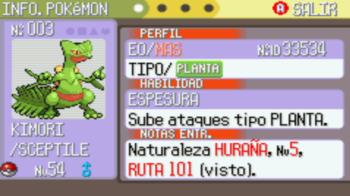
MAS’ trusty starter, KIMORI the Sceptile
MAS started their journey by choosing a Treecko which she nicknamed KIMORI. You might be familiar with that name: KIMORI (キモリ) is Treecko’s official Japanese name. MAS must have really loved the Treecko, or rather sped through the game with Treecko, as it ultimately grew to be a Lv. 54 Sceptile holding an EXP. Share. Despite its high level, it never reached maximum effort values, so it was likely switched to the middle of the party midway through the game’s progress. Well, it turns out Sceptile was switched out for a reason…
MAS only caught three other Pokémon in the game; a Zigzagoon on Route 101, the gift Wynaut egg you receive in Lavaridge Town (hatched in Team Aqua’s Hideout on the east side of Lilycove City), and the version exclusive cover legendary Kyogre, none of which were used in battle. While playtesting a videogame in a QA setting, one rarely plays as an ordinary player would, catching every Pokémon you come across. Rather, you’d be working in segmented fashion, or crossing off spot checks on a list, and to expedite these tasks, one might utilise some shortcuts. What could these shortcuts be?
Debug tools, obviously! As a debugger or playtester, tools were provided to generate Pokémon in the game and reach specific stages of the game faster. By looking through the savefile, we can determine that MAS didn’t generate any debug Pokémon in her own game; instead, she traded for generated Pokémon that were made using in-house tools. On her trainer card, MAS recorded four Link Trades, and on the savefile we find precisely four Pokémon generated through debugging features. In order to complete Link Trades, you would need to trade something in return. The Pokédex says that another species Pokémon was caught that is presently missing from the savefile: a Wurmple. As such, we can deduce that Wurmples, and presumably Zigzagoons, were used to trade for the below debug Pokémon. Let’s take a look at them.
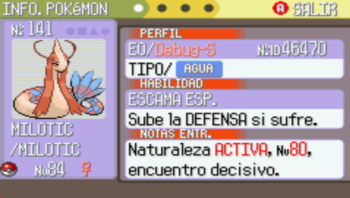 First is a Milotic that was obtained by the trainer name “Debug-S” (“S” refers to Spanish) with an ID number of 46470. This Milotic was caught at the Fateful Encounter location (not to be confused with the Fateful Encounter flag found on event distributions from FireRed, LeafGreen or Emerald), and it was caught at Lv. 80 in a Poke Ball. The Trainer Name and the met location were set because it was generated using the Create PkMn option in the Spanish Debug Menu of Pokemon Ruby and Sapphire. It was levelled up in battle a few times, but its individual values (IVs) are all set to 0. This Milotic has maximum contest stats. Evolving Feebas into Milotic through routine gameplay takes a maxed out Beauty stat, but in this case all Contest stats are maximized, yet this didn’t happen via PokéBlocks as only one was blended by the savefile.
For whatever reason, MAS entered a Cool Contest with this Milotic and earned the Cool Ribbon. A Beauty Contest would surely have been more thematic! Moreover, this Milotic only carries a single Cool move in its current moveset, Iron Tail, but two Beauty moves, Surf and Ice Beam.7Although it was through the normal contest rank and it would be fairly simple to win, having it enter the Cool Contest is an interesting choice. Speaking of Surf, MAS did not obtain HM03 Surf in her playthrough, for she failed to visit Wally’s house in Petalburg City after defeating Norman to obtain it. We can assume, then, that the Milotic (or the Azumarill listed below) was transferred to MAS in order to travel to the sixth gym in Fortree City.
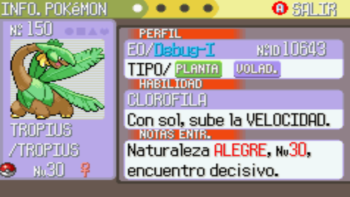 Next, we’ll take a look at a Tropius obtained by “Debug-I” with an ID number of 10643. This Tropius was also caught at the Fateful Encounter location at Lv. 30 in a Poke Ball, with 0 IVs in all stats, and it was only halfway trained to the next level. What’s interesting is the language it was generated in; while the above Milotic’s language was set to Spanish – the same as MAS’ savefile, – this Tropius comes from an Italian language debug generator. Judging by its moveset of Fly, Flash, Rock Smash and Cut, we know what this Tropius was used for, and it wasn’t for battles. (Yes, a classic “HM Slave”.)
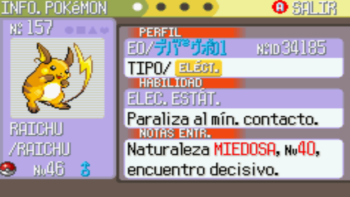
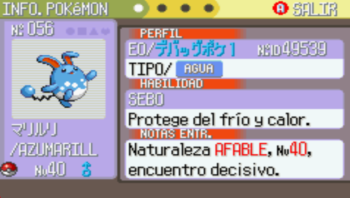 Lastly, let’s look at two Pokémon generated from the trainer name デバッグポケ1 (DebugPoke1): An Azumarill with the ID number 49539 generated in Japanese (or possibly no language set), and a Raichu with the ID number 34185 generated in English. These two Pokemon were created using the Japanese Debug Menu from the Debug ROM of Pokemon FireRed and LeafGreen by selecting Specifics under Create Pokemon. Both Pokémon also have 0 IVs in all stats, were also caught at the Fateful Encounter location, and were both caught at Lv. 40 in Poke Balls. Azumarill’s moveset also contains all HM moves and was used in a few battles, while Raichu is holding an Amulet Coin, and although it’s not currently in the front slot of the party, it was used in plenty of battles to gain experience and more money for the trainer.
 These debug Pokemon in tow, backed up by her starter Sceptile and the hatched Wynaut, MAS easily defeated the Elite Four to complete the game and earn a Champion Ribbon on all participating Pokemon. This took her a breezy 10 hours and 43 minutes – quite fast, for a casual playthrough can easily take twice as long. After finishing the game, MAS only played a few more minutes, traveling to Lilycove City as the final resting place, not stopping to even release the roamer Latias into the wild. In other words, aided by the debug Pokémon, MAS beat the game and – presumably – having playtested whatever pertinent portions of the game’s text and dialogue in the process, simply concluded her adventure there.
EMERALD (ENG) – BUSA / 57153 / 111h 8m
This savefile is… Very sparse, for how much play time is recorded. Our trainer, BUSA,8As with MAS, we don’t know what BUSA could mean in this context. Is it B-USA referencing the country or regional language, or is it a shortened nickname like [Haya]BUSA? chose May as the playable character, and we can tell by flags in the savefile that she chose Mudkip as her starter. The starter Mudkip, however, is not located in the savefile, nor is the starter Marshtomp or Swampert. At least, not how we know it.
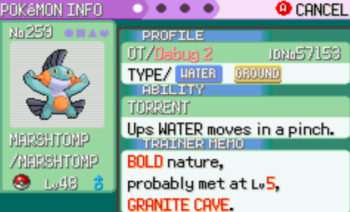 In the first slot of the party is a Lv. 48 Marshtomp caught by the Trainer Name “Debug 2” and ID 57153 – the same ID as BUSA from this very save. There’s just one issue: This Marshtomp was caught in the Granite Cave at Lv. 5. We can immediately tell that their starter Mudkip was modified using debugging tools during the playtest of this game. The Marshtomp’s Trainer Name was changed, and its met location was changed from Route 101. The telltale sign of such debug modifications is its current moveset that includes the HMs for Cut, Fly and Flash, all of which Marshtomp cannot officially learn. Marshtomp was not trained organically as it hasn’t received any EVs nor EXP, yet it was levelled up from Lv. 5 to Lv. 48 (more info on that later). Its IVs, however, are completely natural and normal this time. Lastly, it’s also holding the TM47 for Steel Wing – the only TM47 in the savefile – oddly enough also found in Granite Cave.
Now, Emerald savefiles track many things via so-called “flags”, one of which is Pokémon evolution. For Mudkip to evolve into Marshtomp, it must have incremented this counter by one. But it’s set to zero. Alternatively, Mudkip could have been traded to and evolved in another Pokémon game, yet there’s also no recorded Link Trades. All this suggests that the game wasn’t started via routine means; rather, it appears that the the playtester used debugging tools to receive Marshtomp directly from Professor Birch’s bag, or possibly even injected it directly into the game without interacting with Birch. Furthermore, these tools may have allowed the tester to start their adventure at a custom point in the game, so it’s very possible that they selected Granite Cave as the start location and simply enabled an option to receive Marshtomp as their Lv. 5 starter.
BUSA only caught three Pokémon in this save naturally: A Wurmple and Poochyena duo in Route 102, and the overworld Sudowoodo at the end of the game in the Battle Frontier. She also received the gift Castform after freeing the scientists in the Weather Institute from Team Aqua. The few other Pokémon in this save were generated through the various debugging or testing they had available.
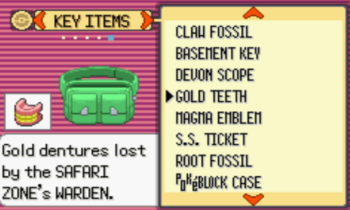 As with the MAS save, BUSA also skipped obtaining the HM03 Surf from Wally’s house. Instead, MAS used the debugging tools to modify the contents of the bag. The FireRed and LeafGreen-exclusive items, which are the Bicycle, Gold Teeth, Fame Checker and the Vs. Seeker, are loaded in, as well as both of the Mach Bike and Acro Bike that are normally mutually exclusive. There are two Wailmer Pails, two Go-Goggles and two Devon Scopes – similarly, in the official release sans debugging tools, you can only have one of each Key Item. BUSA also has both the Claw Fossil and the Root Fossil; ordinarily, when you pick one in the desert area of Route 111, the other crumbles and gets buried along with the rest of the castle it was found in.
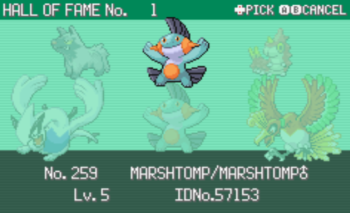 With these various shortcuts aside from Surf, BUSA likely teleported to the Pokémon League with the Marshtomp, Wurmple and Poochyena in tow… at levels 5, 3, and 3, respectively. That’s right, throughout the game Marshtomp had never levelled up, it had never been in battles, even though the savefile has recorded hundreds of both wild battles and trainer battles. We can assume, then, that BUSA never actually faced the Elite Four and teleported through each door by turning off collision with the debugging tools, just as she’d done for the entire game. She entered the Hall of Fame with those three Pokémon, an extra Marshtomp that was cloned from her starter, and… both a Lugia and a Ho-oh? And at Lv. 1? Where are they in the savefile? They must have been released when their purposes were fulfilled during the testing.
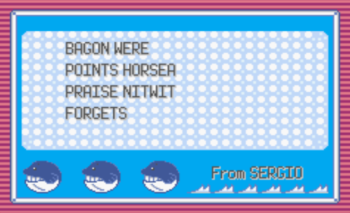 BUSA entered the Hall of Fame with a playtime of 30 hours and 37 minutes. She entered the Hall of Fame a few more times in the next dozens of hours; in the next attempt, we can see the Marshtomp was levelled up from 5 to 48, Poochyena was levelled up from 3 to 49, the extra Marshtomp, the Ho-oh and the Lugia were removed and replaced with the Sudowoodo from the Battle Frontier. The Pokemon were likely levelled artificially by using the Party Pokemon selection in the Debug Menu. For the two subsequent entries, Poochyena was removed and it was replaced with two debug-generated, Spanish Crawdaunt clones that are currently Lv. 1 caught by “Debug P” in a Master Ball in Littleroot Town at Lv. 2 with full 0 IVs, plus a mimicked in-game trade of a Lv. 1 Spanish Horsea “caught” in Pacifidlog Town holding a Wave Mail carrying an, eh, questionable message. The Trainer Name “Debug P”, by the way, is the name given when using the Pokémon Emerald Debug Menu after selecting “Create Pokemon”.
One final remarkable detail: BUSA actually “completed” the HoennDex. That’s right: Taking a look at her Pokédex, she has 386 Pokémon seen and 386 Pokémon caught, which – like much of the above – is a result of debug tool shortcuts. Finally, as the game BUSA allowed to choose a Johto starter as a gift, she picked Totodile.
EMERALD (ITA) – Amy / 35955 / 0h 37m
Amy chose to play as May in the Italian language for Pokémon Emerald. Unlike the other games listed here, this game was played and saved only once for about thirty minutes then put away, never to be resumed.9The savefile’s hex values tell us that no backup save is present. Amy picked Torchic as her starter, defeated a few wild Pokémon encounters along the way, and battled Brendan on Route 103. Once this rival battle was complete, Amy explored the cart’s debug features.
While Amy didn’t organically catch anything else in the game, she generated various Pokémon with the Trainer Name (OTN) “Debug P” and her own Trainer ID (TID). The “P” in this case likely stands for “Pokémon.” These Pokémon were all generated in Italian at a fixed Lv. 60, caught in Master Balls in Littleroot Town met at level 2. Note that I say “met”: They were not encountered at level 2 since they were not trained in battles and have not gained effort values. They were created using the Create Pokemon feature in the Debug Menu. Each one of them have 0 IVs in all stats, similar to the ones generated on MAS’ Spanish Sapphire savefile. Their movesets are all standard level-up movesets, for they all carry the last four moves in their move list before reaching Lv. 60.
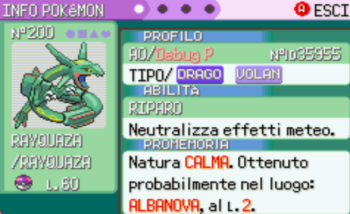 The debug Pokémon generator did not have any limitations on what could be created; Amy generated another Torchic similar to the starter she chose, she generated early wild encounter Pokémon such as Zigzagoon and its evolution Linoone, Poochyena, Wurmple and Lotad, and she generated evolved Pokémon such as Kirlia and its evolution Gardevoir, Breloom, Pelipper, and Delcatty. The highlights among them are the strong, late-game Pokémon: a Wailord, Flygon, Salamence and Metagross, which by themselves are powerful even in modern competitive environments. The game’s legendary Pokémon Kyogre and Rayquaza are also present.
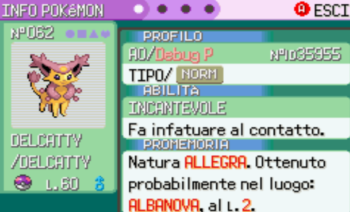 Nearly all of these Pokémon were generated with the same hidden Pokémon ID (PID) value, meaning they all have the same Calm nature with 0 IVs and are female gendered. The exception is Delcatty, who is Jolly nature and is male. The Torchic is also Calm and male with the same values as the rest, but its gender is explained by different gender ratios for starters which results in the specific PID value being a different gender for weighted gender distributions.
What, then, to make of this savefile as a whole? Amy flexed the debug tools without actually playing, which disqualifies it as a MAS-style playthrough save used for linguistic testing. Obviously, this may yet have been the ultimate goal, with strong Pokémon spawned in to facilitate a playthrough that never happened. Alternatively, Amy’s file may have constituted a debug test of sorts. Once she had ascertained that the debug tools were functional and caused no issues with the system nor her Emerald, that was the end of the road for this particular savefile. In other words, this GBA saveboard is, in its final form, nothing more than a debug tool test.
LEAFGREEN (ITA) – KITAMUu / 21288 / 33h 27m
Unlike the above saves, this one by KITAMUu did not generate Pokémon via debug options, nor did it generate items, take advantage of shortcuts, or show telltale signs of messing with debug menus to break the game in any capacity. Rather, it was seemingly used to playtest one very important yet unreleased piece of content: the Altering Cave.
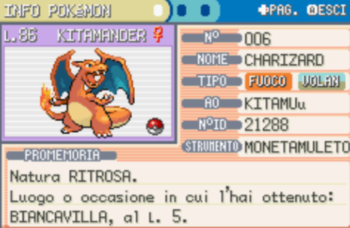 KITAMUu chose the “Red” player character on an Italian language game of Pokémon LeafGreen, and christened his rival /KUSHI/. His starter, Charmander, he nicknamed “KITAMANDER”, or an amalgam of his own name and the starter’s species. This Charmander, now a Charizard, is easily the highest-levelled and strongest Pokémon in the save, coming in at a whopping Lv. 86. Charizard was properly cared for, as it has maximum effort values and sits in front of the party holding an Amulet Coin. Clearly, KITAMUu was maximizing profits just as much as he was maximizing Charizard’s potential.
Along the way, KITAMUu caught various Pokémon. Judging by the naming order of the boxes and how each Pokémon is spaced out to fill a certain number, KITAMUu was almost certainly trying put together what is nowadays known as a “LivingDex”. That is, to catch one of every Pokémon numbered #001 to #386 and place them in their respective box positions in numerical order. To his credit, he did a nice job attempting it. The Kanto Dex sections in the box are half-filled with 72 caught in the Dex, and there are a handful placed in the Johto Dex sections totalling up to 106. The boxes for the Hoenn Dex are almost empty, but this is to be expected since in FRLG, Hoenn Pokémon can’t be obtained until after you receive the National Dex and trade with the other games in the generation.10KITAMUu registered more Pokémon as seen than caught, as there are 132 registered as “Seen” in the Kanto Pokedex for an overall 179 entries in the National Pokedex.
When KITAMUu arrived at the Pokémon League to challenge the Elite Four, he was overprepared. His Charizard was already at Lv. 77, surpassing even the Champion’s beefiest Pokémon by a large margin. Besides his trusty KITAMANDER, our player brought along a full team consisting of a freshly-caught Marowak from Victory Road, two Meowths (one nicknamed “MEOWKITA”, repeating his earlier naming scheme), a Poliwrath, and a Doduo, who was later leveled up to evolve into a Dodrio. We may assume that the KITAMUu outclassed the Champ with ease. Our NoE playtester beat the game in exactly ten hours, moving on the explore the Sevii Islands afterwards and continuing to work on his LivingDex.
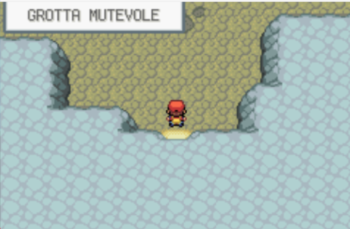 Importantly, one location seemed to be on KITAMUu’s mind and quite possibly the reason why this savefile exists at all. The Altering Cave is a seemingly indistinct grotto found on Outcast Island and normally, the only Pokémon one can encounter there is a plain old Zubat. There’s a reason that it’s called Altering Cave, however. Developers GameFreak conceived, designed and programmed a way to switch up its Pokémon encounters, yet the key to unlock this gameplay mechanic – a so-called WonderCard – was never distributed to players worldwide. It’s fair to say, then, that nobody ever got to experience catching anything other than Zubat in Altering Cave but GameFreak and Nintendo employees. Of which KITAMUu just happened to be one.
The question is, how exactly was he able to acquire the so-called WonderCard (WC) necessary to access Altering Cave content in LeafGreen? It’s clear that for all of the game-manipulating options at Nintendo employees’ disposal, it likely did not happen through a debug menu. We know a thing or two about Pokémon debug menus thanks to various dataleaks over the years.11Some debug test cards are found here: https://projectpokemon.org/home/files/file/4151-wc3-debug-test-cards For example, by entering LeafGreen’s debug menu and selecting the “TAMADA” option, various WonderCards can be automatically received in the game. KITAMUu made use of this functionality: Both the AURORATICKET (to catch Deoxys) and the MYSTICTICKET (to catch Lugia / Ho-Oh), are present on the savefile, the tickets having been added to the player’s item bag after talking with a PokéMart deliveryman.12Lugia, Ho-oh, and Deoxys have all been caught on KITAMUu’s savefile. There’s no record of Deoxys currently on the save, but we can tell through specific flags that the Birth Island puzzle was solved and Deoxys caught. Crucially, the WonderCard for the Altering Cave script can’t be loaded via the “TAMADA” option, or any other debug option. The reason for this is unclear: It could be that the Altering Cave was still in development when the debug ROM was finalised, or for whatever reason, GameFreak may have decided against including it.
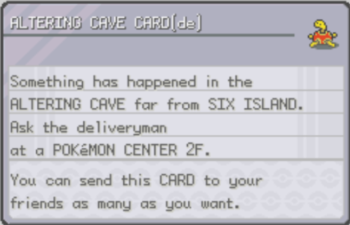
With debug shenanigans ruled out in the acquisition of the Altering Cave WC, this leaves one other option: a pseudo-official method. In FRLG, WonderCards are normally received at official distributions through the Joyspot feature provided by the Wireless Adapter accessory. It’s probable that sans a debug menu option to inject the Altering Cave WC, NoE mimicked the normal process. That is: KITAMUu would have had to unlock Mystery Gift in his savefile by entering the catchphrase LINK TOGETHER WITH ALL on the survey in a PokéMart. Via another device of some decription available at NoE, the Altering Cave WC was then locally transmitted for KITAMUu to obtain it. (As an outside possibility, it could be that NoE sent savefiles to GameFreak for them to upload the Altering Cave WonderCards.)13While it seems paradoxical for GameFreak to have NoE translate Altering Cave content but not allow them to transmit the WC themselves, from an aspect of information control, this isn’t terribly unlikely. Moreover per the GigaLeak, we know that GameFreak kept the German Altering Cave WC on file, and the company’s history of retaining total control over overseas distributions (such as those at the PC New York) is also well-documented.
There are some peculiarities about it, however. Although KITAMUu played an Italian savefile, the WC for the Altering Cave is listed in its MYSTERY GIFT menu with a (de)-tag indicating the German version, yet its text is in English and thus unlocalised.14The English Altering Cave WC similarly produces English text. Dataleaks blessed us only with the above two WonderCard languages (not even the Japanese original), so we don’t know if FIGS localisations existed for it.15Specifically the GigaLeak. Similarly for Emerald, only Japanese and English language Altering Cave WCs are out there. It’s somewhat unusual if they indeed do not. In your average localisation process, the Japanese source is often translated to English first, which is then used the basis for further translation into FIGS. Localisation of these European tongues usually proceeds apace, the languages more or less keeping up with one another under similar deadlines. So if only English translated the Altering Cave WC, it’s tricky to divine what this might mean. It could suggest that development of the Altering Cave was terminated sometime in the timeframe between its WC translation into English (perhaps even at Nintendo of America) and the intended start date of FIGS localisation. It is, in other words, plausible that the Altering Cave got stuck in limbo, playable but unfinished and not cleared for FIGS translation pending an official decision on its fate. Which of course begs the question why KitamuU playtested the Cave at all.
 As it is, Altering Cave’s mechanics themselves are dubious and feel placeholder-y. After receiving the Altering Cave WC, the player can speak with the deliveryman on any PokéCenter’s second floor, who then responds with the following text (which, as it’s hardcoded into the FRLG games, was localised into all of EFIGS):
Thank you for using the MYSTERY
GIFT System.
Recently, there have been rumors
of rare POKéMON appearances.
The rumors are about ALTERING
CAVE on OUTCAST ISLAND.
Why not visit there and check if
the rumors are indeed true?
Instead of giving you some key item or Pokémon as the gateway to Altering Cave, the delivery guy functions as a manipulable script that cycles the cave’s active Pokémon. Each time you press A on him triggers a new Pokémon in the grotto, and this can be done indefinitely. Note that I say “press A”, for the deliveryman doesn’t actually use his words or provide any kind of feedback that he, in fact, is the master of Altering Cave’s spawns. This strikes us as rather odd; it’s assumed that a better system of spawn rotation was intended – using the real-time clock, for instance – but never implemented.
In total, nine different Pokémon are available in Altering Cave. Besides Zubat, there’s Mareep, Aipom, Pineco, Shuckle, Teddiursa, Houndour, Stantler and Smeargle. Deliveryguy offers these in National Dex order; talking once unlocks Mareep, chatting again frees Aipom, again replaces it with Smeargle, once more loops back to Zubat, and so on. Levels of these Pokémon range between 3-13 on the low end (Mareep) to 19-29 on the upper end (Pineco).
Now, I’d love to sing the praises of these unreleased Pokémon, touting how special they could – and perhaps should – have been. None of them are readily available in FireRed / LeafGreen, and releasing the Altering Cave WC early the lifecycle of these games could’ve made for a neat little collection at worst, and a competitive dream at best.16See for example collector Reisora’s excited response to PCNY’s early release of non-Hoenn species Mareep and Houndour: https://pokemonhistorian.com/pcny-project/pcny-preservation-records/#Reisora The reality is, however, that the development of Pokémon Emerald took away the Altering Cave’s raison d’être. It’s hard to say which came first: GameFreak’s decision against rolling out the Altering Cave even in Japan, or their realisation that plans for the development of Pokémon Emerald with expanded and improved wild encounters would make the Altering Cave’s gimmick entirely redundant and, perhaps, not worth the complicated logistics of releasing it. Fact is that all of Altering Cave’s encounters were placed in Emerald: Smeargle at Artisan Cave, with the others included in that game’s extended Safari Zone.
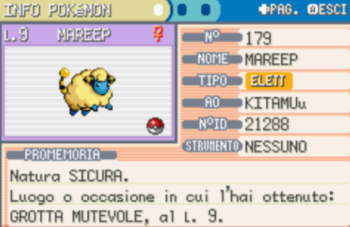 As for KITAMUu’s playthrough, it’s impossible to know if he chased Altering Cave Pokémon in service of playtesting a LivingDex, or if exhausting the Altering Cave’s content was an objective in and of itself. All we can say with certainty is that KITAMUu caught everything on offered from the grotto, sometimes multiples, such as three Mareep (two evolved into Flaaffy and Ampharos, respectively), and three Pineco (one evolved into Forretress). We agree, KITAMUu – if only Pineco had a third-stage evolution! That said, Stantler can’t be found in the savedata, but its Pokédex tells us that at least one Stantler was caught. What happened to it (and the earlier Deoxys), however, is unclear: KITAMUu never recorded any trades.
It’s borderline platitudinal to state that KITAMUu’s savefile is incredibly unique. Seen in a certain light, we might conclude that it contains prototype Pokémon of a planned feature that was left functional but unfinished, being not fully localised, not fully implemented, and not ready for release: the Altering Cave. Unless any more development savefiles surface, KITAMUu’s collection of NoE test subjects may well prove to be the sole surviving example of Altering Cave Pokémon ever generated and caught by someone in an official capacity. Which by itself is one astonishing claim to fame.
FIRERED (FRE) – MELAINE / 40802 / 9h 7m
And last, but not least… Wait, what is this savefile doing here? Although this save was found on a development cartridge, one of the saveboards contains a completely standard, normal playthrough of Pokémon FireRed. There’s no debug-generated Pokémon in the boxes, and all of the items look standard. In other words, there’s nothing that would suggest this savefile was used in a capacity to test tools, translations or find bugs. However, it appears that this savefile did test one rather important thing…
MELAINE began her journey in the Kanto region by choosing Leaf, the game’s female protagonist. She chose her trusty Charizard, which stayed with her in the party until Lv. 49 while holding an Amulet Coin, although it’s not currently in the front of the party. MELAINE worked on completing her Pokédex by catching and evolving Pokémon, using the in-game trade features to trade for the Nidoran♂ on Route 5 and the Farfetch’d in Vermillion City. She conquered each Gym along the way, using a few Pokémon between each Gym before boxing them (Magikarp, Pikachu, Nidoran♂). She then defeated Team Rocket Boss Giovanni at the Silph Co. in Saffron City to earn the Master Ball. The stars of her team were clear: Alongside Charizard, MELAINE was fond of the Lv 45 Kadabra in her party as well as the Lv. 31 Victreebel.
With six badges notched up, the usual next stop is Cinnabar Island, but MELAINE never visited that place. After defeating Koga in Fuschia City (or Sabrina in Saffron City),17These gyms are interchangeable, when you get access to Saffron City you can skip the gym and make your way down to Fuschia City allowing you to defeat Koga, normally the sixth gym leader, then head back up to defeat Sabrina. The final save point is in the Pokemon Center of Fuschia City so we can assume MELAINE defeated Sabrina first, then Koga. MELAINE just… stopped playing the game. She never surfed south of Pallet Town to reach the next Gym, never revived the Dome Fossil, never made it to the Sevii Islands nor caught any of the legendary birds, and she never made it to the Pokémon League to defeat the Elite Four and release the roaming Suicune out into the wild. We can only speculate why MELAINE never continued her adventure after a mere nine hours of play. Was her “play as normal” QA task complete, or perhaps cut short by a looming deadline? Did she have a (testing) goal that she reached, such as obtaining the Master Ball? We can’t really know for certain. We do know, however, that this savefile caught something of a second wind, being used to verify something entirely different – yet hugely important – years later.
In the summer of 2007, Pokémon Diamond and Pearl released in Europe. As a final hurrah to the generation before it, a special distribution was announced for the United Kingdom, Spain, Italy and Germany: Mew. Gasp! Distributable to all five games for generation 3, this Mew was the regional variant of the MYSTRY Mew given out the year prior at Toys R Us in the United States, as well as the Hadou Mew distributed in Japan in 2005 by pre-ordering a ticket to see the film Lucario and the Mystery of Mew. With a Trainer Name of “Aura” and ID 20078, this Mew was compatible with all five European translations (EFIGS) of the RSEFRLG games. But there’s a paradox. Conventional wisdom has it that, for all its compatibilty with French games, Aura Mew was never actually distributed in France. So why does this French FireRed savefile by MELAINE from a development cartridge saveboard contain this specific Mew?
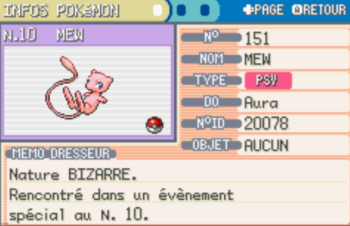 There’s two possibilies: Mew was acquired internally, at NoE, or externally, at an actual, official distribution event. Let’s consider both options.
Since Aura Mew was never distributed on French soil, it was impossible to acquire for French gamers unless they travelled to the UK for the Pokémon Summer Day Camp (August 2-26, 2007), holidayed in Italy to attend Mirabilandia in Ravenna during a narrow distribution window (July 7-8, 2007), visited German McDonalds where Mew was given out, or journeyed to nearby Spain (July 18-August 19) to partake in Pokémon events along its costas. As a result, most of the French general public was locked out from downloading Aura Mew. Insofar as any French Aura Mews came into existence, they likely did so in the hands of holidaymakers, or possibly by a handful of Pokémon enthusiasts who travelled to locations abroad with purpose (to Stuttgart from Strasbourg, for example, or Bordeaux to Bilbao).
In theory, it could be that whoever dug up the MELAINE saveboard brought it to one of these locations, downloaded the Mew, and placed the saveboard back where they found it – perhaps even as an official assigment to roadtest the distribution. Alternatively, the entire MELAINE cartridge could have been used as an employee’s personal plaything kept at work and brought to one of those events. Fact is that even in 2007, Frankfurt had two McDonalds restaurants, so it’s not a stretch to assume that the cartridge travelled from NoE’s offices on the city’s outskirts, to a McDonalds Mew distribution point, and back.
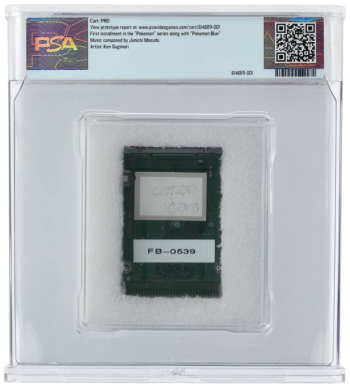
Pokémon Red prototype with FB Number.
In practice, however, these scenarios are extremely improbable. For one, it does not dovetail with NoE’s security practices – known to be extremely tight – to allow stray carts among their employees. As is common across the industry, it is known that Nintendo staff working with devcarts signed them out in the morning and back in at night, thus allowing management to track the whereabouts of each devcart around the clock.18To, of course, prevent IP leak and theft. Keeping one back as a personal trinket then, would have constituted a clear breach of protocol and possible grounds for firing. Furthermore, only a subsection of development cartridges was permitted to leave Nintendo offices at all even on official business. Those cleared for departure bore a so-called “FB number” – essentially a sticker affixed to the front of a devcart bearing a four-digit code prefaced by the letters “FB”. We know from our source that this particular FireRed devboard did not carry such a sticker.19Cartridges used internally had barcode stickers with numbering instead. Assuming, then, that the Mew board’s status did not change at any given point, MELAINE’s FireRed cannot have left Nintendo’s offices, not even for a distribution roadtest. Short of any monkey business, it is thus impossible that the cart wound up at McDonalds for an in-life distribution test.
This leaves the internally-generated option. An employee working on late-stage localisation and QA testing might yet have produced the Aura Mew at the source. To our understanding, international event distributions would normally be hand-crafted by GameFreak in Japan, then sent over to Nintendo branches in Europe, the United States, or wherever else they were required. We know that – as was common for the era – Aura Mew were distributed through a GBA SP with a safety mechanism to seal the distro cart in place with tamper tape. It stands to reason that before relaying these specially prepared SP systems to each destination country, the distribution as a whole had to be tested. In order to do so, one would require a second system plus an extra game with a compatible savefile. How convenient, then, that saveboards and development cartridges for the generation 3 Pokémon games were still in storage at NoE! As such, it’s quite possible that an employee took out and used one of these games to connect to the Mew distribution console and generate an Aura Mew to the MELAINE savegame. In all likelihood, more than one NoE Aura Mew was created in this manner – there was all of EFIGS to test, for example, across the five different compatible titles of Sapphire, Ruby, Emerald, LeafGreen, and FireRed. (That’s a hypothetical 25 Aura Mews.) Fact is, however, that only this FireRed French board wasn’t subsequently discarded, overwritten, or destroyed.
Now, if the above interpretation is correct and our French Aura Mew was generated by, and at, NoE, then this particular specimen should rightfully be considered a prototype Mew! The Mew was not used in battle, and if the above scenario transpired as we imagine it, it’s probable that after successfully distributing the Pokémon and being satisfied with the result, the employee placed the FireRed game back into storage, thereby leaving the development cartridge and its savefile in their 2007 state.
SAVEFILES DOWNLOAD: Pokemon Development Saves
