
Blue Campaign, October 1997 – March 1998 (5+1 sheets)
Hot on the heels of the Original Campaign, the Pokémon stamp Blue Campaign kicked off in the month immediately following, ie. October 1997. Why, then, Blue? A logical answer would have been: To celebrate to concurrent release of Pokémon Blue in Japan! But that wasn’t the case – Blue had come out in limited form a year prior, on October 15, 1996, as a CoroCoro Comic exclusive.1Blue’s full commercial release wasn’t until October 10, 1999. So where does that leave us? Well. Expertly timed Pokémon Blue one-year anniversary celebrations, perhaps. A homage to Blue Oak, the player’s rival from the Generation I games, maybe. Or, if we construe “Original” to mean red and green, a simple default to Blue as the only vacant Pokécolour.2Pokémon Yellow came out in September 1998, almost a year after. Unhelpfully, the nearest thing to an official campaign mission statement refrained from expounding, offering no more than:
“To express our gratitude to everyone who helped make the first Pokémon Stamp campaign a success, we’re releasing the Pokémon Stamp Blue Version!”3「第1期ポケモンスタンプを盛り上げてくれたみんなへの感謝の 気持ちを、ポケモンスタンプブルーバージョンを発行して表すことにする!」Source is GSLM October 1997, Year 4, unknown page number.
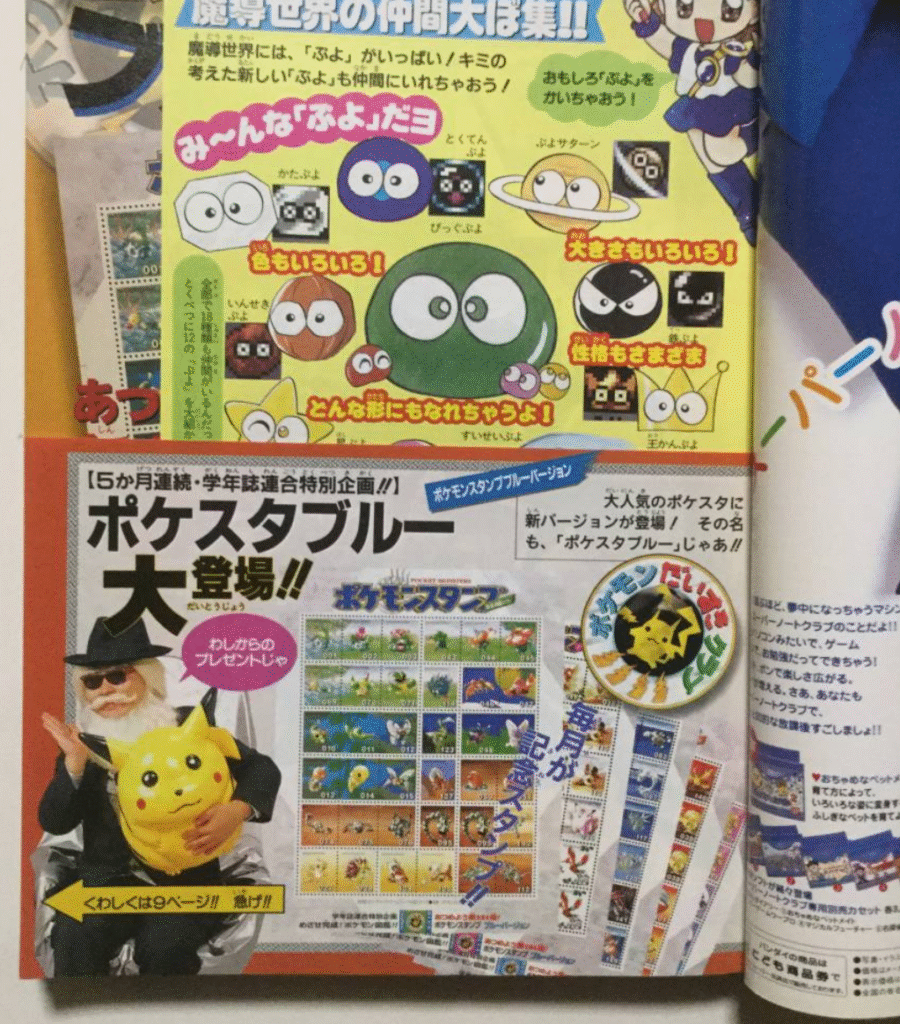
Kaichou presents: the Blue Campaign. GSLM October 1997, Year 4.
In any case, Blue was very much crafted from same the mould as OG with a few minor tweaks and changes. Such as sheet presentation: Individual Pokémon stamps were now to be arranged in rows according to typing rather than (seemingly) randomly. In total, the Blue Campaign featured five dual (or even triple) type sheets: Bulbasaur (Grass/Bug/Ground), Charmander (Fire/Electric), Squirtle (Water/Dragon),4I believe this is officially called “Water/Ice” even though half the sheet is dragons. Eevee (Normal/Flying) and Mewtwo (Psychic/Poison/Fighting). Shogakukan identified the sheets by type combo – Psychic/Poison/Fighting (エスパー毒格闘), Normal (ノーマル), and so on – but for the sakes of brevity and consistency, we’ll stick to our top-left naming scheme. Naturally, the campaign finished with a beefed up special “golden” Mew minisheet in March 1998, and while not required to complete one’s sensibly blue-coloured Blue Member Card application, it was needed to attain the satisfaction of completing one’s not-blue Blue stockbook.
Equally interesting, the Blue Campaigns knew a deviant inter-magazine rotational pattern that I haven’t been able to fully tease out. In contrast to the OG Campaign, the Learning Kindergarten magazines took part this time, making for a record 7/10 participating GSLM series. You’ll understand that with seven magazines but only five unique sheets, some monthly duplication was unavoidable. GSLM October 1997 Years 1-3, for instance, respectively carried the pleasingly sequential Bulbasaur, Charmander and Squirtle sheets, but then repeated Bulbasaur for Year 4 (and presumably Charmander and Squirtle again for Years 5-6). By contrast, the Mewtwo “Psychic sheet” in February 1998 could at least be found in all of Learning Kindergarten, Year 1 and Year 4, and perhaps in all of that month’s issues. At a minimum, these data points suggest routine triple duplication, but to ascertain whether this holds up across the breadth of the campaign, more information is needed.
Shortcodes are Bulbasaur (B), Charmander (C), Squirtle (S), Eevee (E), Mewtwo (M2), and Mew (M).
Blue Rotation - ©PokemonHistorian.com
| OCT | NOV | DEC | JAN | FEB | MAR | |
|---|---|---|---|---|---|---|
| L KG | C | E | M2 | M | ||
| YR1 | B | E | M2 | M | ||
| YR2 | C | S | E | M2 | M | |
| YR3 | S | E | B | C | M2 | M |
| YR4 | B | C | S | E | M2 | M |
| YR5 | C | M2 | M | |||
| YR6 | S | M2 | M | |||
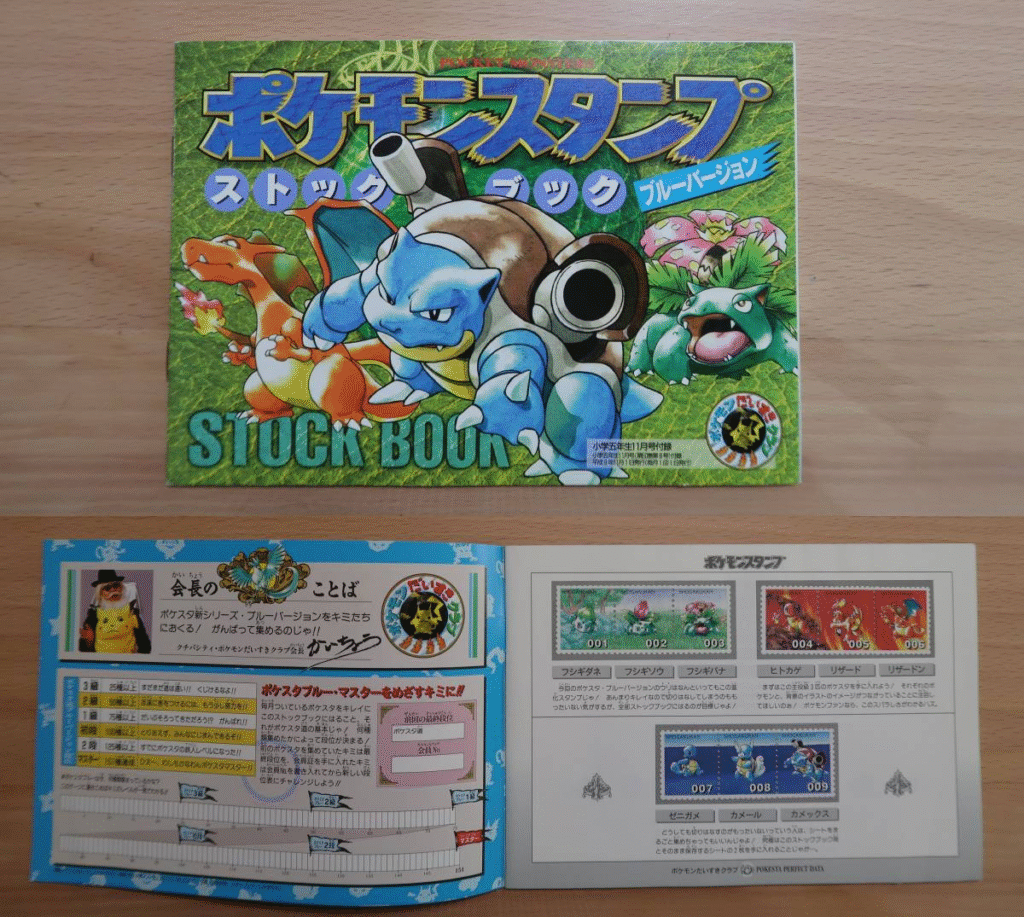
Blue Campaign Blastoise-themed stock book.
Fans who navigated the shifting sands of sheet availability found an entirely new stockbook enclosed in the November 1997 GSLM issues. Sharing design elements with its predecessor, (blue) mascot Blastoise now took up Charizard’s spot in the Kanto trio’s middle. And as the campaign name would have it, this stockbook wasn’t tinged black, but coloured a bright blu– oh, nope. A lush green. Right. I guess blue-on-blue is hard on the eyes. Either way, inside the stockbook readers discovered the familiar combination of goofy Kaichou portrait, motivational stamp ranking up to “Master” tier, and a 151 stamp progress tracker – all in glorious colour this time to replace the grayscale.
New was a small pink inset where participants were encouraged to jot down their Trainer ID (TID) issued with, and printed on, the previous (OG) campaign’s Fan Club Member Card. Which is a little puzzling. Why? Because it created the impression that said TID was truly a personal number to be carried forward between stamp campaigns. As far as we know, however, TID was reflective of application speed rather than applicant data. In other words, the Member Card given to a hypothetical John Doe for completing the Blue Campaign wouldn’t retain his TID from the Original Campaign; rather, if his were the 46221st successful Blue application processed by Shogakukan, his resulting TID would be 046221. TID, in other words, was a disposable, unretainable number.
Collectors who submitted the campaign’s five colourful “Club Marks” to Shogakukan in Spring 1998 were eligible for a Blue Member Card. Virtually identical in design to the OG black one, like before, it carried a congratulatory note from the Chairman (omedetou!!) on its back that commended the participant’s dedication and attempted to impart a sense of love and gratitude for Pokémon.5Translated, roughly: “Congratulations!! In recognition of your remarkable achievement in collecting all 151 Pokémon Stamps: Blue Version, and to honour your dedication, we present this membership card. Please treasure it as a symbol of your unwavering love for Pokémon, never forgetting the heartfelt spirit of our exclusive club. -Chairman.” On the front, it had space to write down one’s name, address and telephone number and to stick a personal photo like it were an official ID card.6 All of which few did, for I’ve seen precisely none with personal information in online marketplaces like Mercari or Yahoo Auctions. Of course, it could also be that would-be Member Card sellers are sufficiently concerned about revealing private information to discourage them from listing their cards online. Or perhaps non-pristine Member Cards are assumed to have no secondary market value.
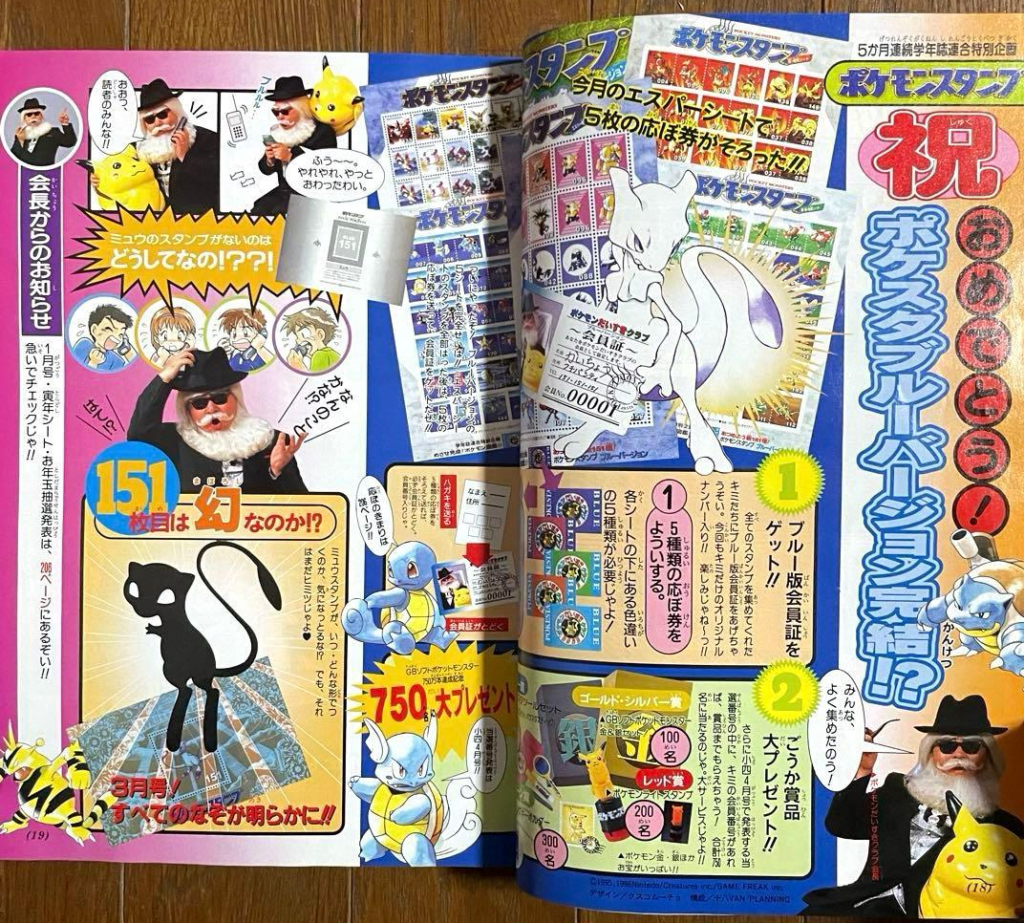
“Congratulations! The Blue Campaign is finished!” GSLM February 1998, Year 3.
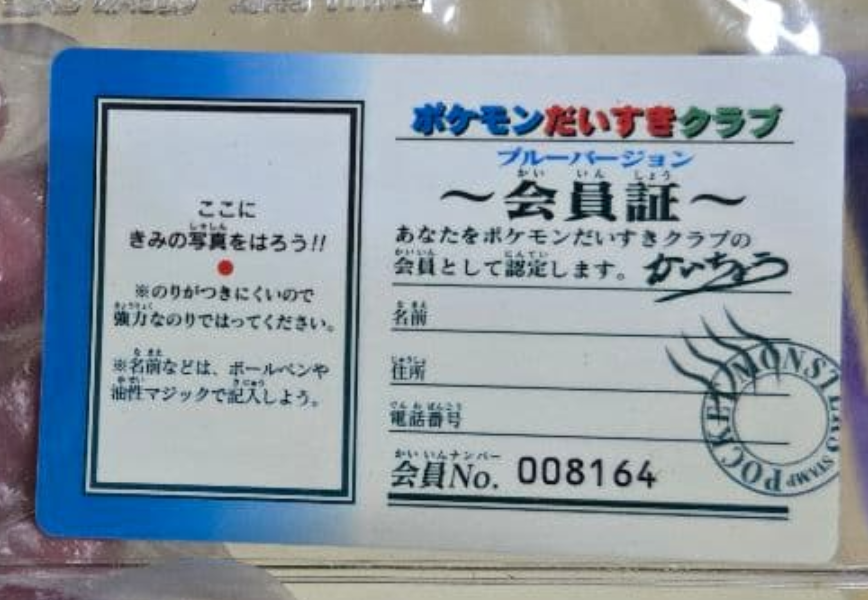
Blue’s second lowest known TID: 008164.
Finally, I leave you with yet another Shogakukan TV commercial ft. the grotesque CG Chonkachu (above). Comprised of recycled assets, this October 1997 promotion was essentially identical to April’s with the stockbook and stamp designs substituted. Still weird? Yup. Still weird.
Incidentally, this is the final stamp TV short I’ve been able to find. Which could mean any number of things, from a change in Shogakukan’s production values and/or budget to waning Pokéfan enthusiasm (resulting in a failure to record and/or archive.) It’s hard to say. What is clear, however, is that the Blue Campaign represented the pinnacle of Shogakukan’s stamp drive popularity, with GSLM’s Pokéstamps dominating the zeitgeist like never before (or since).
NAVIGATION:
Original Campaign < > Complete Campaign
Audiovisual
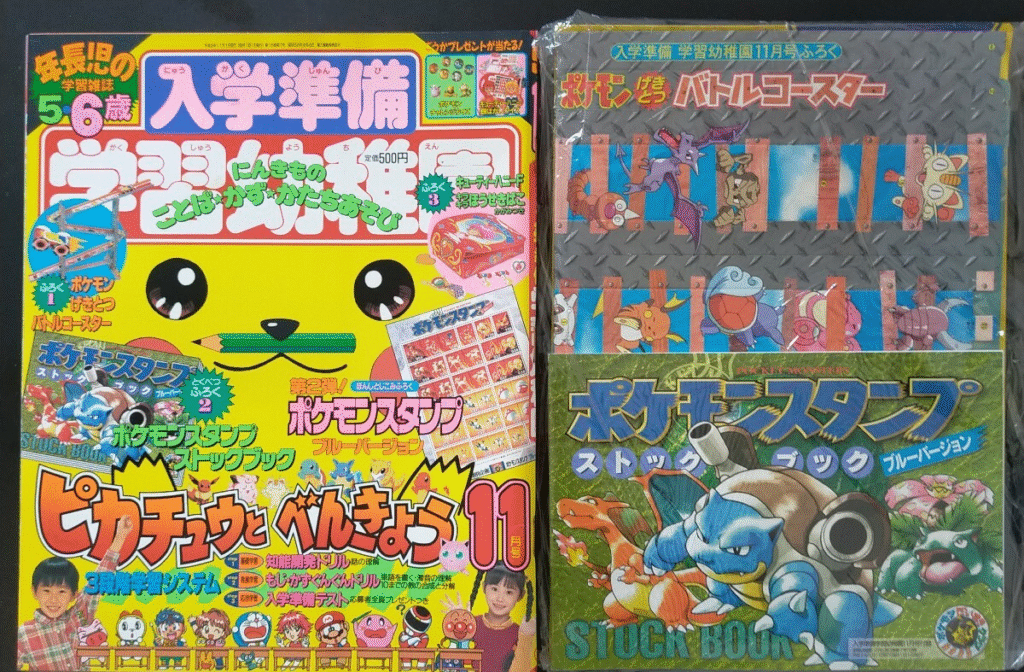
The GSLM November 1997 Learning Kindergarten issue advertises the burgeoning Blue Campaign. A supplementary stockbook is enclosed.
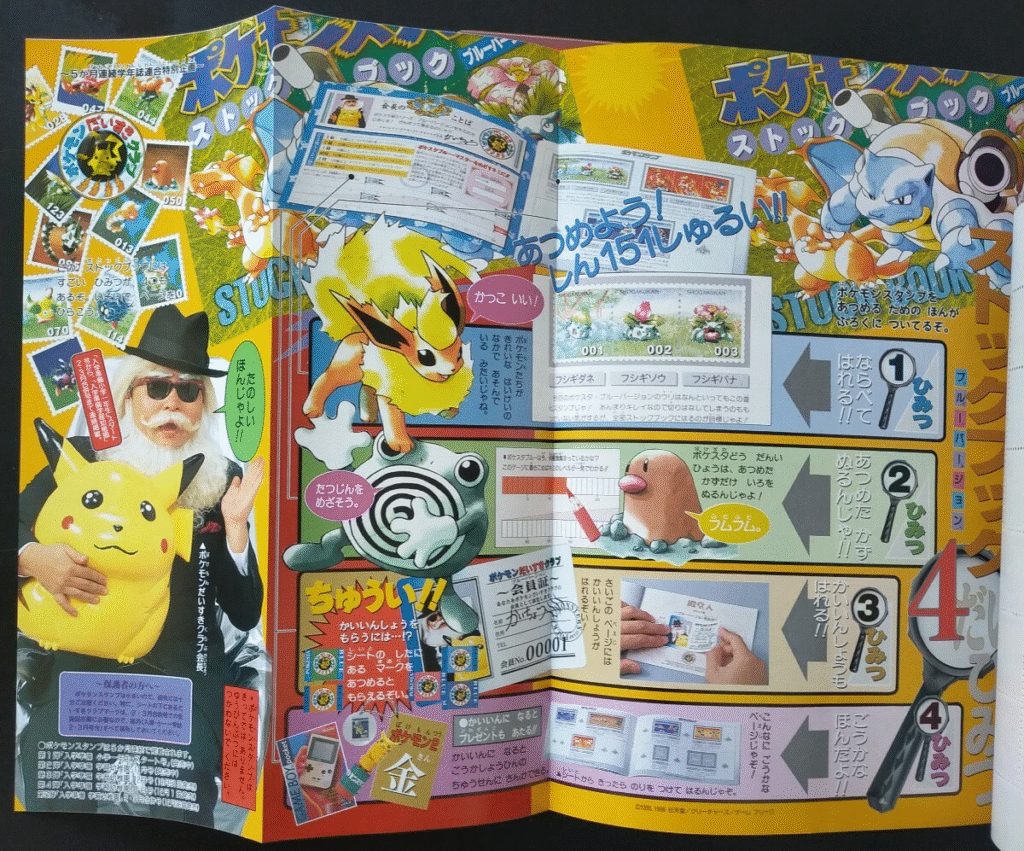
The Daisuki Club Chairman offers a stepwise explanation of the Blue Campaign. GSLM November 1997, Learning Kindergarten issue.
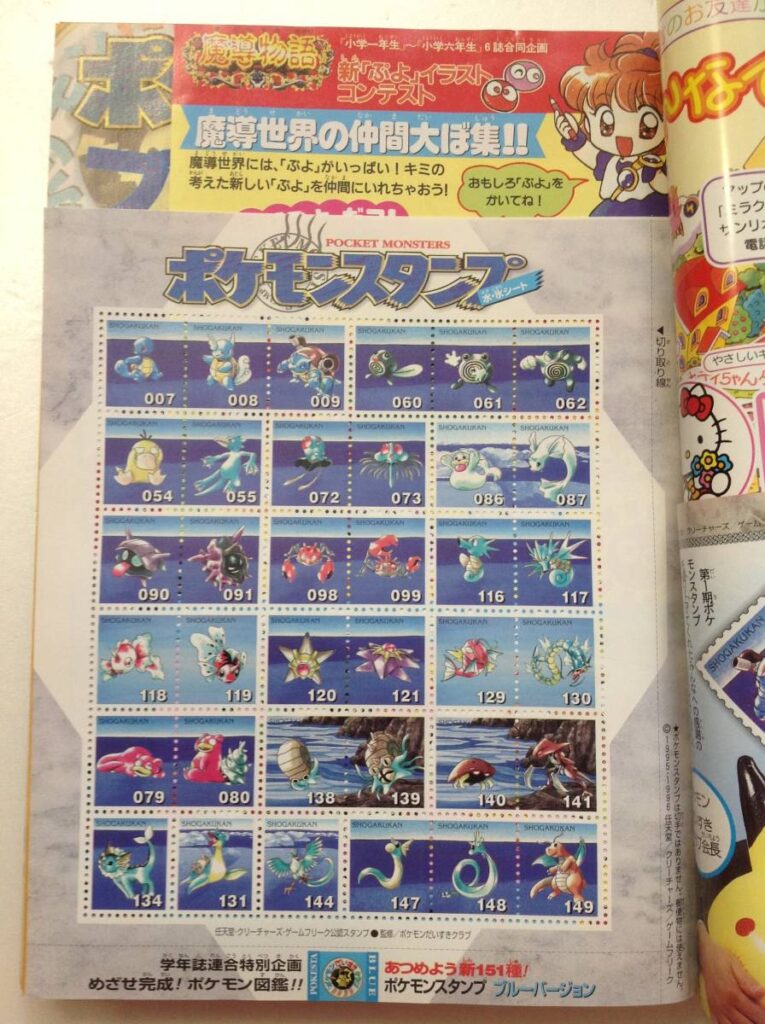
Blue Campaign Squirtle sheet. GSLM October 1997, Year 3.
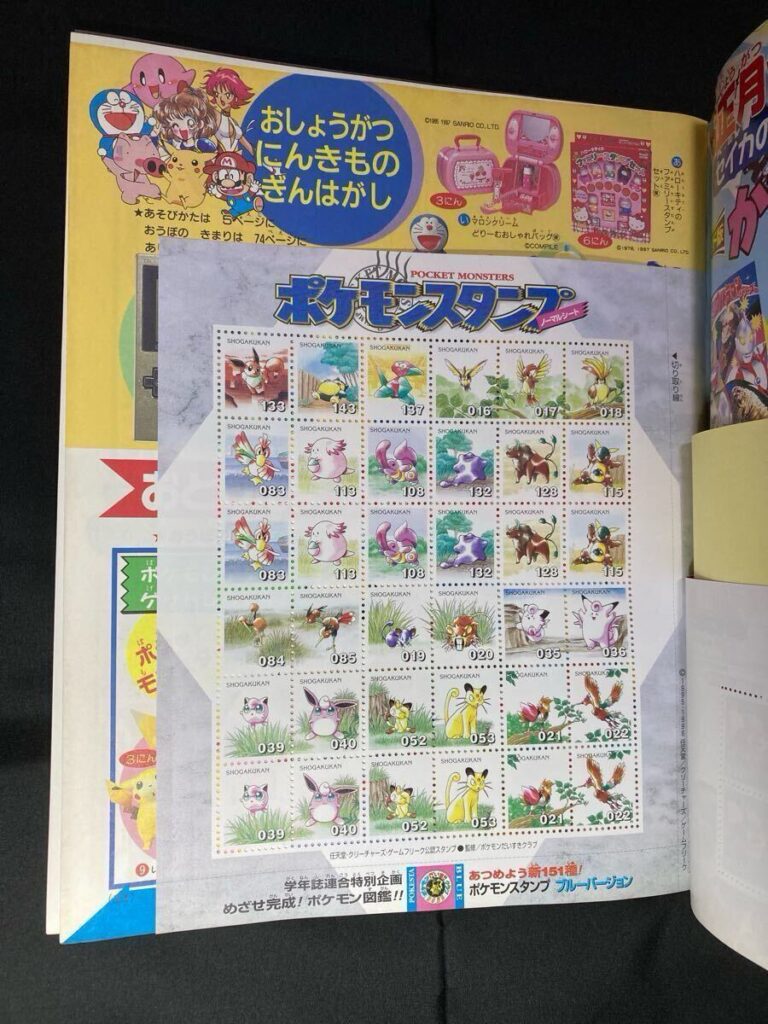
Blue Campaign Eevee sheet. GSLM January 1998, Learning Kindergarten. Year of the Tiger “A” was included in the same issue.
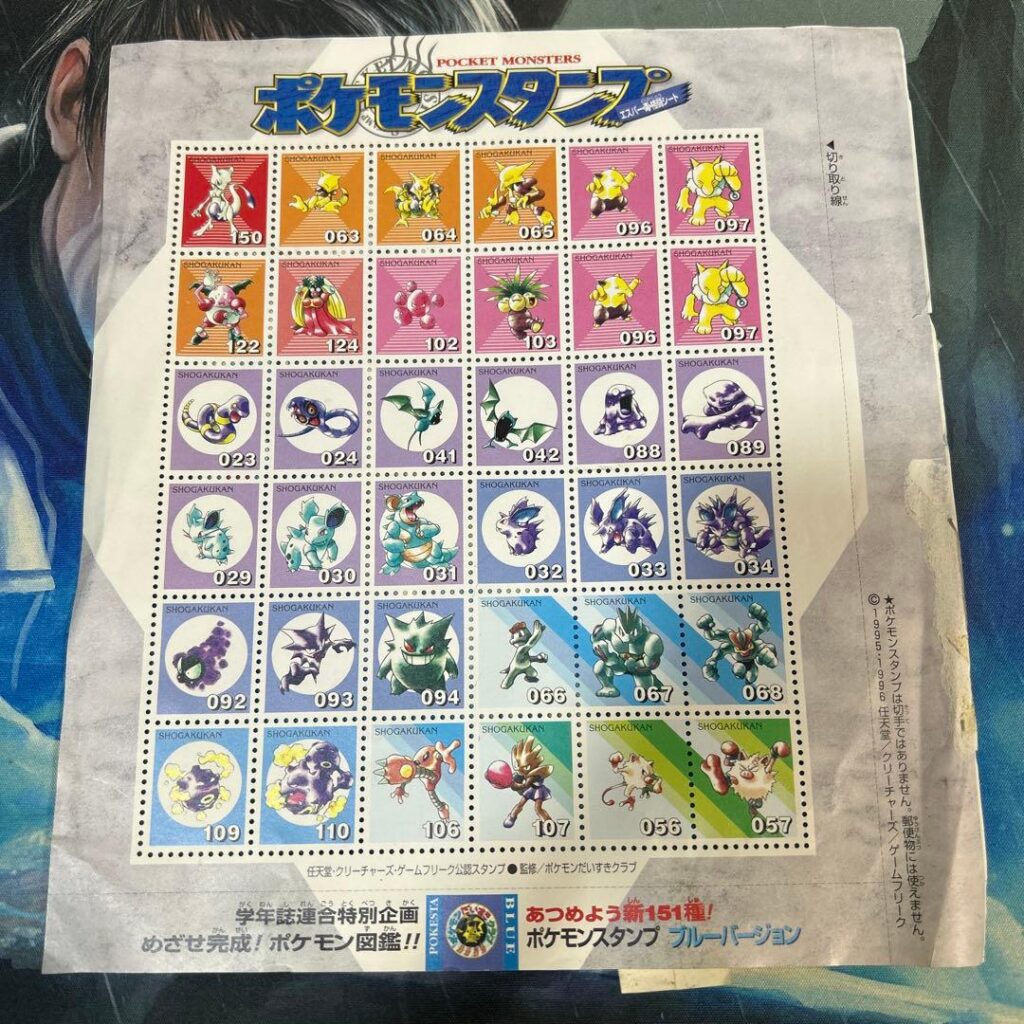
Mewtwo sheet, Blue Campaign.
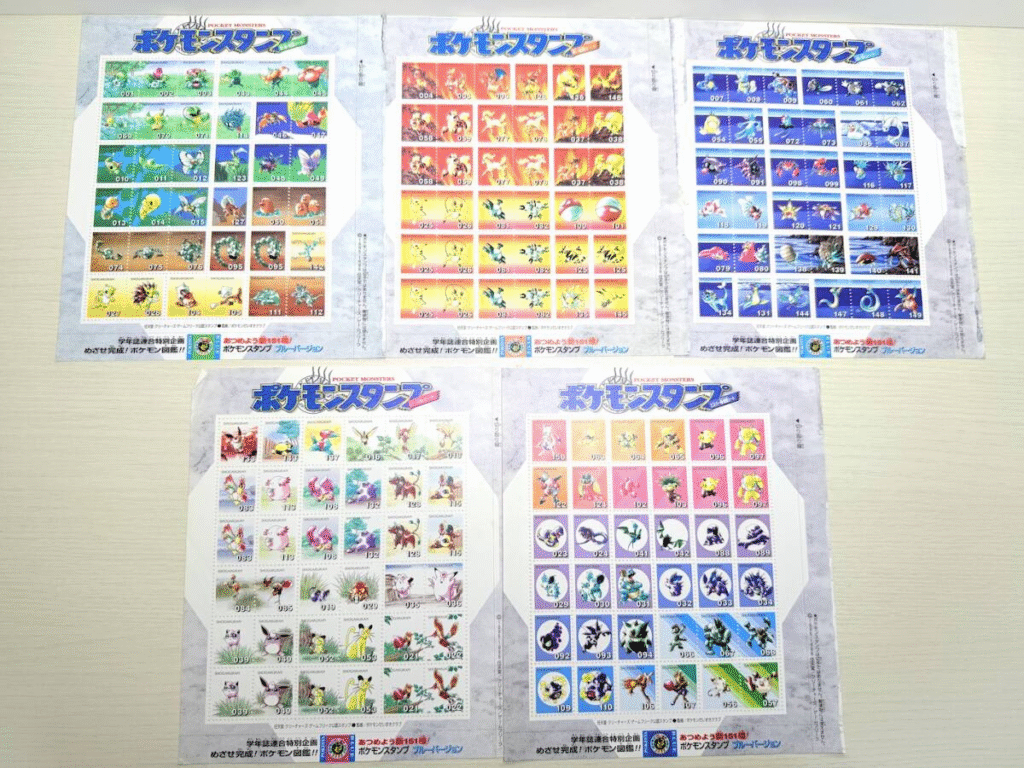
All five Blue Campaign sheets.
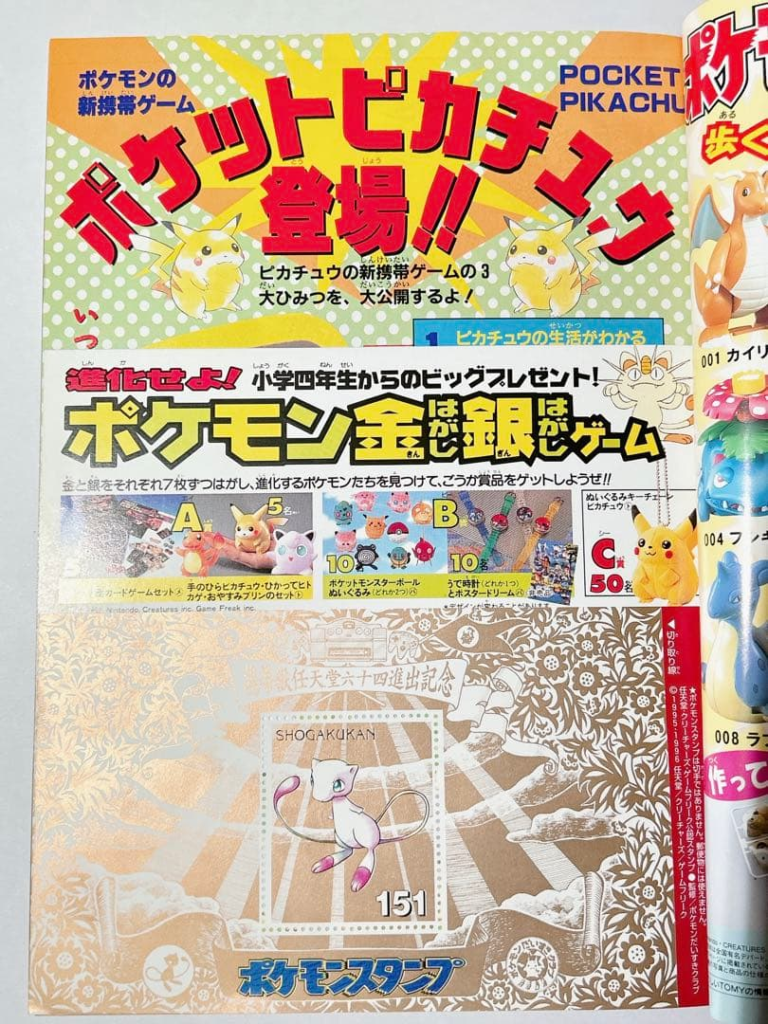
Golden Mew sheet. GSLM March 1998, Year 3.
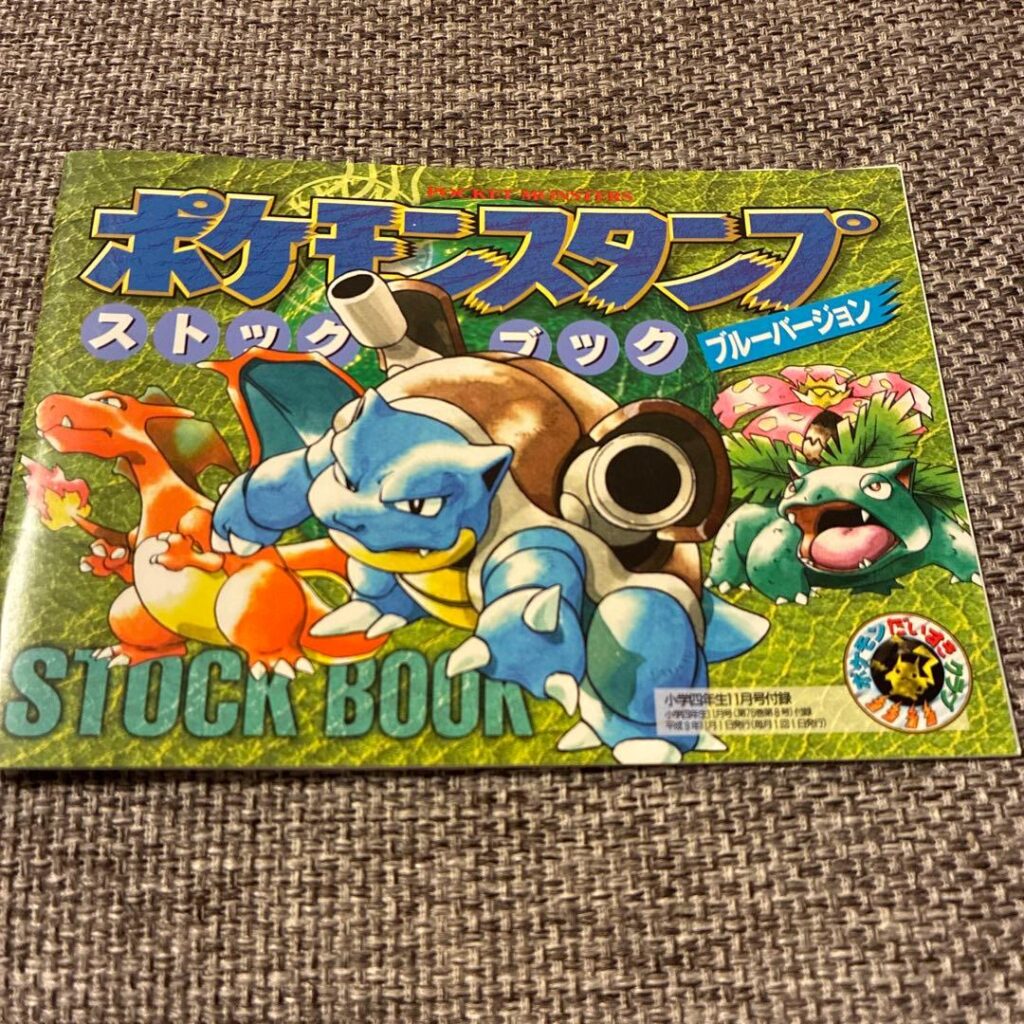
Blue Campaign Blastoise-themed stock book.
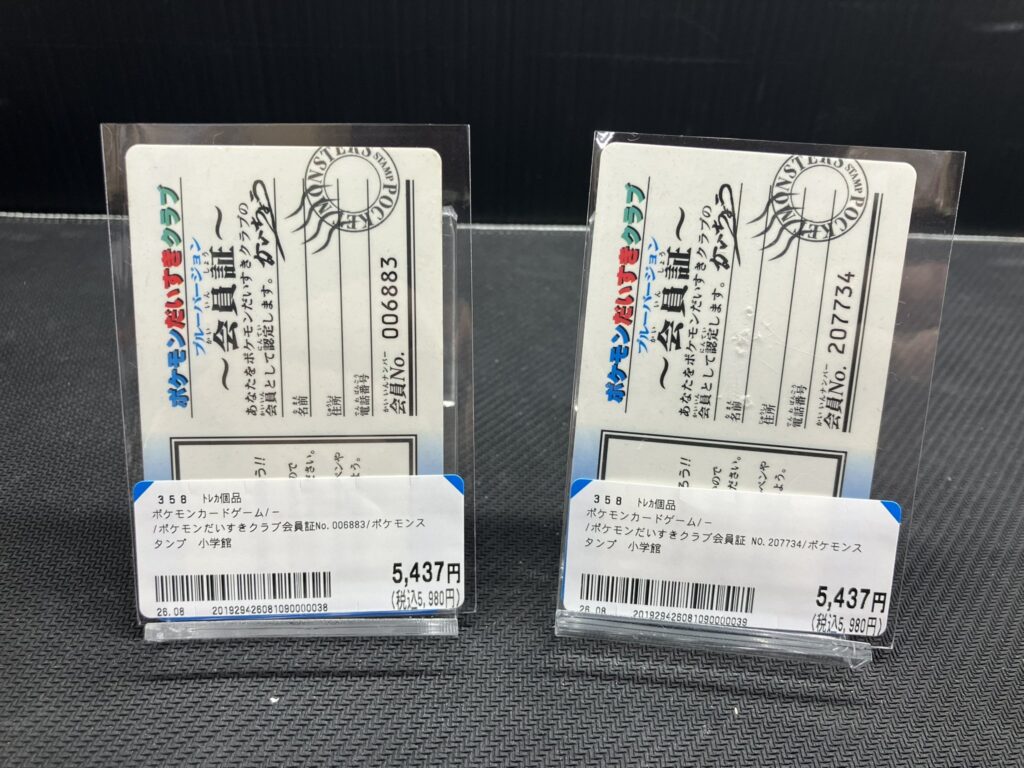
Blue’s lowest known TID: 006883.
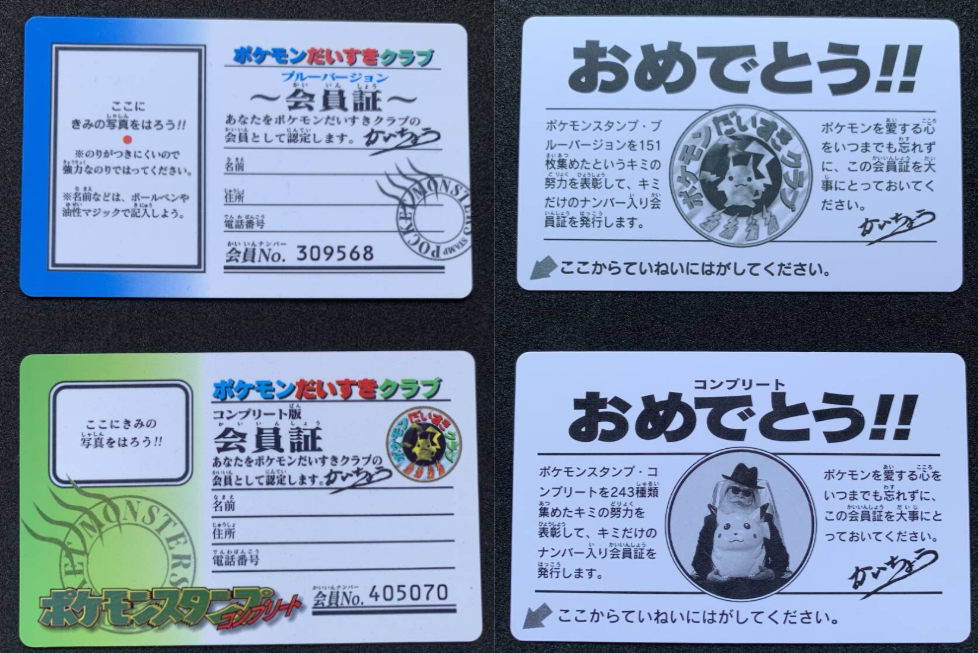
Blue Campaign Member Card (top row) alongside Complete Campaign Member Card (bottom row).
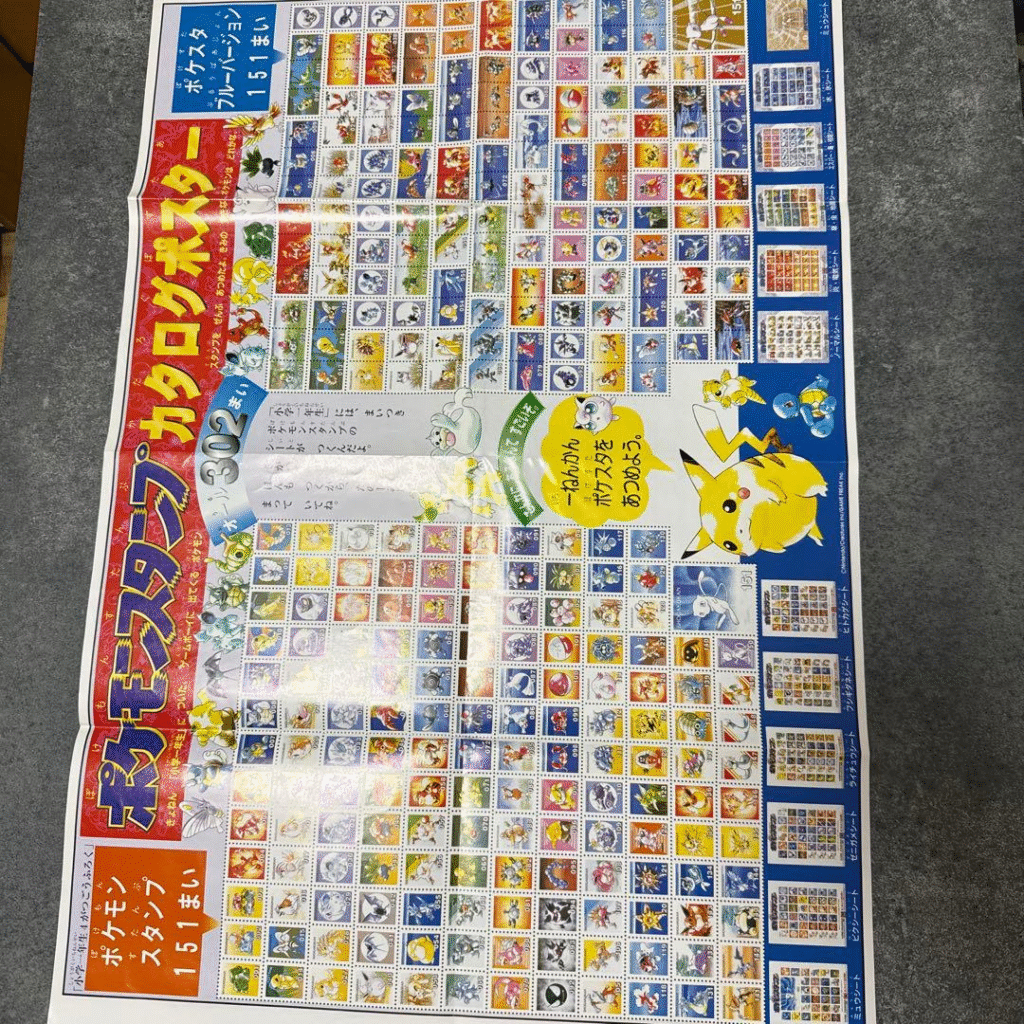
Stamp collection poster – Original Campaign (left) and Blue Campaign (right).
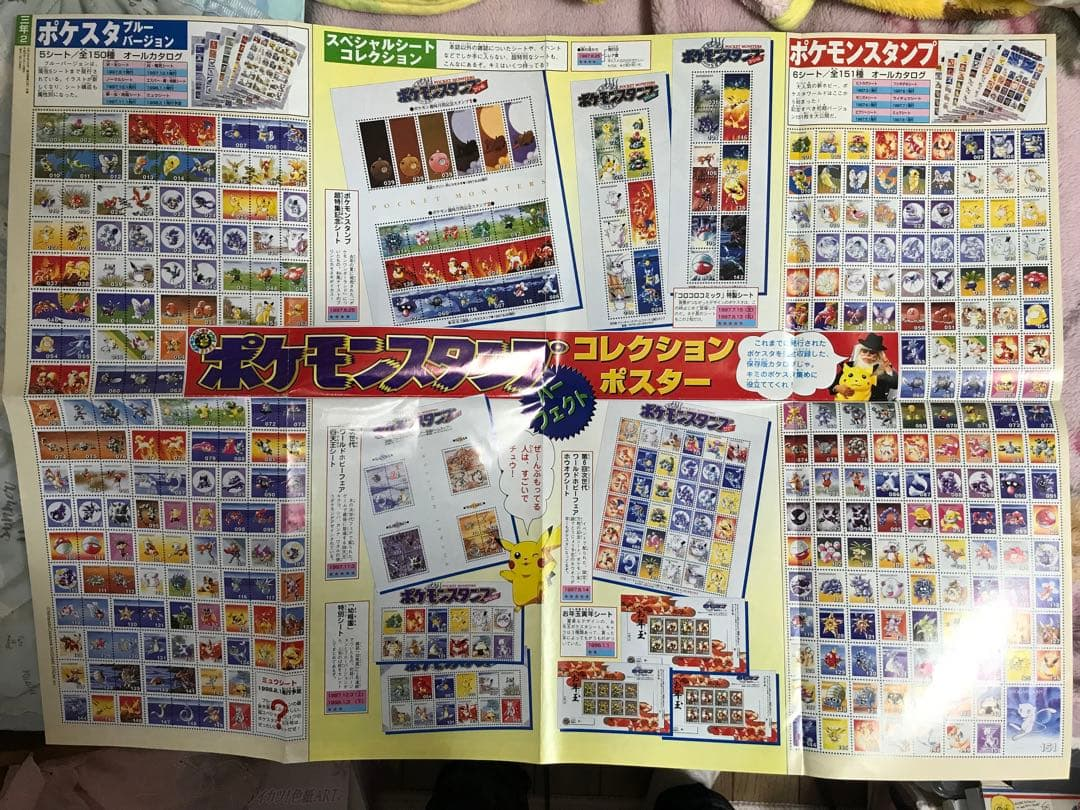
Stamp collection poster, ca. Q1 1998, showing all stamp sheets issued up to February 1, 1998 (Note how the March 1998 “Kabuki sheet” and Golden Mew do not feature.) Original Campaign on the right, Blue Campaign on the left, and auxiliary sheets in the middle.
