
Original Campaign, April – September 1997 (6 sheets)
On February 27, 1996 – some 30 years ago – Pokémon Red & Green released in Japan to initially modest success. Over the course of that year, the popularity of Pocket Monsters picked up steam, then snowballed, and soon acquired an unstoppable momentum. A cultural phenomenon was born, and publishing house giant Shogakukan quickly took notice. By late 1996 Pikachu started to appear in the company’s children’s magazines like CoroCoro Monthly,1Pokémon first appeared on the cover of CoroCoro Monthly in October 1996 (see here), and on the front of GSLM in March 1997. then dominate and saturate them, the burgeoning fandom’s insatiable appetite for more Pokémon content making for – perhaps – the greatest boon to periodical sales since Doraemon.2This historical popularity uptick is evident even today – on the secondary market, post-1996 GSLM magazines are considerably more abundant. Given this tailwind, it made sense for the publisher to pull out all the stops and claim the ballooning Pokéfandom for its own to sell yet more magazines over a prolonged period of time. But how?
In April 1997, Shogakukan surprised readers with a two-page spread in, it is assumed, every grade-year of GSLM. Not only did these pages acquaint the general public with newfangled “Pokémon stamps”, they also pitched the novel concept of a GSLM-borne Pokémon stamp campaign. For six consecutive months, between April and September 1997, Years 1-6 of GSLM would each enclose sheets of 36 faux postage stamps with Pokémon portraits and Pokedex numbers on them. GSLM encouraged children to utilise the lickable 151 in two ways. First, to look (見), cut (切), paste (貼) and glue (湖) their stamps into a Kanto Starter-themed stockbook to follow in May’s issue. And second, to collect cutout Pikachu “Club Marks” (one per sheet) and mail the resulting half dozen to Shogakukan affixed to a special postcard provided in the – we think – September issue. Those who did so could expect to receive the mark of a true Pokéfan: a prized Pokémon Fan Club Member Card with personal TID. Yes, apparently convinced that the campaign needed a human face, Shogakukan put forward the entirely fictitious Fan Club Chairman, or Kaichou, to nominally run the whole shebang, whom the two-pager introduced as stamp-creator and campaign manager.
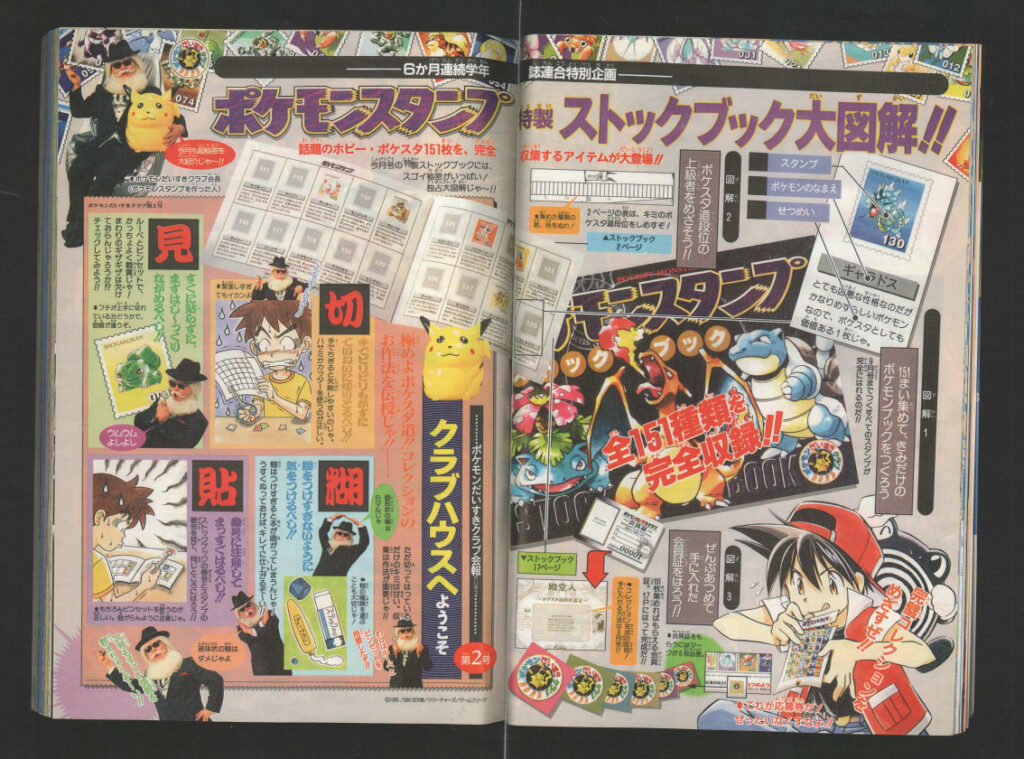
The Fan Club Chairman instructs readers on Shogakukan’s maiden stamp campaign. GSLM April 1997, Year 3. Via @poken_kibou here.
Now, this first go-around – which we’ll dub the Original Campaign – is of particular interest because it established conventions that would govern stamp campaigns for the next six to seven years. So before we get into the audiovisual materials, let’s examine these recurring parameters.
First is the matter of GSLM’s various grade-years. With four different preschool-level and six unique elementary school-level magazines to choose from every month, Shogakukan prided itself on exceptionally bespoke content – a granularity that was perhaps the secret to GSLM’s success. Did all of these, then, take part in Shogakukan’s stamp rallies? Not quite. Out of the ten, the same suite of six elementary grade-years (1-6) participated routinely into the 2000s. The preschool magazine aimed at the youngest demographic, “Sprout” (めばえ, ages 2-4), understandably skipped the campaigns. Issues of “Fun Kindergarten” (たのしい幼稚園, ages 4-6) are comparatively rare, and I’ve not been able to find evidence of stamp sheets in the handful I’ve come across. Which leaves the generic kindergarten level (幼稚園, ages 3-6) and “Learning Kindergarten” (学習幼稚園, ages 5-6), that mostly did their own thing, offering occasional smalltime 5×2 or 6×2 sheets with or without wafer-thin “stock files” (LINK).3Interestingly, flagship manga-mag CoroCoro Monthly also offered two non-campaign, “special” compact 2×6 stamp sheets concurrent with the Original Campaign in its July and September 1997 issues. See LINK HERE. However in at least two instances – the Blue Campaign and Stadium Campaign – “Learning Kindergarten” rolled with the big boys, but the precise criteria are unclear to me. A campaign’s marketing tune may have been a factor, or perhaps their taking part was borne of practicality, making for a (more) logical stamp sheet rotational pattern. Which helpfully brings us to the next point.
Namely, the design and availability of Pokémon stamp sheets. Campaigns alternated between standard 6×6 sheets in most stamp drives to jumbo 10×5 sheets in a select few (Complete, Ruby & Sapphire). To tell sheets apart, we commonly identify them by the “lead” Pokémon in a sheet’s top-left corner. The OG Campaign counted six unique Pokémon stamp sheets – the median, give or take one, with the 2000-2001 Gold & Silver Campaign’s 9+1 sheets the plentiful exception. Now, it would be poor salesmanship to offer identical monthly sheets in each participating grade-year magazine, wouldn’t it? Quite! As such, a pattern of sheet availability commonly looked something like this:
Y1: A B C D E M
Y2: B C D E A M
Y3: C D E A B M
Y4: D E A B C M
Y5: E A B C D M
Y6: A B C D E M
Thanks to 1997’s incredible resource that is Pokémon Wonderland: PokéStamp Super Special, we know the Original Campaign’s precise full rotation. For example, April 1997 Year 3 carried a Charmander sheet while April 1997 Year 4 included a Squirtle sheet, and Year 5 had a Clefable sheet. The data are best summarised in a table:
Rotation: Original Campaign. Source: Pokémon Wonderland Vol.1 (1997), p31-33.| APR | MAY | JUNE | JULY | AUG | SEP | |
|---|---|---|---|---|---|---|
| YR 1 | B | R | Ch | S | Cl | M |
| YR 2 | R | Ch | S | Cl | B | M |
| YR 3 | Ch | S | Cl | B | R | M |
| YR 4 | S | Cl | B | R | Ch | M |
| YR 5 | Cl | B | R | Ch | S | M |
| YR 6 | B | S | Ch | Cl | R | M |
The OG sheet leads, by the way, were Bulbasaur (B), Charmander (Ch), Squirtle (S), Clefable (Cl), and Raichu (R) plus the September 1997 closer… Mew (M).
To encourage long-term participation, GSLM on several occasions offered six-month subscription bundles with unique bonus stamp sheets as an additional incentive (see Miscellany section). It’s assumed that GSLM subscribers made up the majority of the magazines’ readership, although this didn’t stop (young) adults from gaming the system and purchasing April’s Years 1-5 all at once to gather the various sheets and five of six Club Marks in one fell swoop (as detailed in this tweet). Of course, such wily Pokéfans had to wait for September’s Mew regardless to round out their sets. Which conveniently brings us to the third convention.
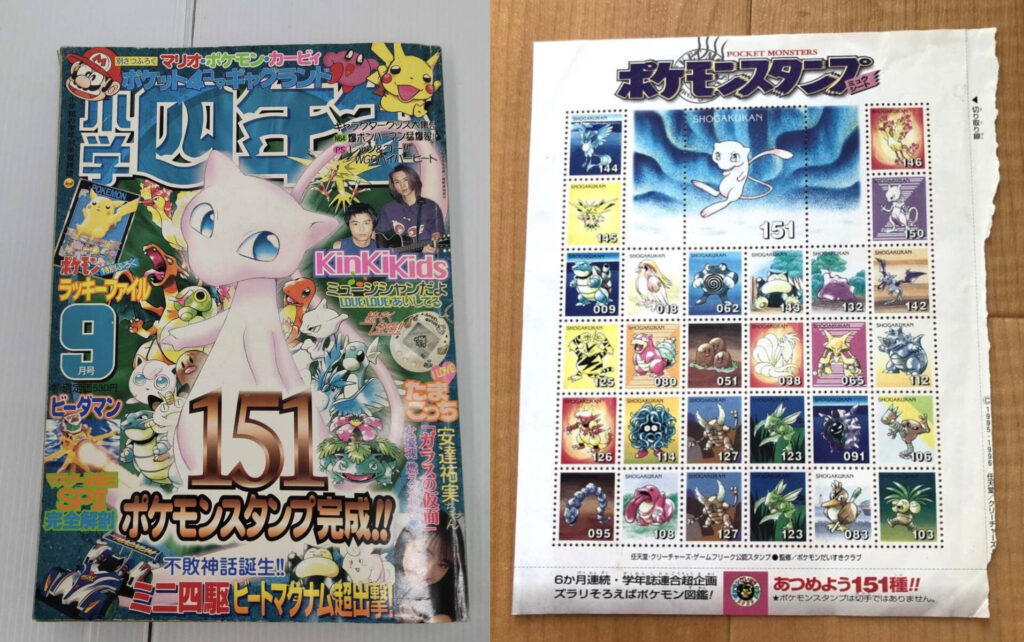
The giant Mew cover of GSLM September 1997, Year 4, alongside the enclosed Mew stamp sheet.
Mew. Campaigns finished with Mew. Always. The undying subject of playground rumours and under-the-truck gaming mysteries, Mew enjoyed a hypnotic appeal. Everyone wanted their very own. But such a prize was both illusive and elusive, as opportunities to obtain Mew in any capacity were scant – a fact, of course, not lost on Shogakukan. The OG Campaign, in September 1997 issue, wrapped up with an eye-catching 2×2 Mew portrait (“M” in the rotation table above). The Blue Campaign offered a golden Mew in March 1998. The Complete Campaign concluded with a woodland Mew in September 1998, while Stadium had a large, special Surfing Pikachu, Mew and Bulbasaur slip in April 1999. Even the 2000-01 Gold & Silver Campaign finished with a dual Mew-Celebi sheet. Not until 2003’s Ruby & Sapphire Campaign did Hoenn Legendaries finally take over from the pink peril.
Fourth, every campaign’s second GSLM issue invariably included a “stockbook” to paste one’s stampy acquisitions.4So for the OG Campaign beginning April 1997, this was the May issue. Colourful pocket booklets of thin, glossy pages roughly A5 in size, these – in the case of the OG Campaign – reserved 151 stamp spaces, one for each of the campaign’s Pokémon. And while the precise design and orientation of the stockbooks evolved through to 2006, they roughly retained their form factor. As for the Original Campaign’s booklet, it featured Venusaur, Charizard and Blastoise set against a jet black background accompanied by the text “Pokémon Stamps Stockbook”. Overleaf readers found first a portrait of the supervising Fan Club Chairman, then a tongue-in-cheek incremental ranking to gauge the increasing impressiveness of one’s stamp collection, and finally a colourable stamp collector counter to track one’s progress. At the booklet’s very back, there was space to affix one’s Member Card under a header that, in a nudge to the aforementioned collection ranking, read Hall of Fame Entry (殿堂入) and PokéStar Rank Certification (ポケスタ道段位認定). Helpfully, the pastable space’s printed text also reminded readers to gather up their Club Marks and send them to Shogakukan to receive a Member Card. Which brings us to…
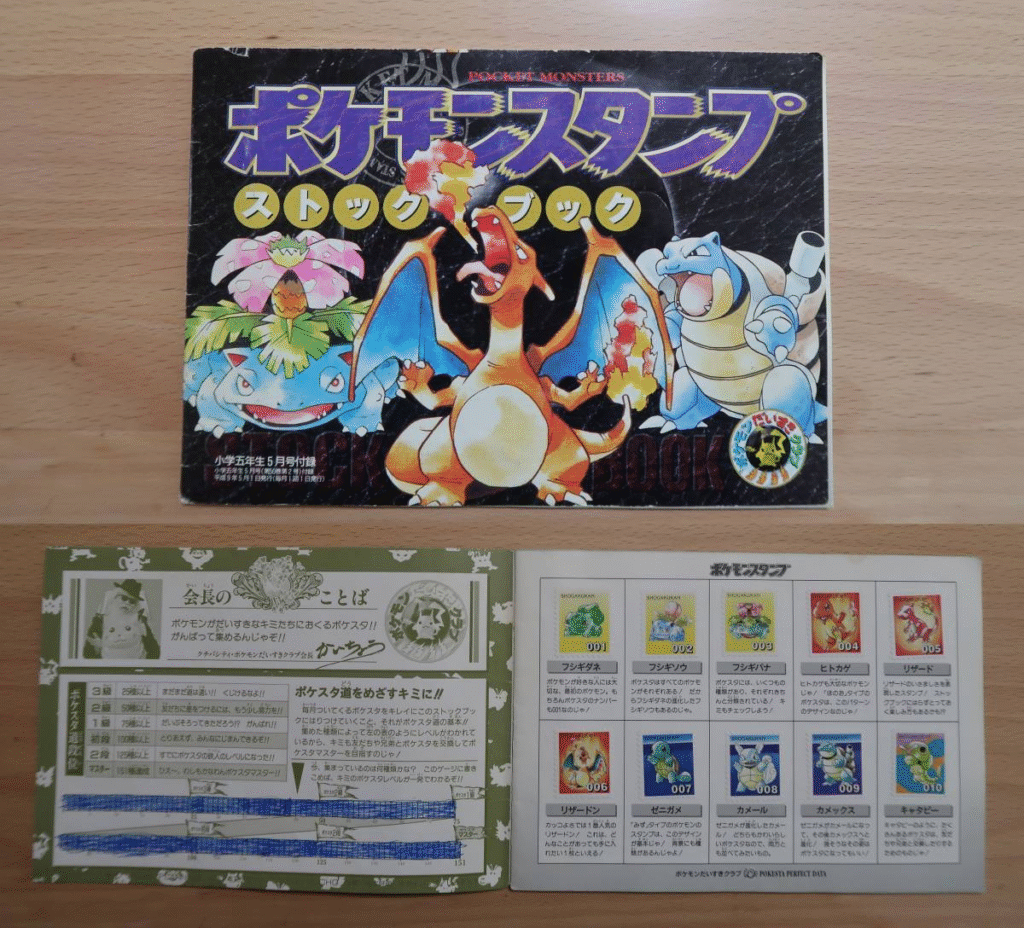
Original Campaign Kanto-themed stock book.
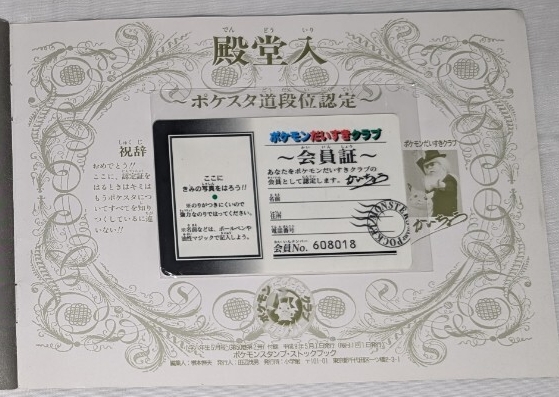
Black Daisuki Club Member Card affixed to a completed OG Campaign stock book.
The stamp campaigns’ higher purpose, or the ultimate goal that transcended the mere lick-and-stick of hundreds of scraps of paper. I speak, of course, about the acquisition of that quite useless piece of plastic to certify that you, too, had been suckered into buying five consecutive issues of Shogakukan’s GSLM: one’s very own Fan Club Member Card! I jest, of course – who wouldn’t want an exclusive, wallet-ready Daisuki ID that bore the Chairman’s signature and testimony to prove that you had successfully run the Shogakukan stamp gauntlet. It was the kind of thing that got childhood imaginations running, and in a time when the Pokémon TCG was still in its infancy and no such thing as social media to broadcast extent of one’s fandom across the globe yet existed, a Daisuki Club Member Card was unquestionably the nearest thing to watertight evidence of being the ultimate Pokéfan to conveniently pull out and shove in the faces of everyone who would and wouldn’t listen. As you will have gathered, this Member Card prize was to become a fixture of the Shogakukan stamp-formula, with this first one coloured a subdued grayish-black. Incidentally, the highest OG Trainer ID# I’ve seen is 608018 which – assuming that TIDs were issued sequentially to successful participants starting from 000001 – indicates a lot of completions!5You might think: “These are impossible numbers!” But I assure you they’re not. At its peak in 1973, GSLM Yr1-6 monthly circulation topped out at over 5 million copies cumulatively. Even by 2004, when GSLM was already in considerable decline, the combined grade-years 1-6 still sold over 800.000 copies a year (or about 70k month). Boosted by the popularity of Pokémon and the stamp campaigns specifically, monthly numbers for the late 1990s were firmly in the 1-2 million range. See the introduction to this article series for more information, and Wikipedia here for figures.
Finally, the last common denominator: The presence of the make-believe Daisuki Club Chairman. I could essay on this guy, and we’ve already outlined the basics of his persona in the introduction to this article series. Billed as the inventor / creator of Pokéstamps, he was omnipresent in every single major Shogakukan stamp campaign but 2006’s Diamond & Pearl reboot. His popularity was such that he appeared in an official Pokéstamp event at 1997’s World Hobby Fair, where young stamp collectors could meet the old fella in the flesh and have their picture taken with him. If there ever was a grandfather idol, this geezer was it. Utterly synonymous with Shogakukan Pokémon stamp drives, the Chairman’s appearance could only mean that a campaign was about to start, expand or wrap up. Which, until 2001, was pretty much constantly. As such, you’ll see his face a lot in the magazine pages scattered throughout this article series.
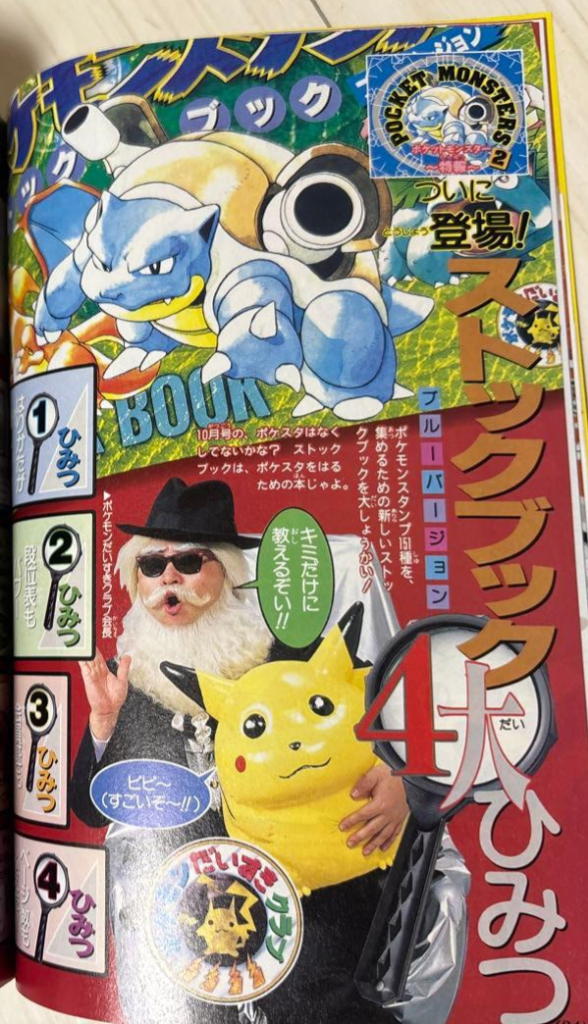
Meet the Daisuki Club Chairman. GSLM November 1997, Year 2.
Right. Is there, then, anything else of note about the Original Campaign? Certainly! Shogakukan actually put together a TV commercial to promote its maiden stamp drive (above). It aired, presumably, in April-May 1997, and featured a mildly terrifying, white-mouthed chunky Pikachu holding a stockbook who gets chased down and whacked by a metamorphing flock of manhunting stamps before proceeding to Thunderbolt them into an album. The 90s were wild. (Helpfully, the ad also tells us exactly which GSLM grade-years participated.)
By September 1997, the Original Campaign had come to a close, to be immediately followed by… The Blue Campaign!
NAVIGATION:
Introduction < > Blue Campaign
Audiovisual
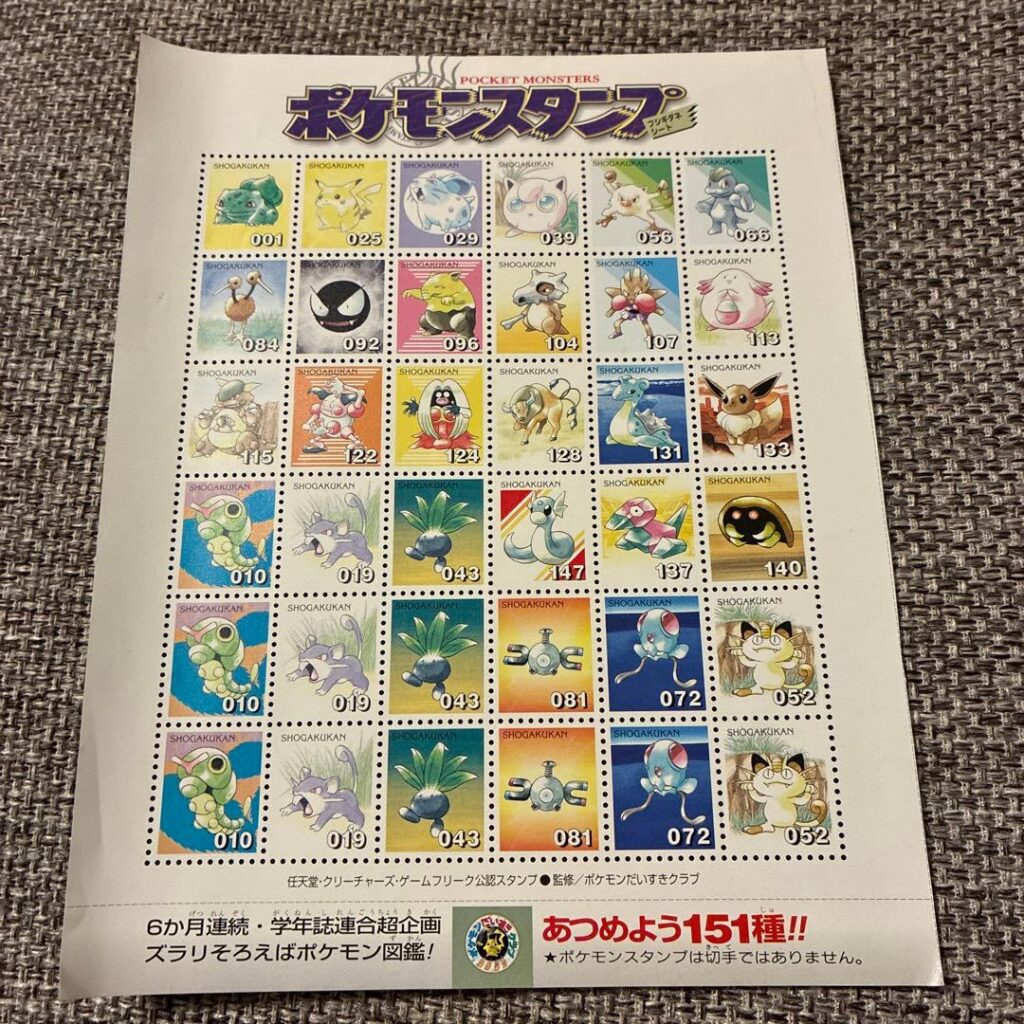
Bulbasaur sheet, Original Campaign.

Original Campaign Charmander sheet. The Chairman recaps the how-to’s on a monochrome insert. GSLM April 1997, Year 3.
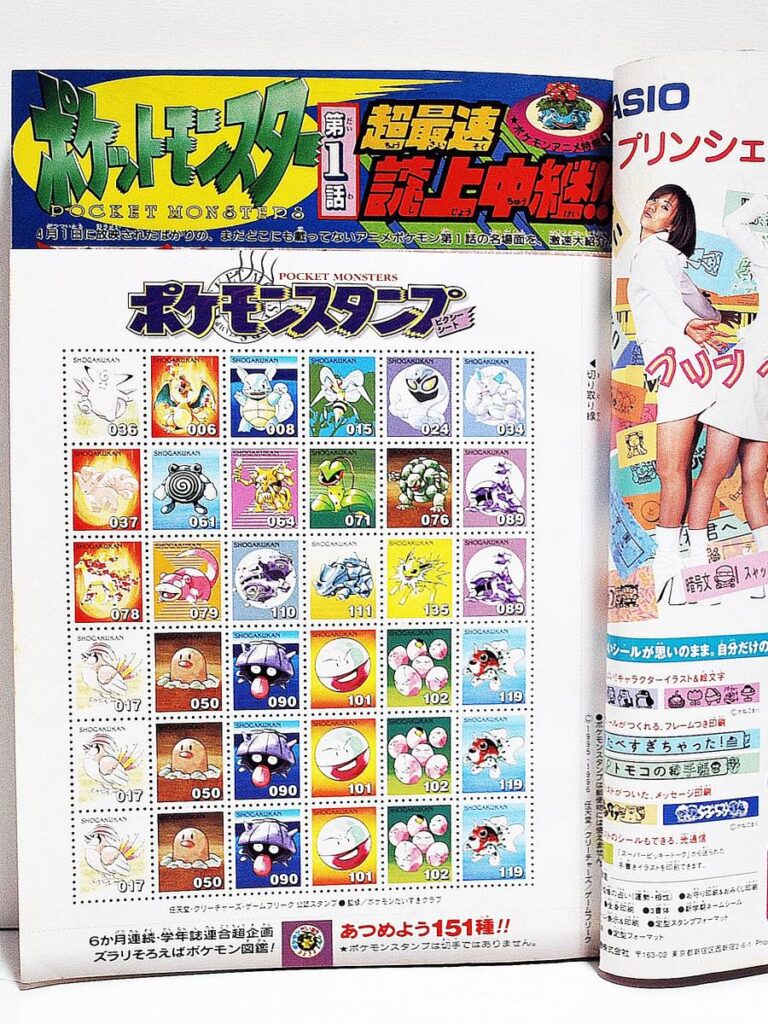
Clefable sheet. GSLM May 1997, Year 4.
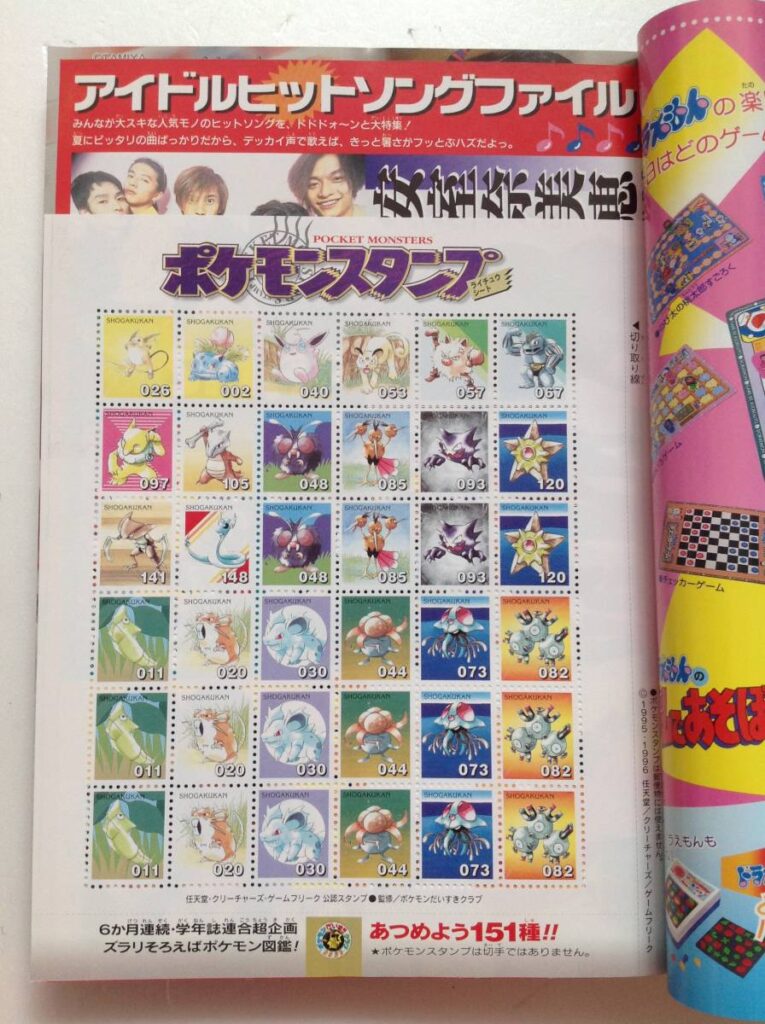
Raichu sheet. GSLM August 1998, Year 3.
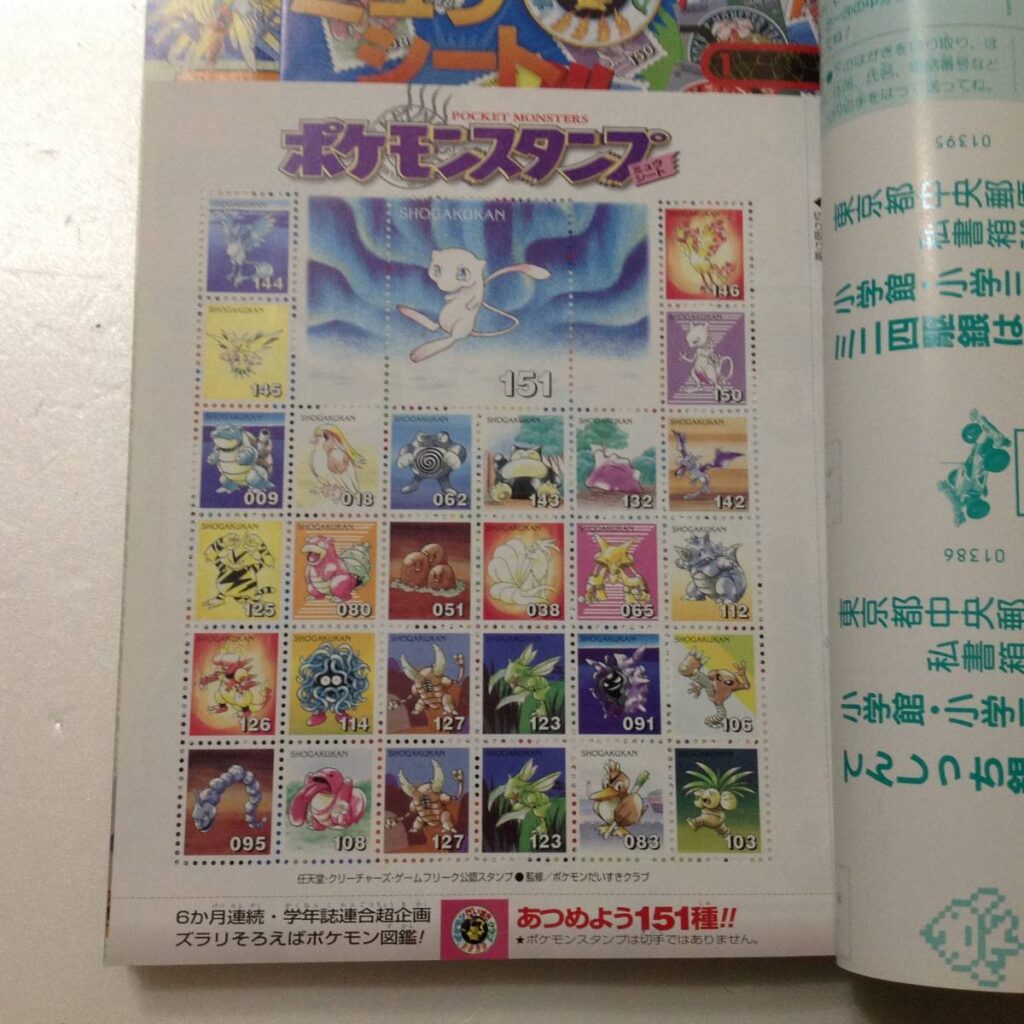
Original Campaign Mew sheet. GSLM September 1997, Year 3.
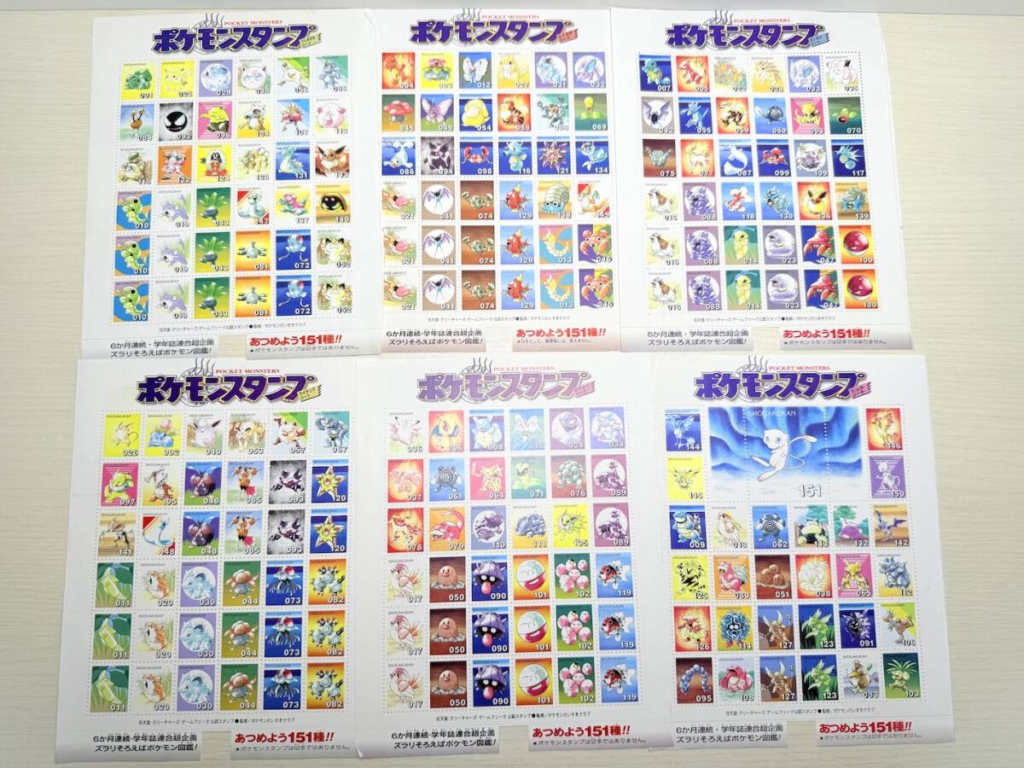
Collection of all six unique Original Campaign stamp sheets.
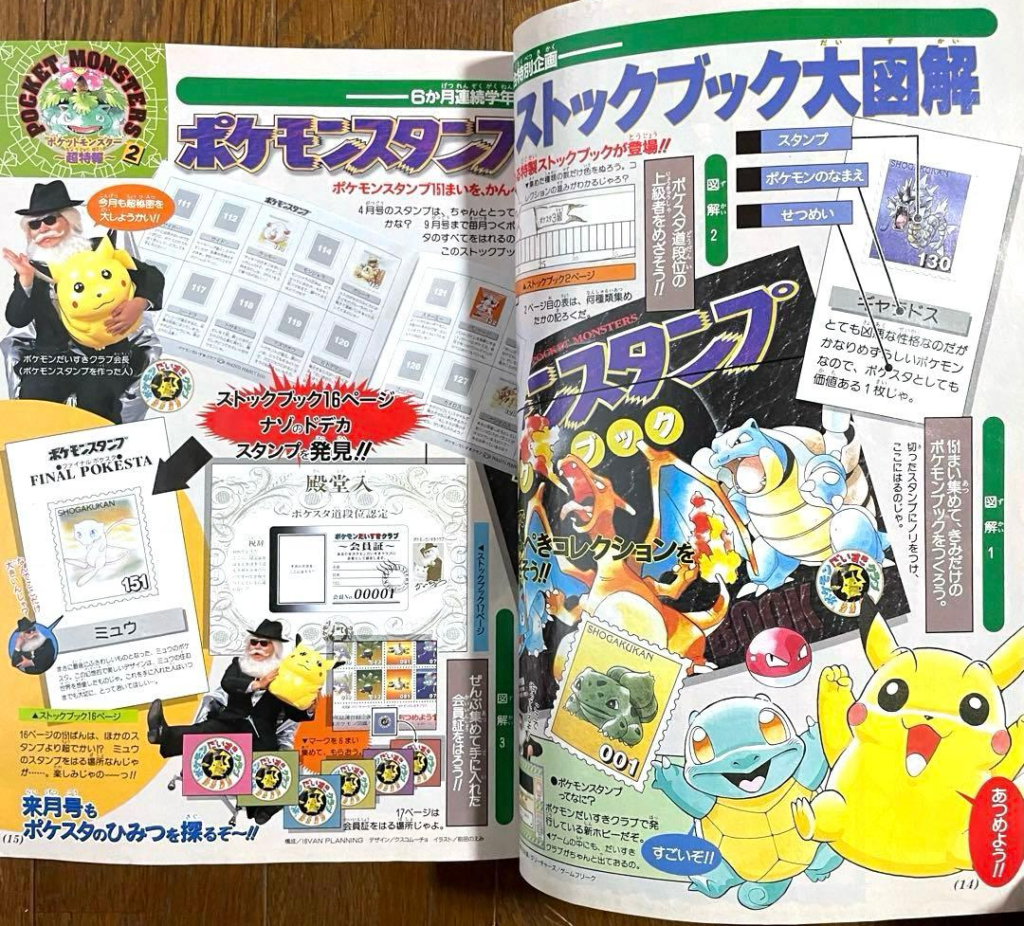
The Chairman introduces readers to the Original Campaign stockbook. GSLM May 1997, Year 3.
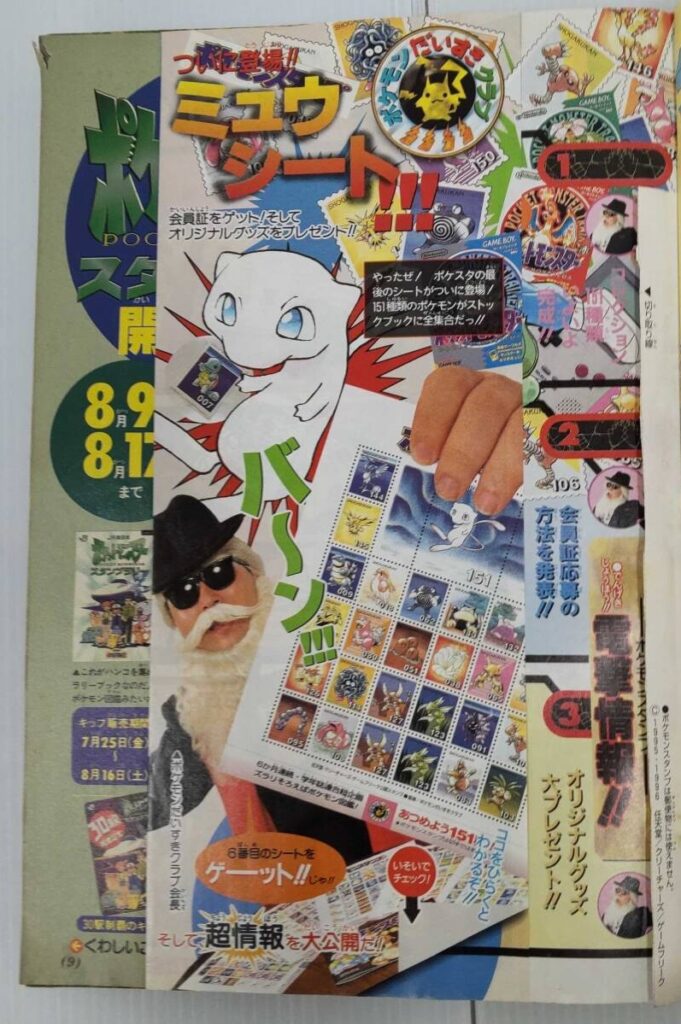
Mew sheet GET! GSLM September 1997, Year 4.

Kanto-themed stockbook as a supplement to GSLM May 1997, Year 3.
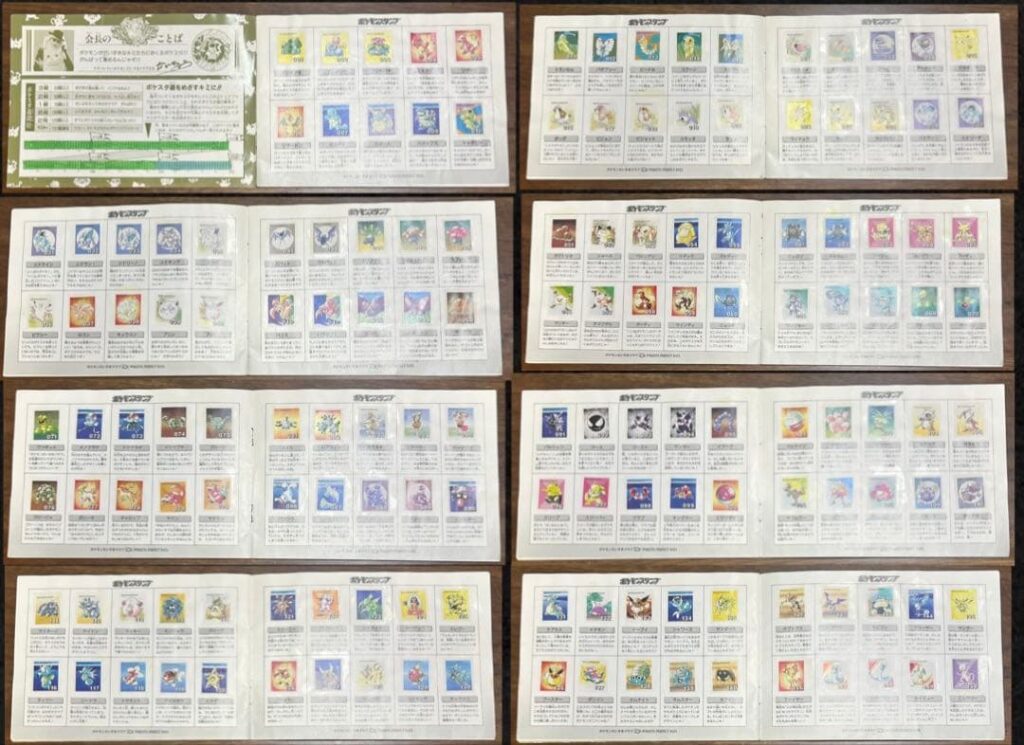
A completed OG stock book (Mew page not pictured.)
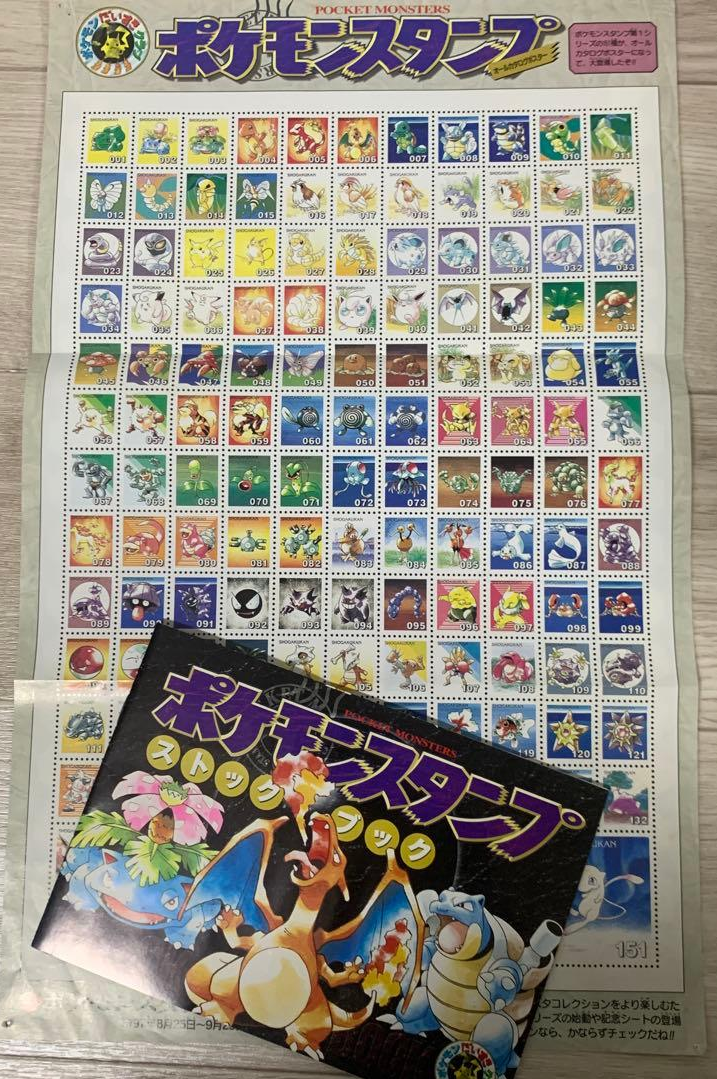
Original Stamp Campaign collection poster with Charizard-themed stock book. Poster included in Pokémon Wonderland Vol.1, August 1997.
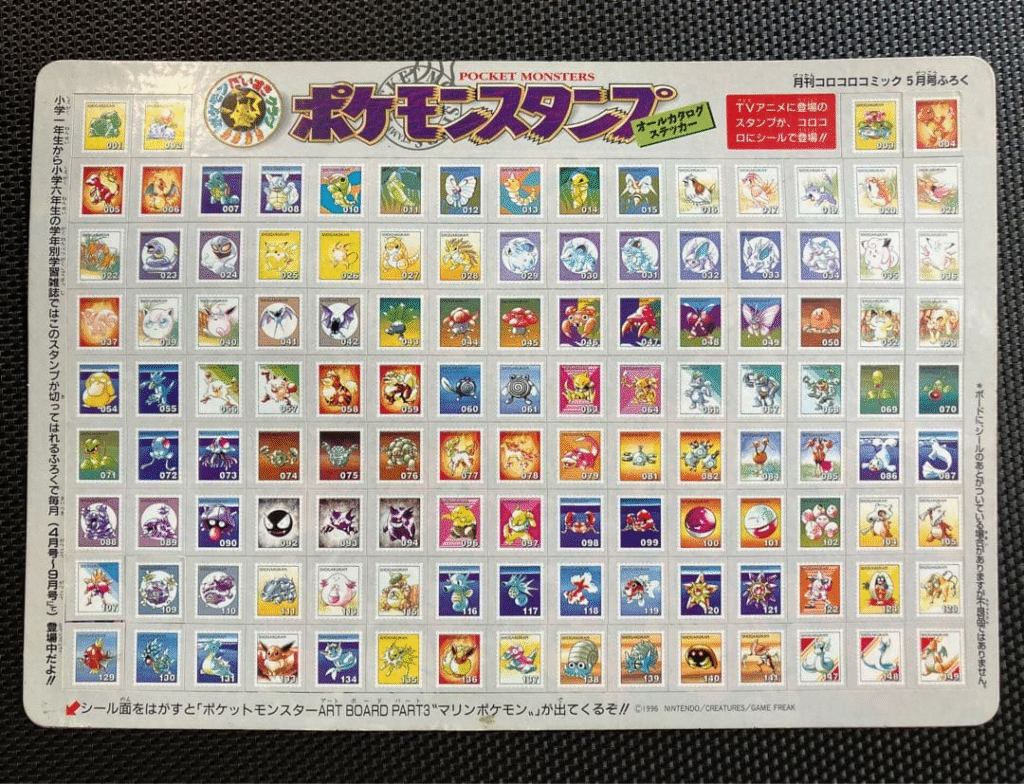
GSLM Original Stamp Campaign Art Board. Supplement to CoroCoro Monthly, May 1997.
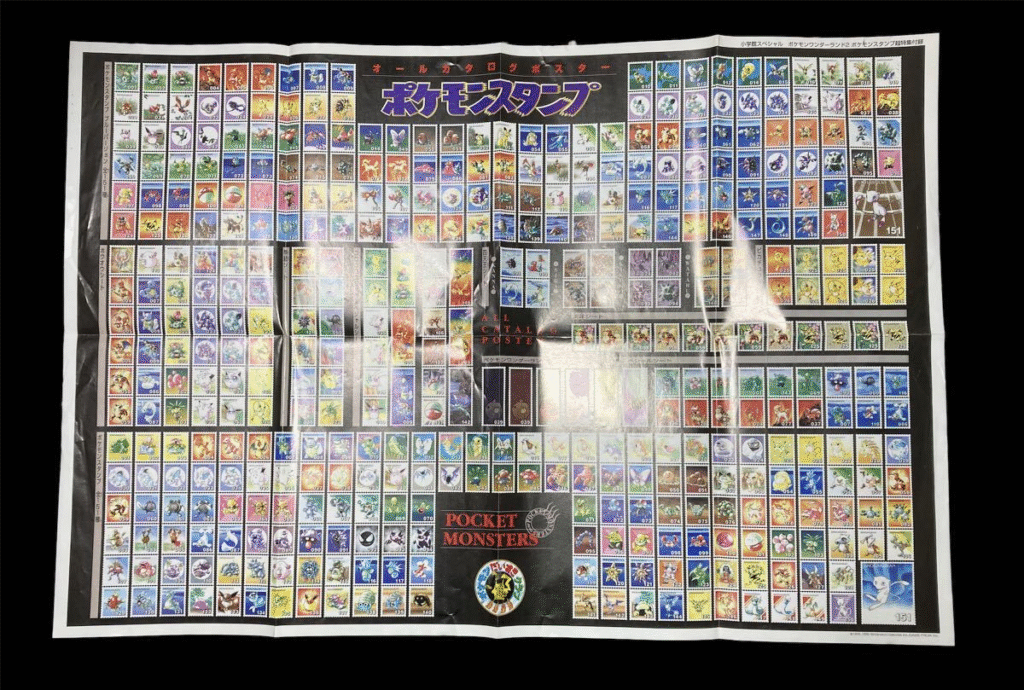
Stamp collection catalog. Presumably included in Pokémon Wonderland Vol.1, 1997.
