
Complete Campaign, April – September 1998
Much like how the Original Campaign had rolled over into Blue, so Blue pivoted straight into the Complete Campaign. Starting in April 1998, Complete (コンプリート) was the last of what I consider to be the Pokéstamp original trinity, ie. publisher Shogakukan’s back-to-back-to-back 1997-8 campaigns with a joint, recognisably uniform presentation from sheets to stockbook to Member Card. With 243 unique stamps on offer spread across six months’ worth of GSLM magazines, Complete eclipsed the previous two campaigns in scope and ambition. And yet, the epithet “complete” was somewhat tautological, for OG and Blue had equally featured the (then) full spectrum of 151 Kanto Pokémon. Complete was just… more complete, courtesy of some fancy bonus stamps. Let’s take a look.
Predictability notwithstanding, this is not to say that the Complete Campaign shunned innovation entirely. Take sheet size: A full sheet of stamps was now a rectangular 10×5 to replace the conventional 6×6 grid. Complete featured six unique sheets, each officially named after the first regular top-left portrait: Venusaur, Charizard, Blastoise, Pikachu, Clefairy, and familiar universal closer Mew (September 1998), now detached from Blue’s golden background and transplanted to a woodland setting. Altogether, this made for just shy of 300 stamps of which, as mentioned, 243 unique. Owing to insufficient data, Complete’s precise GSLM rotation is unclear to me. It’s evident, however, that only GSLM Years 1-6 took part this time, with Learning Kindergarten renewedly sidelined after its surprise participation in the Blue Campaign.1Learning Kindergarten rather offered 5×2 sheets themed around a specific evolution line, such as Clefairy or Charmander (see here LINK) As such, with five standard sheets to six grade-years, monthly duplication was unavoidable.2If I had to hazard a guess, I’d say that Years 1 and 6 carried identical sheets each month, for the age gap between their respective audiences is widest and the odds of readers jumping between the two from month to month (to discover duplicate sheets) thus minimal.
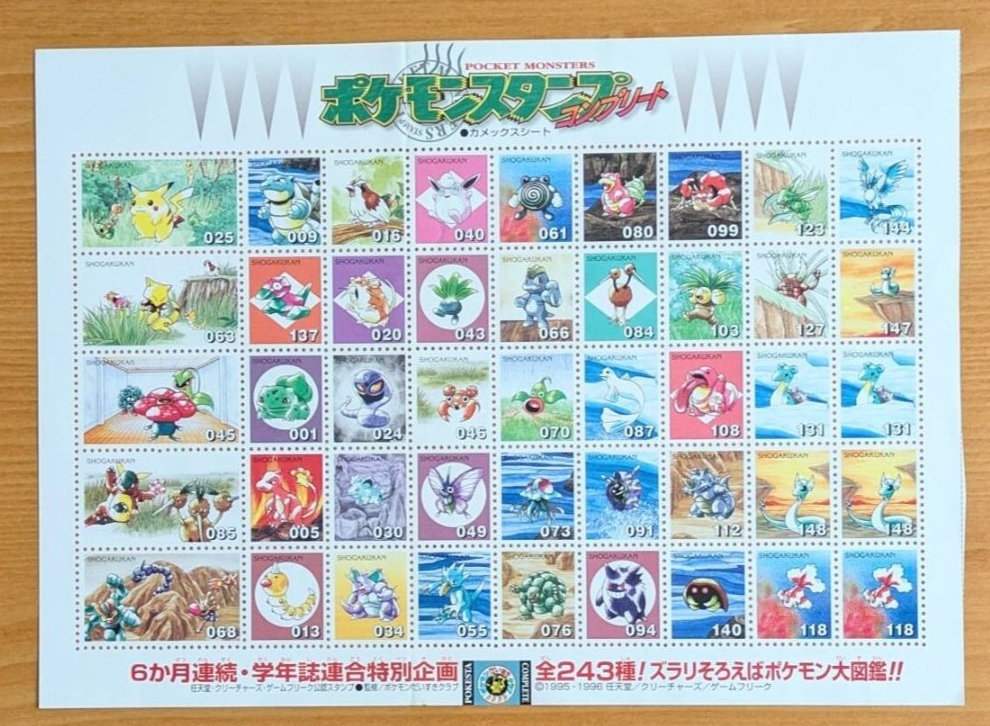
Complete Campaign Blastoise sheet. Note the 2×1 “Story Series” stamps.
Complete’s stamp sheets are noteworthy in two further respects. First, some 30 of its offerings came in the form of “super wide” 2×1 stamps.3GSLM April 1998, Year 3 dubbed them “Super Wide Poly Sheets” (超ポリュ−ムワイドシート) Known as the “Story Series” (ストーリーシリーズ), these stamps transcended simple portraits to depict charming scenes and action poses instead. Taking their inspiration from well-known RGBY videogame locations, we find Staryu and Starmie bouncing off the walls of Misty’s Gym, Aerodactyl with Kabuto and Omanyte perched on top of pedestals inside the Pokémon Lab, or Weedle, Kakuna and Pikachu chilling inside Viridian Forest – the latter’s design faithfully mirroring Keiji Kinebuchi’s famous Pikachu TCG promo. I personally love the scene with a menacing Mewtwo flanked by Hypno and Kadabra inside Cerulean Cave. They struck a chord with fans, too – one Japanese X user reminisced how their younger self loved the worldview of the Story Series, gazing at the stamps and imagining locations. Unusually, the artists behind Complete’s sheets are known to us (per this tweet): K. Hidenori handled the sheets’ lineup and composition,4By his own account, Hidenori also singlehandedly designed the stamp-related sections and pages of Wonderland Vol.1 (1997) and Vol.2 (1998). Emiko Yoshino illustrated the backgrounds, and Ken Sugimori drew the Pokémon portraits. Notably, up until this point, deviant formats had been the sole preserve of Mew and select non-campaign miscellaneous sheets. But now, all bets were off.
Second, besides the Story Series, Complete debuted the inclusion of multiple unique stamps per Pokémon. Take Charizard, which appeared twice in the campaign: Once as a Fire type on its namesake sheet, and once tucked away in a corner of the Pikachu sheet, now classified as a Flying type. Or Bulbasaur, which was both on the Charizard sheet (Grass) and on the Blastoise sheet (Poison). Only elements of the Pokémon Kanto starter lines were given this special treatment; it would fall to the next campaign, Stadium, to really run with the idea. That said, it’s clear that Complete marked the beginning of free-er Pokéstamp experimentation that, in a bid to keep things fresh, moved away from the rigidity of one stamp-dex entry per Pokémon.
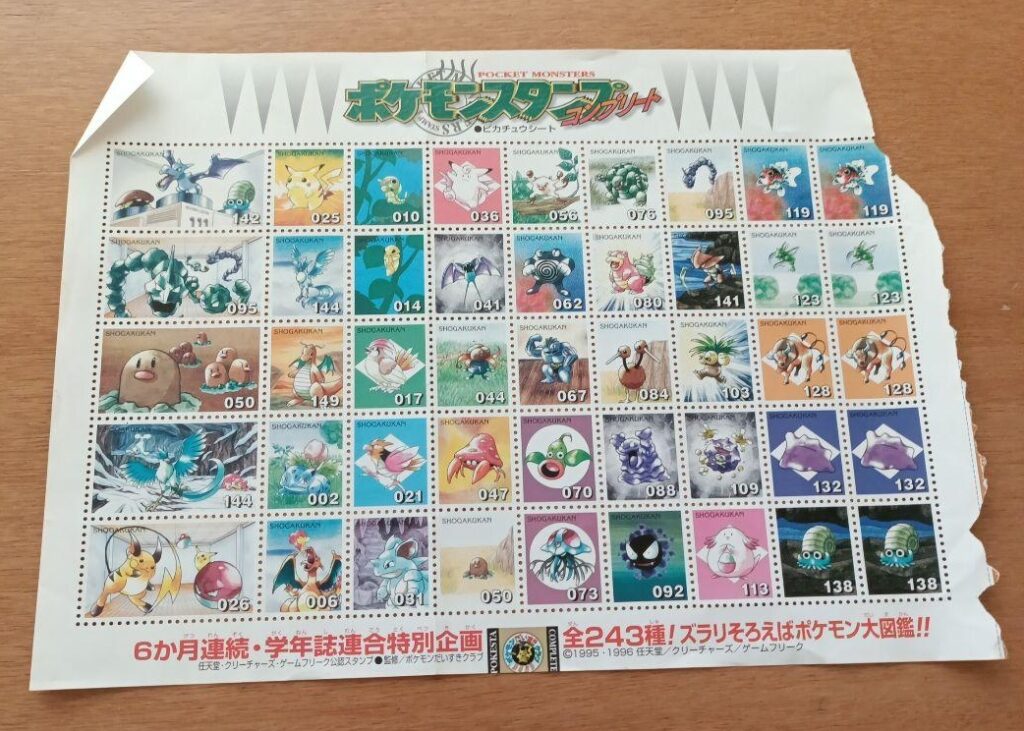
Complete Campaign Pikachu sheet. Note the Flying-type Charizard in the lower-left.
In keeping with this apparent resolve to up the ante, Complete delivered the fanciest stamp stockbook to date. Released with the campaign’s second GSLM issue in May 1998, it included a newly-added foldout page with abundant room to stick those broadside 2x1s. It also included a cool yet disappointingly landmarkless Kanto “Monsters Area Map” of which I frankly don’t quite understand the purpose. Filler, I suppose. Echoing the previous campaigns, the booklet’s exterior once more featured the fully-evolved Kanto starter trio. And sure enough, Charizard muscled out Venusaur and Blastoise to once again hog the spotlight and stand squarely in the middle, breathing fire at a perceived foe. C’mon, Zardboi, let Venusaur have his moment in the sun! (At least Complete’s Member Card was a fluorescent shade of green, which is sorta Venusaur-y, right?)
The rest of the booklet offered few surprises. As always, the Fan Club Chairman was printed overleaf to enthuse would-be collectors about the project (see Original and Blue) and oversee an explanation of Complete’s inflated Pokédex. The Kaichou equally made his routine appearance on the final page by the now-familiar Hall of Fame and Member Card posting space (see below), alerting participants to the existence and purpose of prize-grabbing Club Marks. In an interesting detail, Complete stockbooks now printed their grade-year magazine of origin (小四④/小五⑤ etc.) in the top-right corner of their covers. As far as I know, this served no purpose beyond signalling script difficulty,5GSLM introduces tough to read Kanji gradually by grade-year. The contrast in text difficulty between, say, Years 1 and 4 is quite noticeable. for the Campaign’s prize pool was shared between all six participating grade-years, as we shall see shortly.
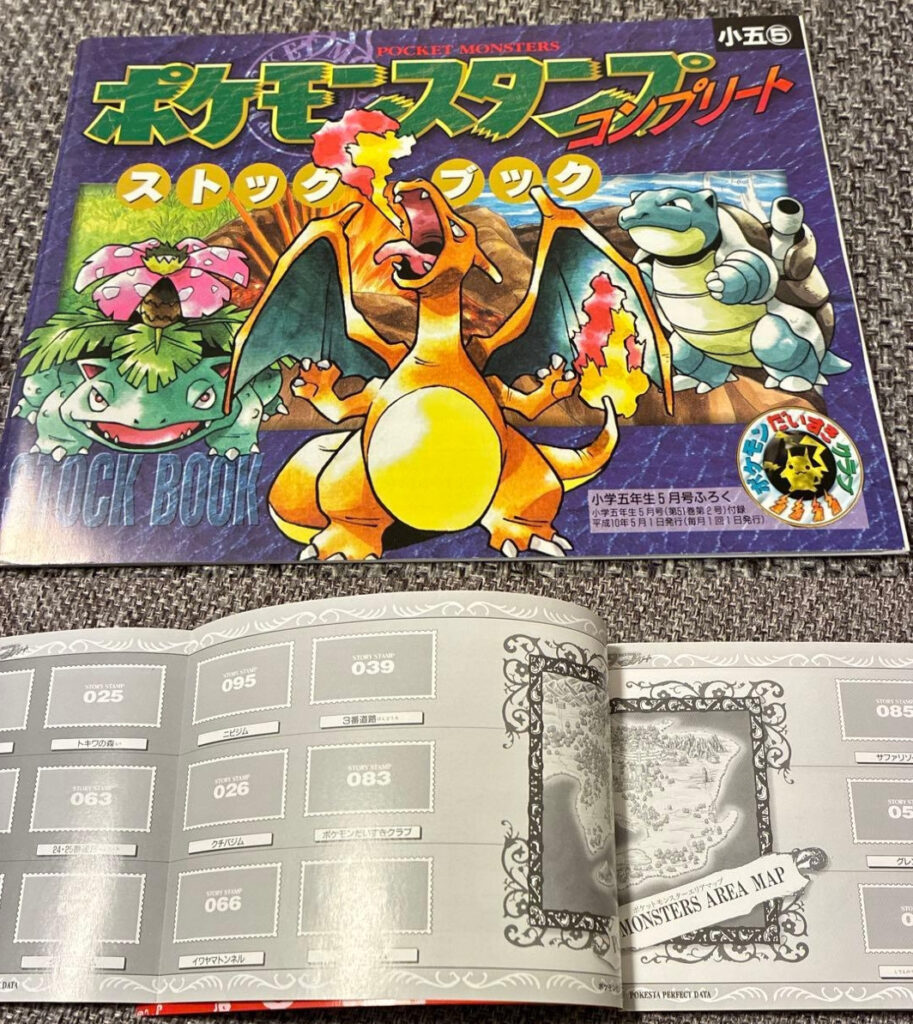
Complete Campaign Charizard-themed stockbook. Story Series foldout with region map at the bottom.
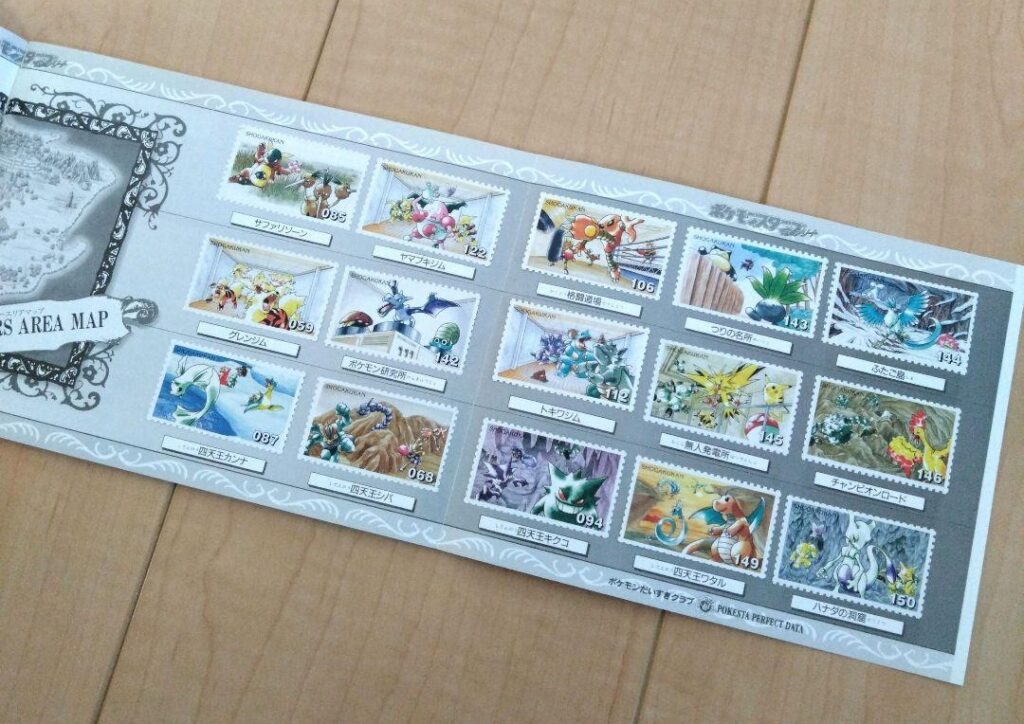
Completed Story Series page. Looks good, doesn’t it?
Campaign prizes, then! By now you’ll know the drill: Collectors could affix six Club Marks to a GSLM submission form and send it to Shogakukan in exchange for a fancy Daisuki Club Member Card (coloured a neon green this time). On the front of the card, there was space to leak one’s personal information to everyone who cast eyes on the piece of plastic. On the back, we find the Kaichou‘s Pikachu-coddling portrait accompanied by pat-on-the-back congratulatory paean to signify that you, the budding Pokémon philologist, had succeeded in sponsoring Shogakukan to the tune of six consecutive GSLM issues. Err I mean, had collected 243 unique Pokéstamps!
The front also bore a six-digit number – the Trainer ID (TID) – that we think was issued sequentially, in chronological order, to successful applicants. (We’ve previously discussed the significance of TIDs in the Introduction here). Complete‘s highest known TID exceeds 600.000 – 603749, to be exact – which if we assume indicates a minimum completion rate is somewhat problematic. Going off a healthy mid-1998 Year 1-6 GSLM circulation that pushed 2 million copies a month (see again the Introduction), then a figure of 600k+ completions demands a ~30% GSLM buyer campaign completion rate. While possible, is this also plausible, particularly given the readership’s presumed decline in stamp interest between OG and Complete and Stadium‘s lacklustre performance, which came right after?6Stadium’s highest known TID runs in the 50.000s. I’m not sure.
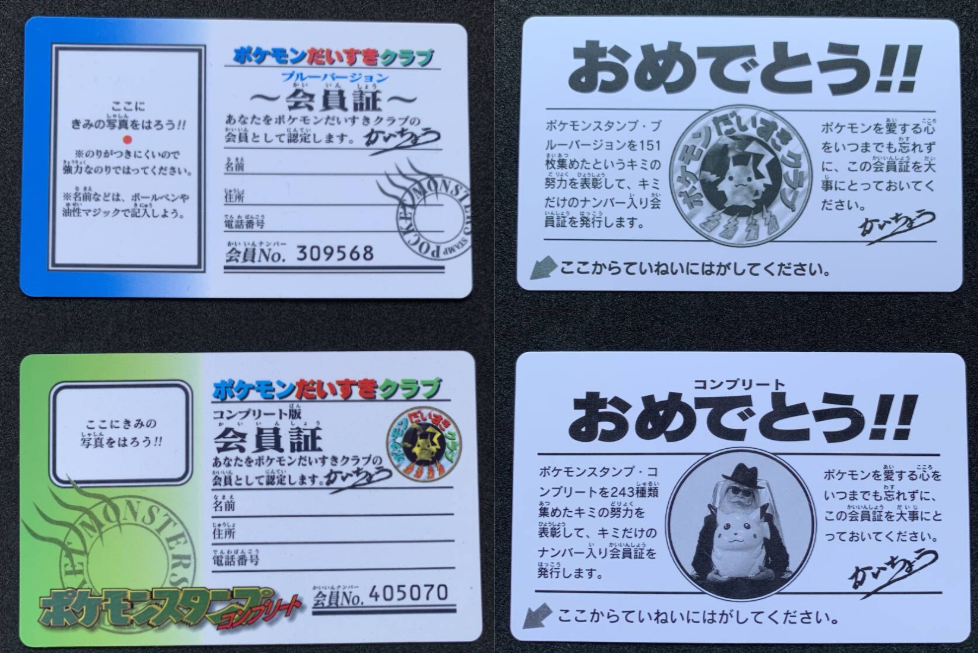
Blue (top) and Complete (bottom) Fan Club Member Cards.
Thanks to some lovely scans of August 1998 (Year 5) courtesy of goonhoon and photographs of September 1998 issues (Year 2, 4) derived from an auction site, we know that other Complete prize incentives existed. It’s impossible to say “stamp” without saying “Chairman”, and for the occasion of touting the campaign’s wares, grandad donned a mustard fedora to replace his usual black one. I suppose he was in a tropical mood. In any case, prize winners were drawn through some form of TID lottery. Those who mailed in all six sheets’ Club Marks entered the draw to win:
– Daisuki Club Special Pokémon Stickers (300 winners)
– Pikachu “Ride” Stamper (150 winners)
– Stamp Badge Set (50 winners)
– N64 Pokémon Stadium (20 winners)
– Fearow and Rapidash “Special Data” (10 winners)
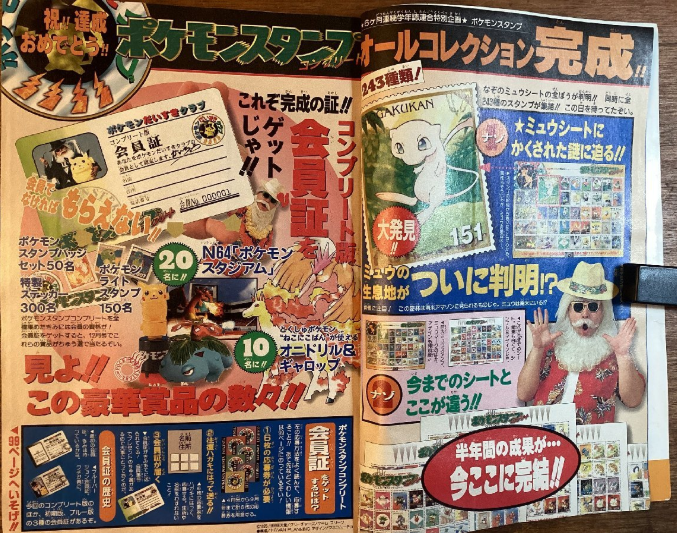
GSLM September 1998, Year 4. Note the Chairman’s tropical appearance. Rapidash and Fearow loom large.
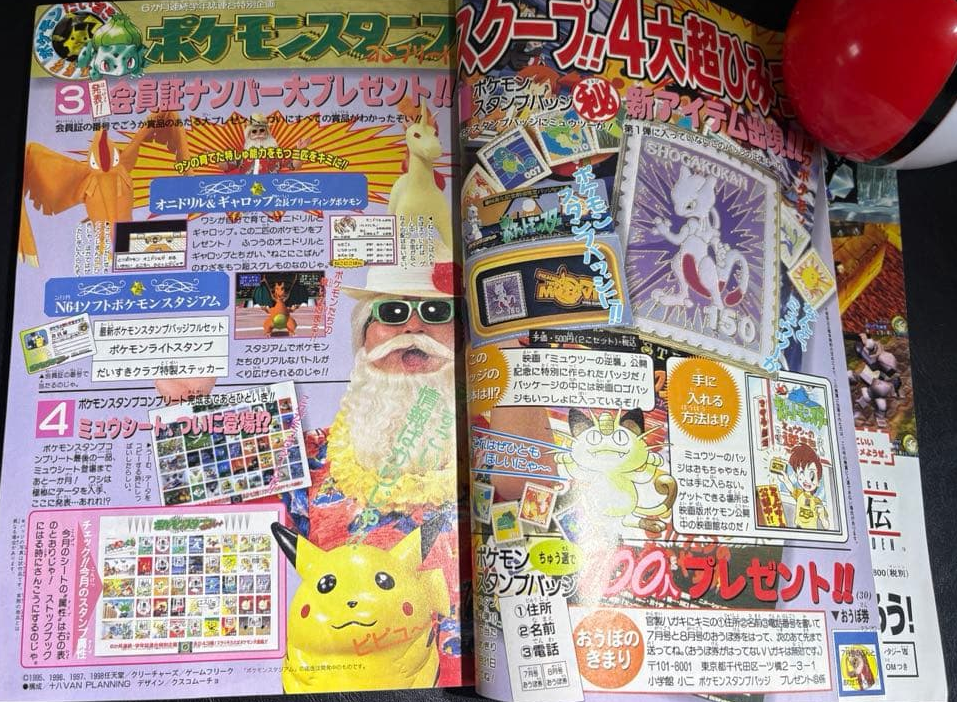
GSLM September 1998, Year 2.
Copies of Pokémon Stadium, wowza! However… You might not expect it at first glance, yet the real eyebrow-raiser here is the presumed grand prize of Kaichou Fearow and Rapidash. Billed as the top prize and clearly intended to be a big deal, the September 1998, Year 4 issue even included a manga short all about the Chairman and his Fearow.7Potentially all of that month’s GSLM grade-years did. Distributed to only 10 winners via, we think, Green or Red cartridge mail-in, these two event Pokémon are the ultimate enigma of modern-day Poké-preservationism. Not a single one has ever been found, and with Generation 1 batteries dying or long dead, chances are we never will.
So! With that covered, let’s turn our attention to the campaign that shook up an increasingly stale formula: Stadium.
NAVIGATION:
Blue Campaign < > Stadium Campaign
Audiovisual
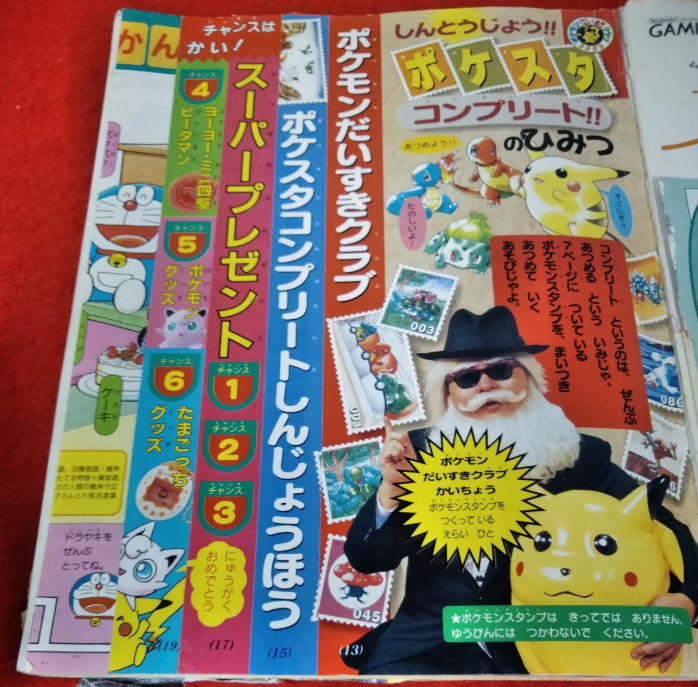
The Chairman advertises the Complete Campaign. GSLM April 1998, Year 1.
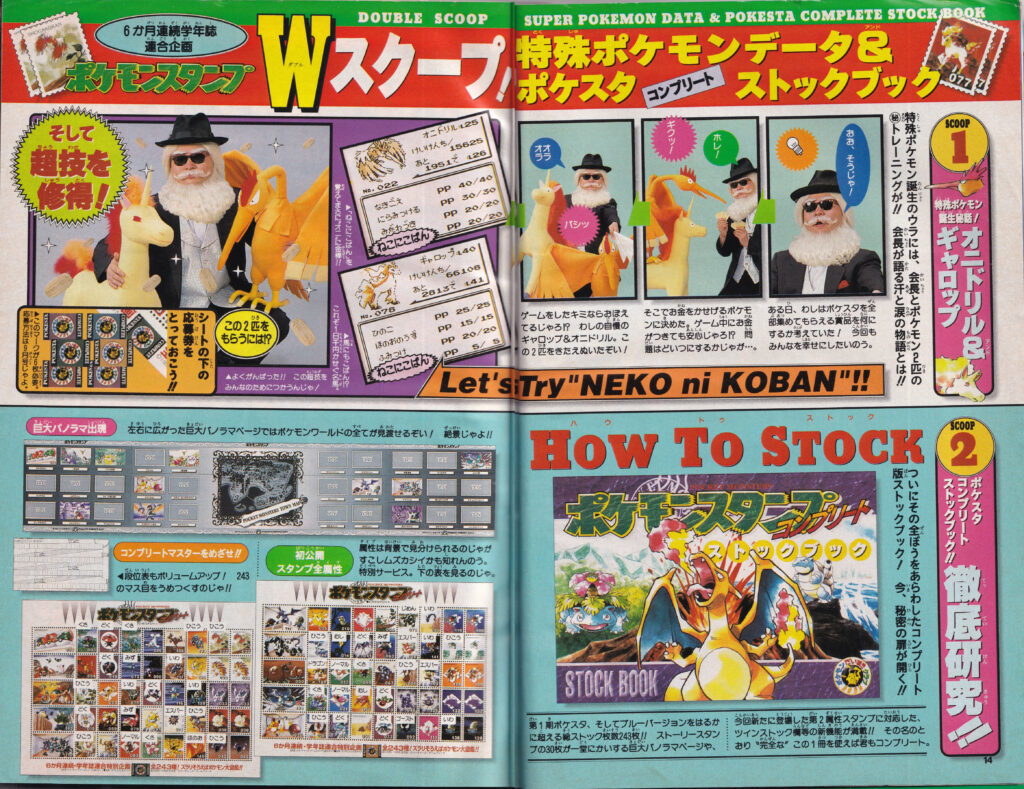
The Chairman breaks down the Complete Campaign. Fearow and Rapidash loom large. GSLM May 1998, Year 6. Goonhoon’s collection.
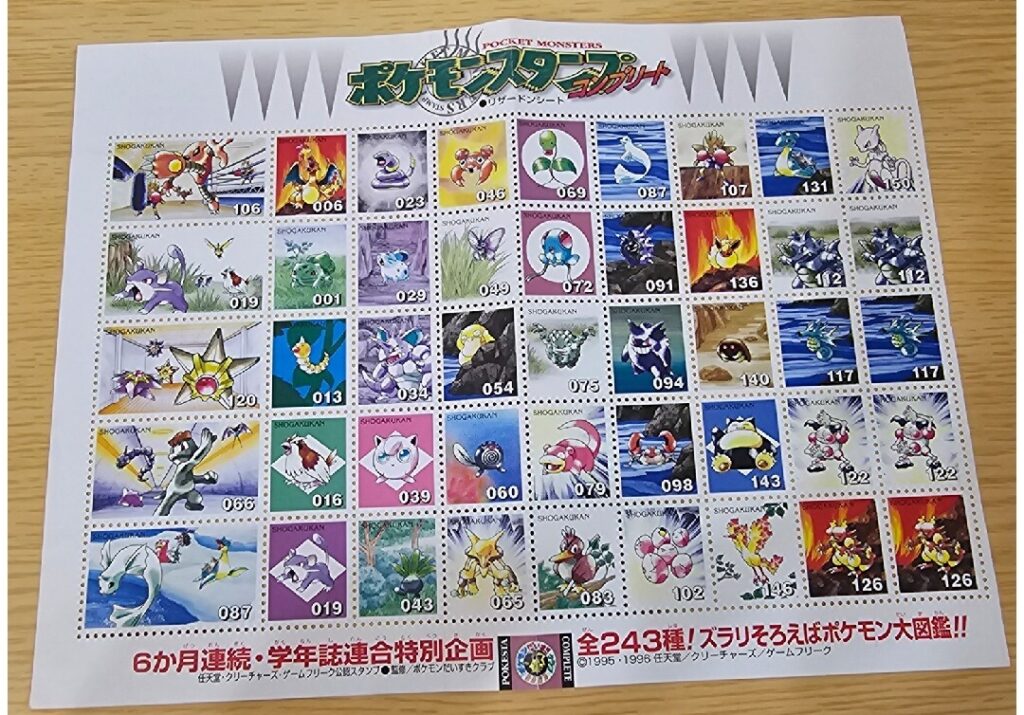
Complete Campaign Charizard sheet. Note the 2×1 “Story Series” stamps.
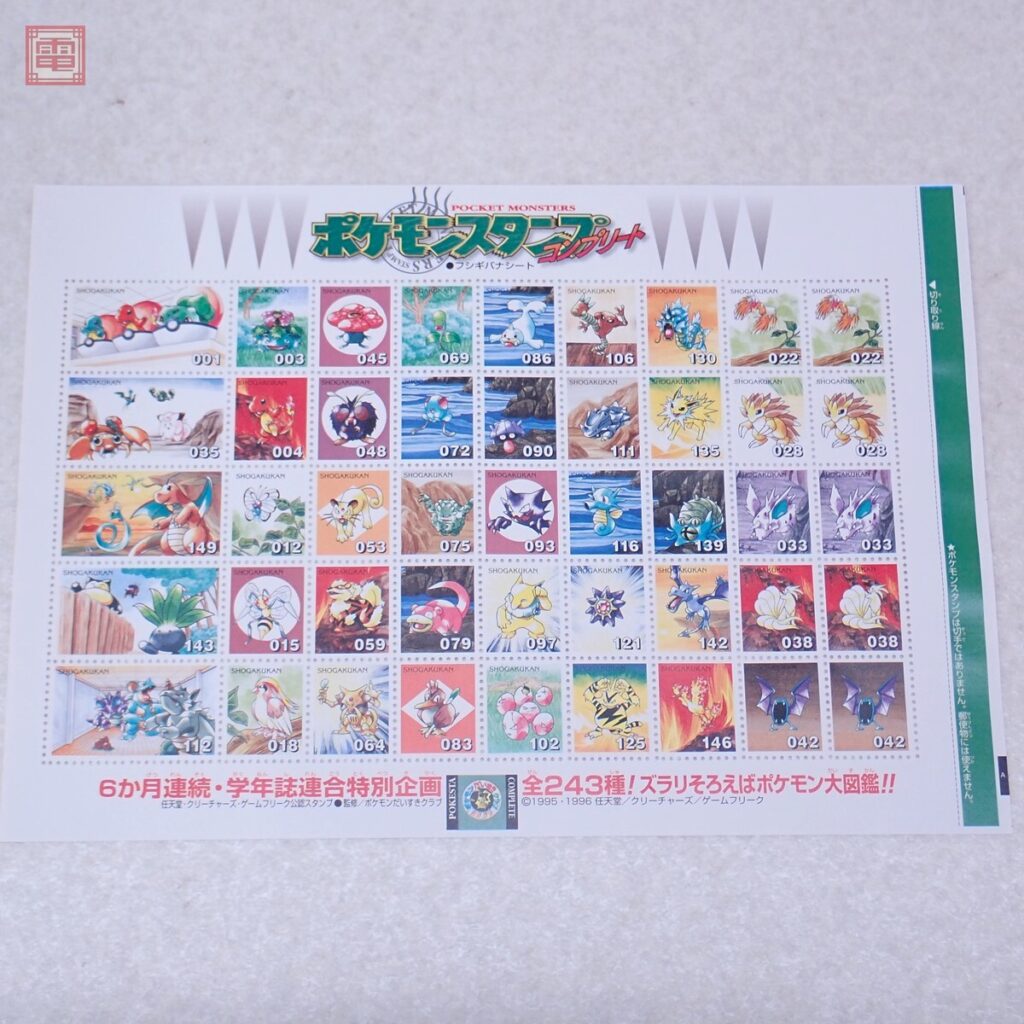
Venusaur sheet, Complete Campaign.
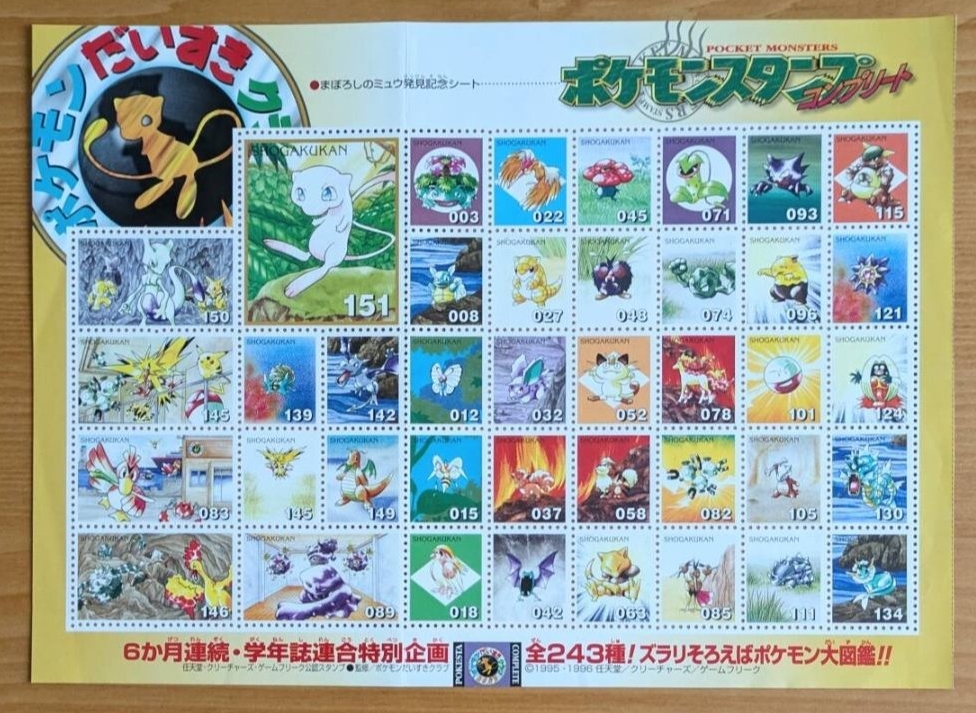
Complete Campaign Mew sheet, GSLM September 1998.
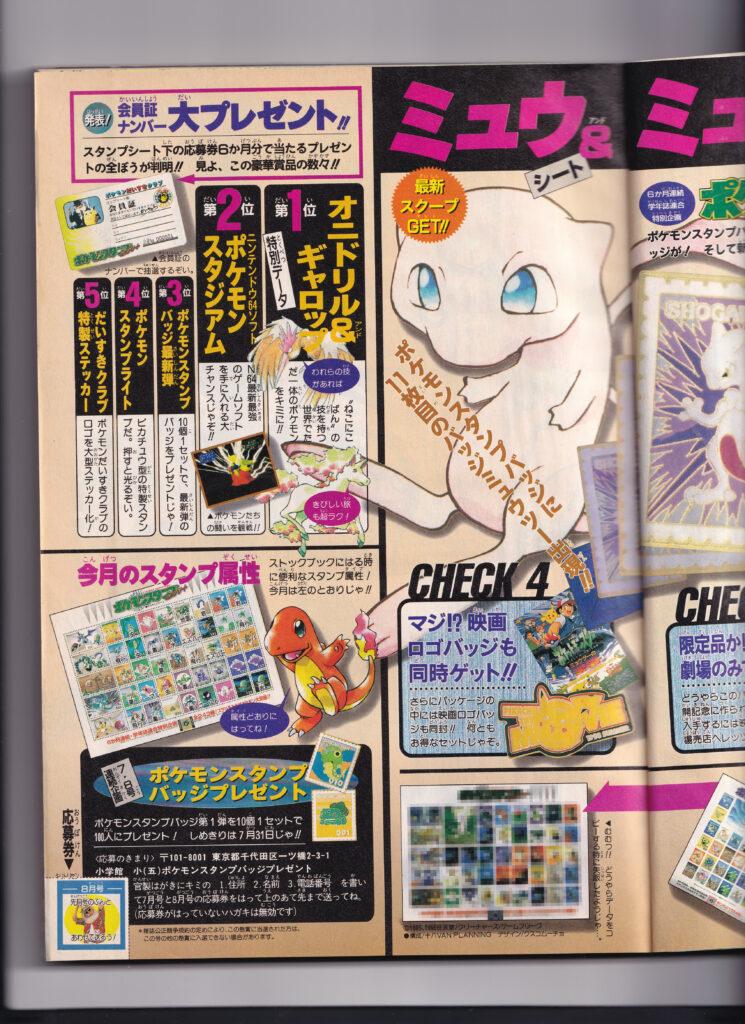
The Complete Campaign’s prizes are revealed in GSLM August 1998, Year 5. Image courtesy of goonhoon.
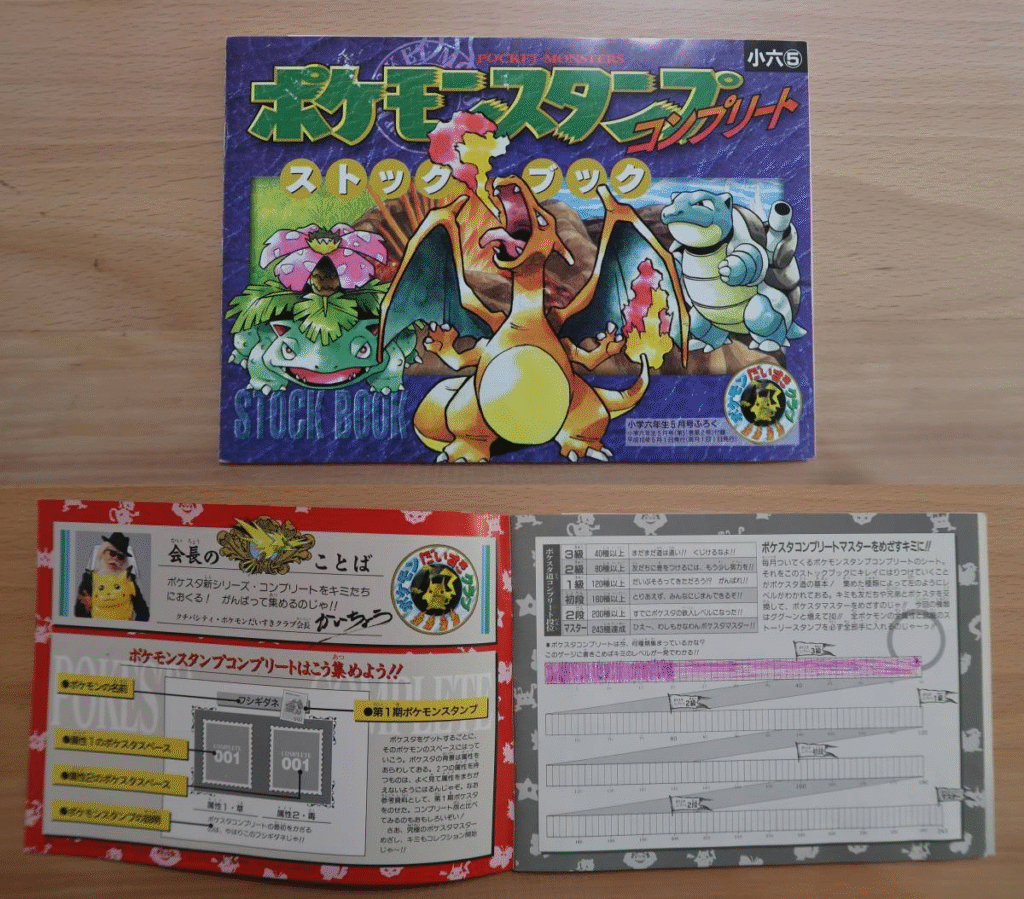
Complete Campaign Charizard-themed stock book. Note how it says コンプリート over Blastoise’s head in order to differentiate it from the OG stock book with similar art.
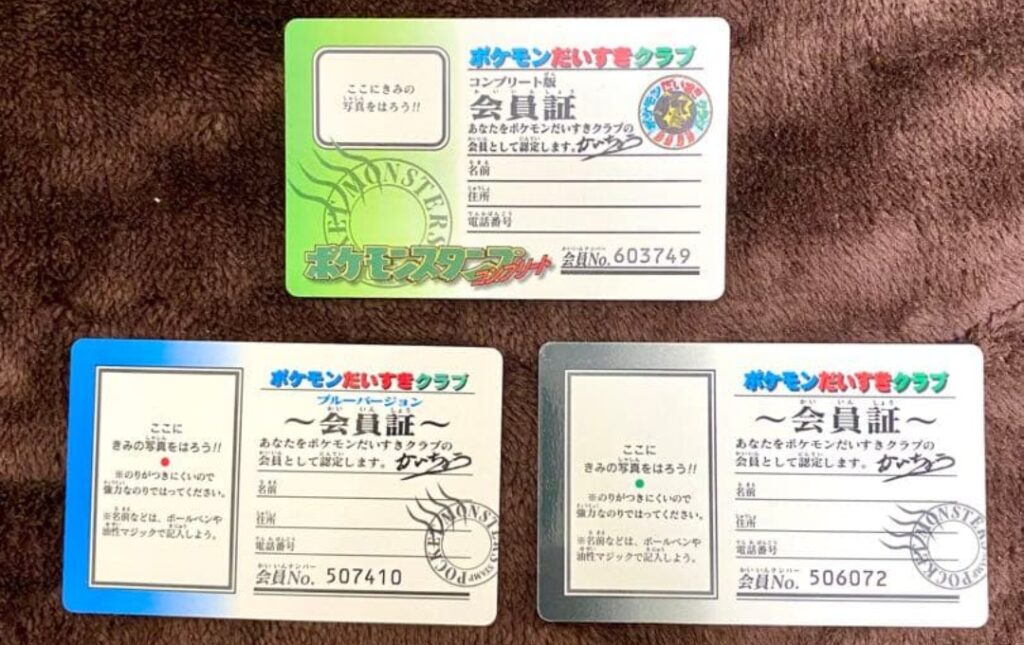
Kanto Daisuki Club Member Cards. Original (black), Blue (blue) and Complete (green).
