
GSLM? Shogakukan? What the devil are those? Relax. I’ll walk you through it. GSLM is shorthand for Grade-Specific Learning Magazine, itself a translation of the Japanese gakunenbetsu gakushuu zasshi (or 学年別学習雑誌).1Some places use the term “Grade-Level Learning Magazine instead. Ever since 1922 (!), publishing house Shogakukan (小学館) has put out a range of hefty monthly children’s magazines packed with fun exercises, popular culture and manga tailored towards children of varying ages. The historical granularity is impressive: In its heyday, readers could choose from no fewer than 10 unique magazines each month – six catering to primary schoolers aged 7-12, plus four kindergarten levels for toddlers aged 3-6 (hence the term grade-specific). Crucial to our story, the upper ranges hosted a series of Pokémon stamp campaigns in the late 1990s and early 2000s.
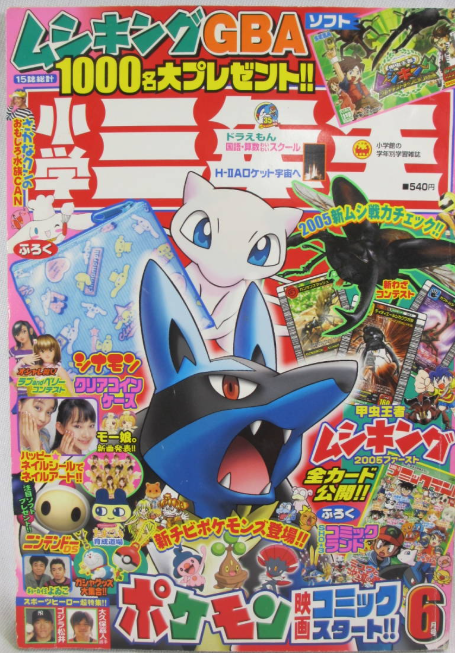
Typical GSLM cover. This one June 2005, Year 3.
What, then, is a stamp campaign? Well! There’s a lot to say here, but I’ll give you the condensed version. In creating its Pokémon collectathons, Shogakukan borrowed from the century-old “stamp rally” tradition, whose essence is to “go place, collect stamps (of the inky variety), complete book, get prize”. Innumerable such rallies take place across Japan each year organised by local governments, railways, and private corporations alike. They’re practically a cultural institution. (Those interested in knowing more may enjoy the “Stamp Absol” article.)
Shogakukan’s adaptation of this formula was simple as it was brilliant. Rather than “go place, get inky stamp”, the publisher realised they could entice the fast-growing Pokécrowd by instead offering “buy magazine, get (paper) stamp bearing the Pokémon’s likeness and Pokédex number”. Stamp campaigns usually lasted between five and seven months, with each GSLM grade-year normally carrying a different 6×6 (or 10×5) stamp sheet on a rotational basis. Dedicated young philatelists could cut up the sheets and paste the individual stamps into the allocated spaces of a custom flip-through album (or “stockbook”) to arrange the collection and revel in their powers of parental persuasion. It’s worth emphasising that we’re talking faux-postage stamps here, not actual mailable ones, even though that practical distinction was understandably lost on enthusiastic schoolchildren – to Japan Post’s great chagrin.
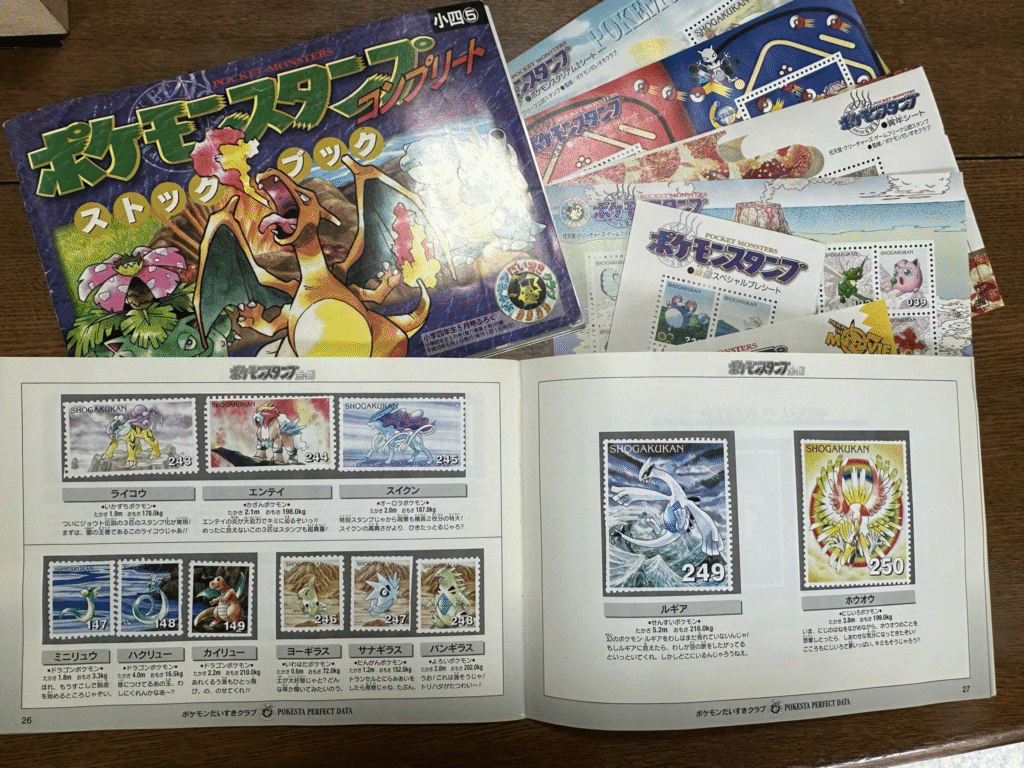
Charizard-themed stockbook (Complete Campaign) with Gold & Silver Campaign stockbook folded open in the foreground.
Now, you may wonder if this stamp business wasn’t a niche affair in a remote corner of Japan’s print media landscape. And rightly so. But you’d be wrong – there’s every indication that Shogakukan’s Pokéstamps were a huge hit among primary schoolers. There were Shogakukan television adverts such as this one. We find YouTube comment sections filled with nostalgic adults. And should you want hard numbers, we only need to look at the effect that the Pokéstamps – or perhaps Pokémon in general – had on GSLM circulation. To be sure, historical print run figures for GSLM are tricky to come by; to our knowledge, no 1990s central source for them exists.2The digital records kept by Japan Magazine Association go back no further than 2008: https://www.j-magazine.or.jp/user/printed. At its 1973 peak, GSLM Years 1-6 sold an unbelievable 5+ million monthly copies.3This number slumped to less than 70.000/month combined by the time Shogakukan pulled the plug in 2012. See also this source. Assuming that GSLM traced the gradual downwards trend of Shogakukan’s flagship magazine CoroCoro Monthly,4Once Pokémon hit it big in 1996/7, the franchise supplanted Doraemon as the central focus and cash cow magazine seller in practically all of Shogakukan’s publications aimed at (young) children. CoroCoro Monthly, for example, saw a sustained doubling of its monthly circulation from ~600k in 1995 to over 1.2m 1996, when Pokémon content began to appear, to a peak of 1.8m in 1997. See here. The partnership between Shogakukan – which also publishes the famous CoroCoro magazine – and The Pokémon Company / Creatures Inc. is as successful as it is enduring. then GSLM monthly readership will have dropped well below 1 million by the mid-1990s (CoroCoro circulation fell to approximately 600k in 1995). The precise pre-Pokéboom baseline, however, is unknown.
No matter. Helpfully, there’s a proxy to help us pinpoint GSLM circulation at a specific moment in time with considerable precision. That is to say: GSLM October 1998 Years 1-6 all included a special Pikachu sheet to commemorate the then-recent Japanese release of Pokémon Yellow. In a stroke of luck, these sheets were serialised, meaning each one printed bore a unique, sequential number. You’ll understand that the highest known figure equals a close estimation of the month-to-month GSLM print run. And this peak number is a whopping… 1690396 – close to 1.7 million! Wowza. That’s a lot of stamp sheets. Incidentally, this peak is conspicuously similar to CoroCoro’s 1997 Poké-fuelled monthly high of 1.8 million. A rising tide lifts all boats, they say.
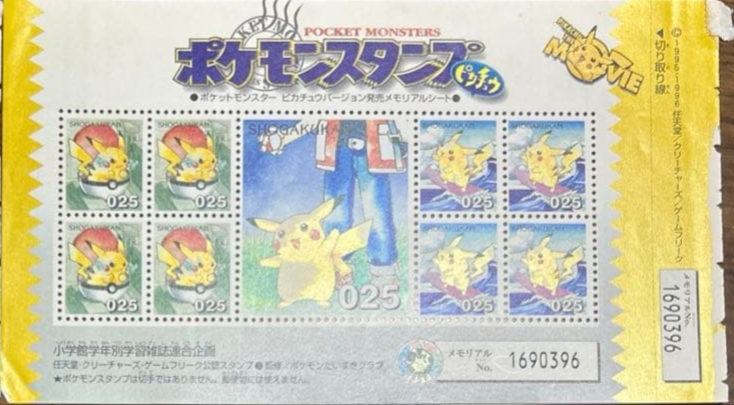
The magical 1690396 Pikachu sheet.
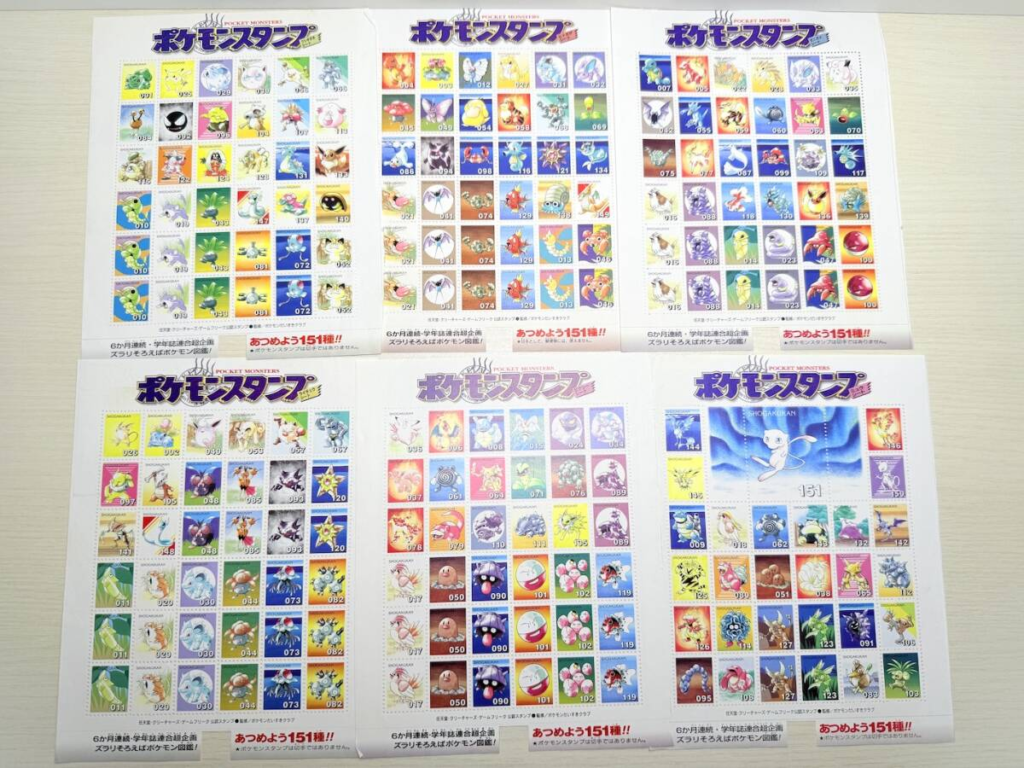
Original Campaign sheets with their Club Marks removed.
Besides completing a campaign’s stockbook for personal satisfaction, was there a higher purpose to competing in Shogakukan’s stamp drives? Well certainly – there were prizes to be won! Take the 1998 Complete Campaign where (among others) stamp badge sets, Pokémon Stadium for Nintendo 64, and the event Pokémon Fearow and Rapidash were on offer. Or the 2003 Ruby & Sapphire Campaign that gave away Jirachi plush, WHF stamp sheets, “Kaichou” Absol, copies of Pokémon Pinball: Ruby & Sapphire, and even orange GBA SPs and complete Nintendo GameCube sets. Eligibility to enter any draw was premised on the participant gathering all of a campaign’s “Club Marks” (クラブマーク), ie. the tiny, stampy logos found at the bottom of every mainline sheet. Intended to be collectively pasted onto a pre-prepared submission form addressed to Shogakukan, harvested Club Marks are responsible for the many surviving examples of Pokéstamp sheets with small yet noticeable square cutouts.
While the prize pool varied between campaigns, one factor remained constant: Every successful applicant could expect to receive a unique completion reward in the mail from Shogakukan. For the first three campaigns – Original, Blue and Complete – this took the form of the coveted Fan Club (or Daisuki) Member Card. Resembling a library card, it bore colourful Campaign data on the front next to space to fill out one’s personal details (and even affix a photograph). On the back, these carried a portrait of the Fan Club Chairman (see below) accompanied by encouraging words of commendation. The 1999 Stadium Campaign instead awarded bespoke Trainer Cards ft. one’s Pokémon of choice, before Gold & Silver returned to the Member Card prize with matching dual IDs. Finally, post-hiatus, 2003’s Ruby & Sapphire axed the Member Card to give a Hoenn-inspired Trainer Card, while the last two campaigns – Contest & Gym Leader and Diamond & Pearl – seemingly did away with IDs altogether.
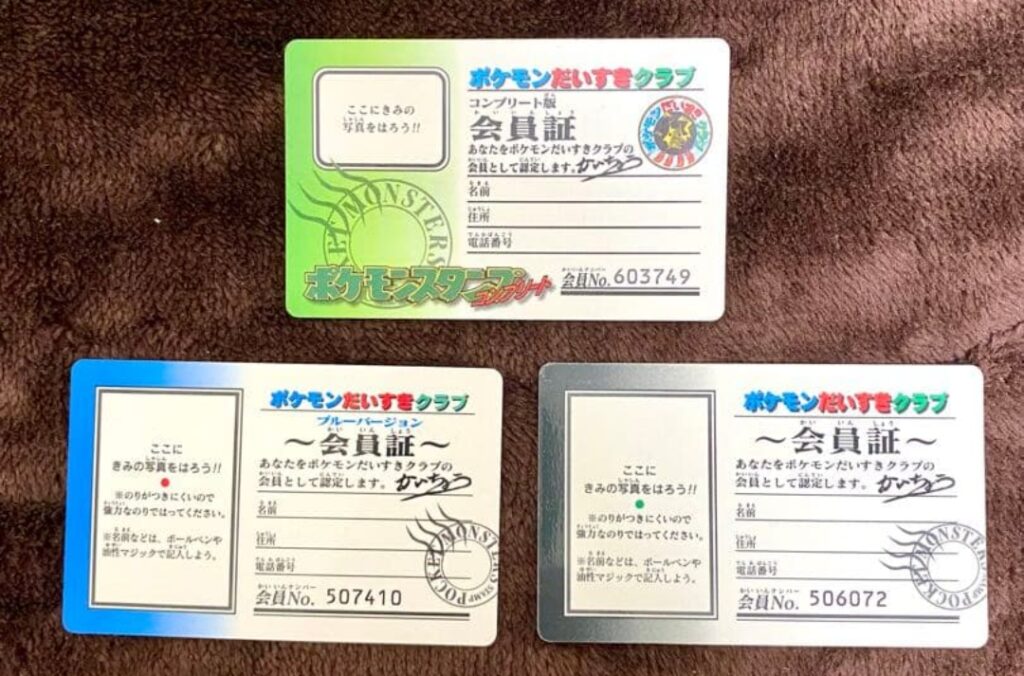
Original, Blue and Complete Campaign Member Cards. Note their ID numbers.
Why is all this important? By studying the ID numbers on surviving Member Cards, we have – after the fortuitous Pikachu sheets – our second proxy to measure the broad popularity of Shogakukan’s Pokéstamp campaigns. You see, we believe that all four types of Member Cards were numbered sequentially. Which is to say, we think that any campaign’s first successful Club Mark submission received ID# 000001, the second ID# 000002, and so on. Similar to the Pikachu sheets above, this gives us a sense of the participation and completion rate amongst GSLM readers. And boy, do these TID numbers run high – in excess of 600.000 for the Complete Campaign (603749, to be exact). This figure had seemed entirely implausible until it transpired that GSLM’s monthly circulation had actually pushed, perhaps even exceeded, two million during the three consecutive campaigns of 1997-8. Is a completion rate of some ~30%, then, realistic? The jury is still out. In any case, by 2003 Pokéstamp enthusiasm had cooled considerably as Ruby & Sapphire failed to reignite the spark of the 1990s, with TIDs running only in the tens of thousands (highest known TID is 12837).
Moving on. We quite regularly encounter a white-bearded granddad donning a fedora and sunglasses in Pokéstamp related materials. This old fella is the Pokémon Fan Club Chairman, or Kaichou. This club, better known as the Daisuki Club, wasn’t real – at least not yet. You may remember RGBY’s Vermilion City Fan Club Chairman who raves endlessly about his prized Rapidash. Shogakukan’s goofy pensioner was the physical manifestation of the Chairman in the videogames, ie. the real-world counterpart to his digital gestalt at the head of the fictitious club. His persona “supervised” every Shogakukan stamp campaign, practically becoming a household name in the process. He even got his own “Pokéstamp Hobby” manga serialisation in GSLM from December 1997 onwards. I know it’s convoluted and absurd. But it worked. So much so, in fact, that thousands of adoring young Poké-philatelists lined up to have their pictures taken with him at an official Pokéstamp event part of June 1997’s World Hobby Fair. Pokémon Wonderland Vol.1 contains the evidence: It’s full of such photos. (Incidentally, Wonderland‘s stamp pages were put together by K. Hidenori, who cosplayed Ash in an official capacity at the same event.)5See tweets here and here and here. An icon and juggernaut of early Pokéculture, the Chairman was ubiquitous in the late 1990s – he even appeared in the Adventures manga! (More on the Chairman in the Stamp Absol article.)
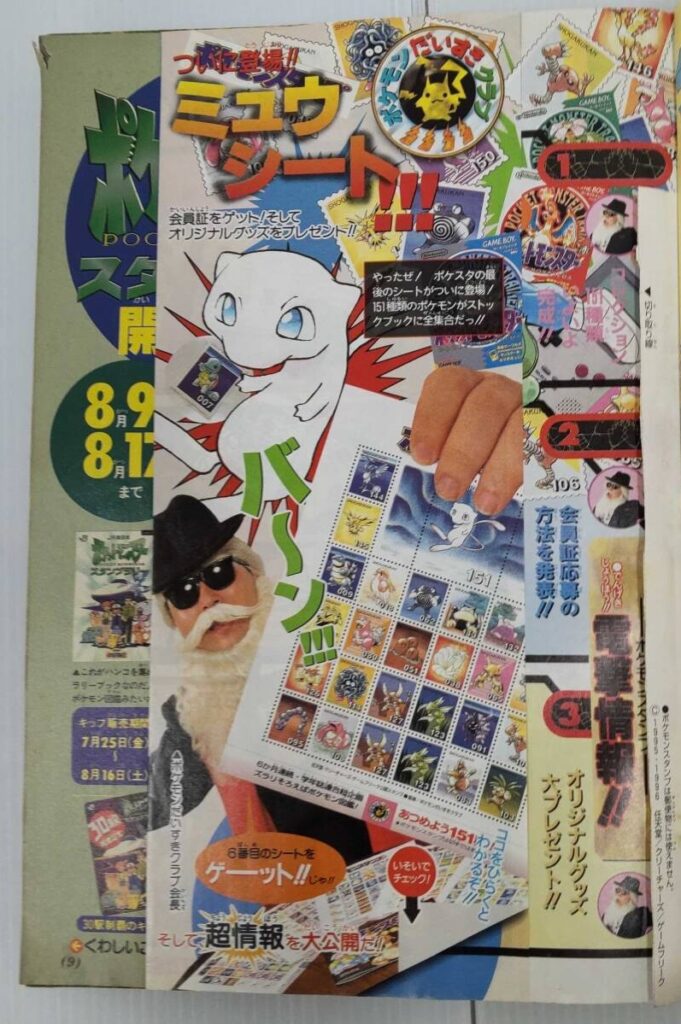
The Chairman sells the audience on the OG Campaign’s Mew sheet. GSLM September 1997, Year 4.
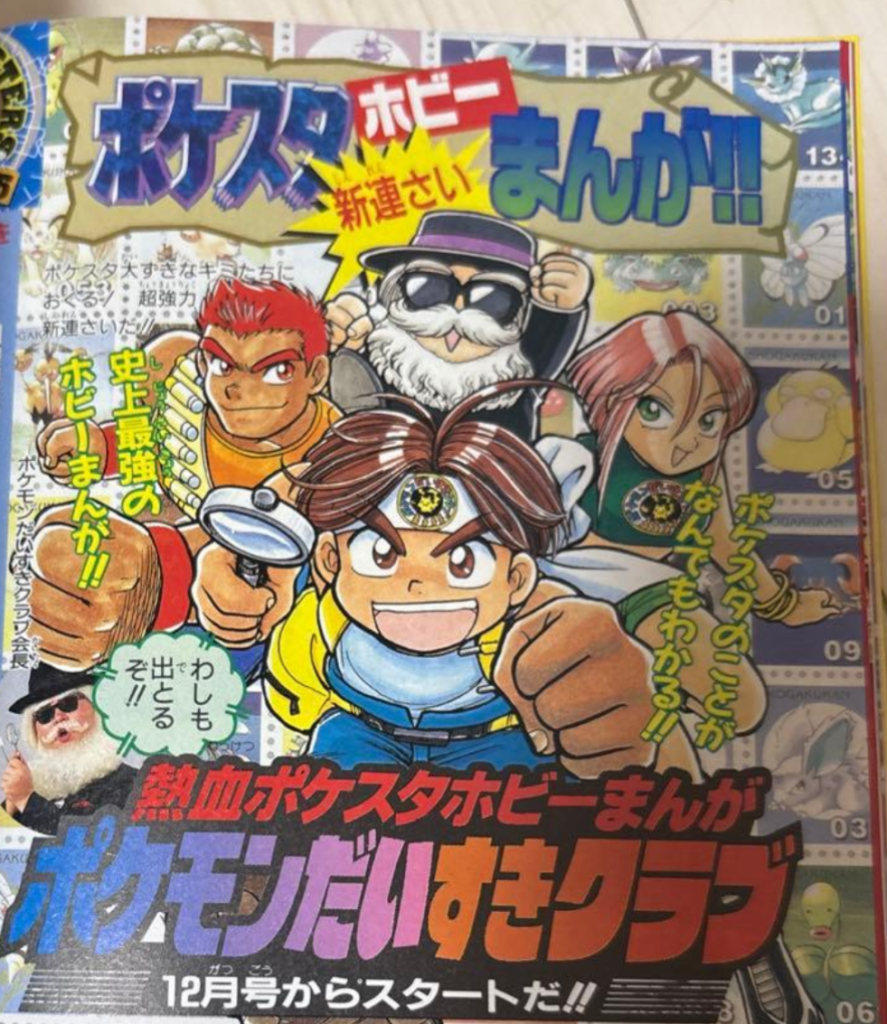
Are you ready for the Pokéstamp Hobby manga? Coming December 1997! Source is GSLM November 1997, Year 2.
Finally, a few technical notes. First, regarding stockbooks: it was customary to release these one month into a campaign, ie. with a campaign’s second GSLM issue. Second, as is the rule with Shogakukan publications, GSLM’s street date ran ahead of the nominal magazine date. In an example, the giant “4” on April 1997’s Year 1-6 GSLM magazine covers notwithstanding, the Original Campaign had technically begun in early March 1997 when the relevant magazines landed on store shelves (official publication date April 1, 1997). But, in order to keep things simple in the face of potentially variable and shifting shelf dates, we go by Shogakukan’s own numbering system. To complete our example, we take the Original Campaign to have spanned April – September 1997. Lastly: Bulbapedia – I love what you do, but kindly remember that copying equals plagiarism. Cite and credit your sources.
All that out of the way, let’s get stuck in, starting with the Original Campaign.
NAVIGATION:
> Original Campaign
