
Stadium, November 1998 – April 1999 (5+1 sheets)
In August 1998, Nintendo of Japan released Pocket Monsters Stadium for Nintendo 64. It heralded a giant leap forward: For the first time, three-dimensional models replaced sprites to have creatures duke it out in equally multidimensional arenas.1A feat famously made possible by future Nintendo president Satoru Iwata reverse-engineering, then porting the Red & Green battle system in the record space of just one week. Revolutionary though this was, Stadium only supported 40 of Kanto’s 151 Pokémon for use in gameplay, the remainder intended to have been unlocked through the abortive 64DD add-on. Unsurprisingly, then, this limited pool of Pokémon gave Stadium 1 the trappings of a glorified tech demo, and as a result the oddball, rough-and-ready title was quickly superseded by the much completer and more fondly remembered Stadium 2 in April 1999.2Simply known as “Pokémon Stadium” in the West. Puh.
Still, as the first ever Colosseum-style Pokémon brawler, Stadium 1 made a considerable splash in Japan. It’s hard to imagine now, but to a generation of Pokéfans, watching their favourite creatures animate attacks in three dimensions was an “overwhelming”, even formative moment.3See also this retrospective on Famitsu: https://web.archive.org/web/20250123013618/https://www.famitsu.com/article/202408/12478 Quite understandably, Stadium 1’s groundbreaking novelty made the game an attractive target for publishing house Shogakukan to latch onto and anchor yet another of its beloved Pokéstamp campaigns. So naturally, they did.
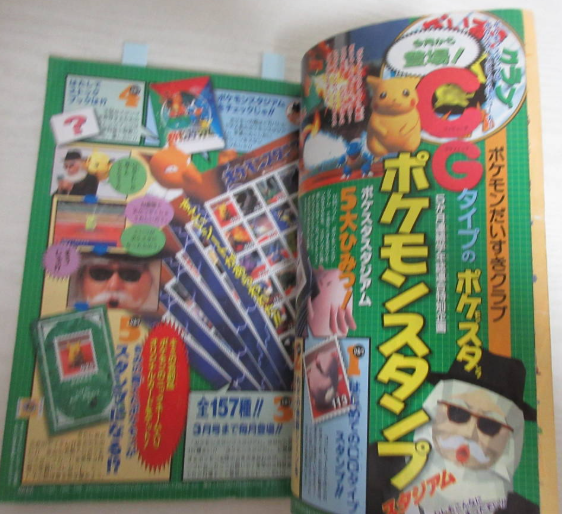
A somewhat blurry Kaichou breaks down the Stadium Campaign in GSLM November 1998, Year 3.
PokéStamps Go CG
Like in prior stamp drives, Shogakukan’s Grade-Specific Learning Magazines (GSLM) would host this fourth iteration. And when the campaign kicked off in GSLM November 1998, it predictably fell to the goofy persona of the Fan Club Chairman, or Kaichou, to announce the Pokéstamp Stadium series and act as its figurehead.4For the first time since the launch of the Original Campaign way back in April 1997, GSLM readers had been given a one month stamp-breather: Complete wrapped up in September 1998, and October 1998 only carried a non-campaign FlySurf Pika sheet. The result was a verdant two-page spread in, among others, GSLM November 1998, Year 3 that, supervised by an endearingly polygonal rendition of the Kaichou, touted a genuine innovation. This newest campaign wasn’t to repeat the done-to-death, slightly dull Pokédex-like portrait stamps that had characterised the Original, Blue and – to a degree – Complete campaigns. No sir. Stadium was to revolve around novel videogamey “CG Type” Pokéstamps.Specifically, this go-around bumped up the stampage to a whopping four uniques per Pokémon: Three high-octane snaps to showcase any particular Pokémon’s three (of its four) standard Stadium moves in the game’s battle mode, plus one trusty full-body shot thematically capped in Stadium during a lull in the action. Take Charizard, who was depicted using Fire Spin, Swords Dance, and Flamethrower. Or Snorlax, portrayed using Amnesia (flat on its back with question marks overhead) Rest (snoozing), and Headbutt (in-your-face close, Prime-style). In this manner, Stadium expanded on Complete’s Story Series groundwork to deliver an array of even more dynamic, character-rich Pokéstamps that were exciting not merely to ogle, but also for what they implied (play N64’s Pokemon Stadium, it’s fantastic!). Nintendo must’ve been pleased.
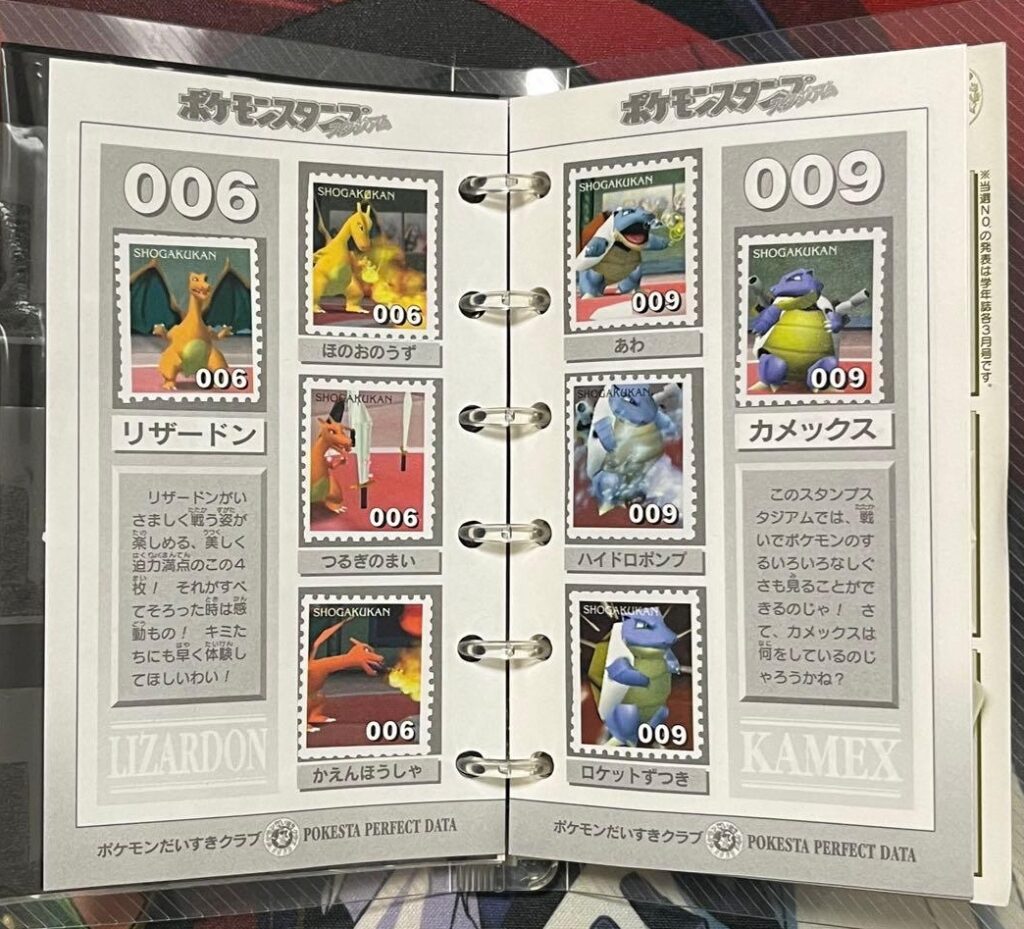
Complete quartets of Charizard and Blastoise stamps pasted into Stadium’s “stampbook”. Blastoise is shown using Bubble, Hydro Pump, and Skull Bash respectively.
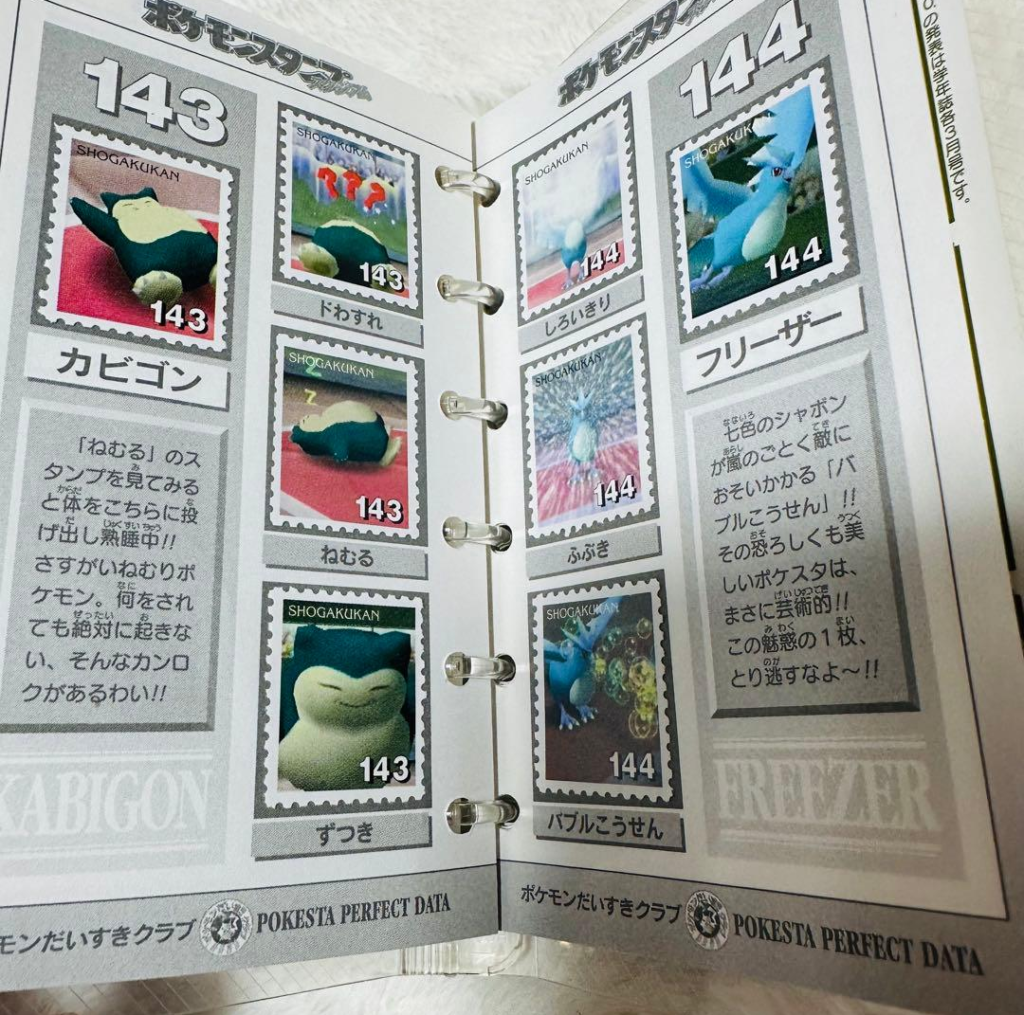
Snorlax and Articuno stamp sets (the latter shown using Mist, Blizzard, and Bubble Beam).
Stadium’s stamp sheets looked a little different too, their format returning to a compact 6×6 grid from Complete’s 10×6. As divulged per the “5 big secrets” in the aforementioned GSLM November 1998 issue, there were to be 157 total Stadium stamps. A number which, you’ll gather, perfectly equals all of Stadium 1’s 40 Pokémon multiplied by four, minus three (for Ditto only received a portrait stamp). In turn, these 157 stamps (plus duplicates) were divided up between five main sheets, which we’ll christen the Pikachu, Scyther, Electrode, Pinsir and Cloyster sheets after the namesake stamp positioned in the top-left corner of each.
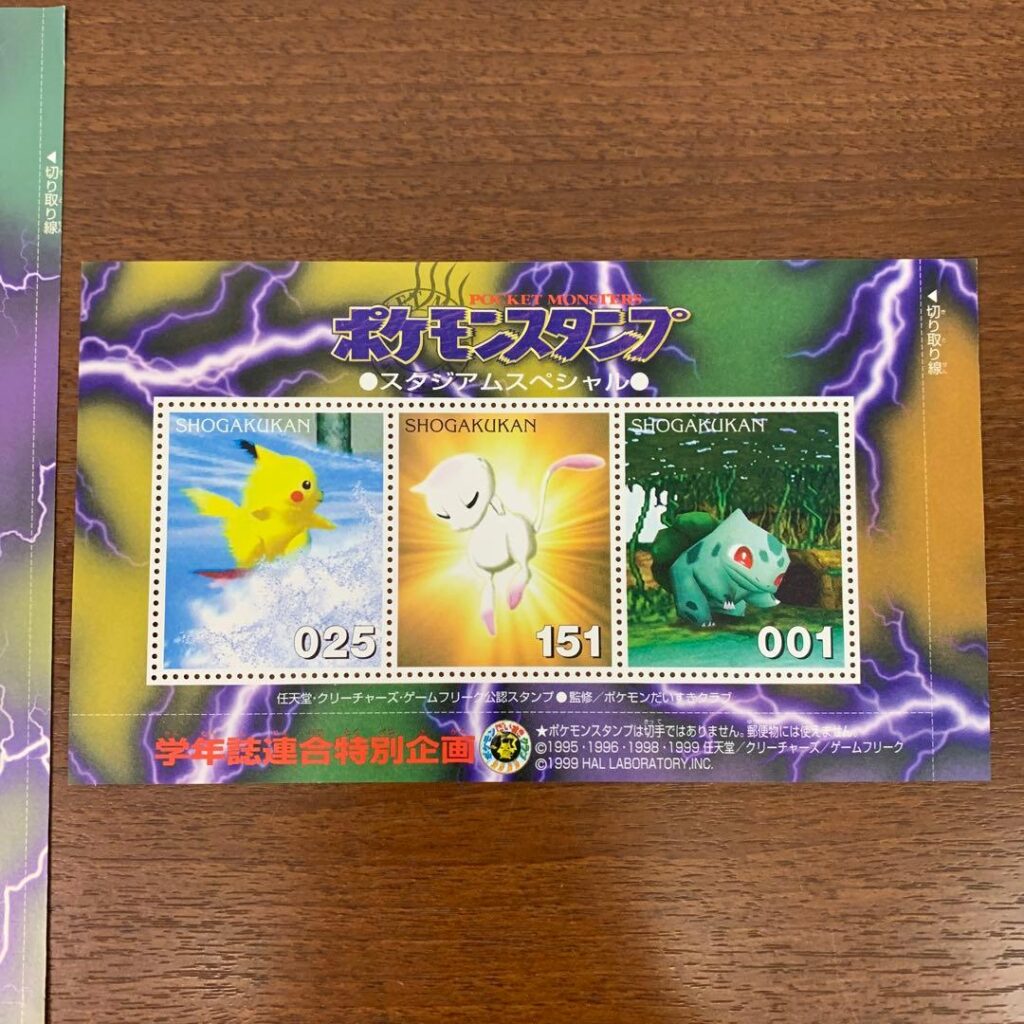
Together these sheets appeared as inserts in five consecutive GSLM issues between November 1998 and March 1999 in Years 1-6 as well as Learning Kindergarten. All were moreover outfitted with the familiar cutout “Club Marks” in varying colours that players could collect and submit to Shogakukan in exchange for (potential) prizes (see below). Finally, as was tradition, the campaign concluded with a “secret” Mew sheet in April 1999 that, besides a large portrait of Mew, also included an equally big Surfing Pikachu and a giddy, dashing Bulbasaur.5For whatever reason, Mew seemingly wasn’t included in issues of April 1999’s Learning Kindergarten. As one might expect, the Stadium stockbook had room to accommodate these “secret” stamps on “special” pages, bringing the campaign’s actual unique stamp total to 160.
Stadium Rotation - ©PokemonHistorian.com
| NOV | DEC | JAN | FEB | MAR | APR | |
|---|---|---|---|---|---|---|
| L KG | S | E | Pn | P | C | M |
| YR1 | E | Pn? | P | S? | C | M |
| YR2 | Pn? | P | S | E? | C | M |
| YR3 | P | S | E | Pn | C | M |
| YR4 | S? | E | Pn | P? | C | M |
| YR5 | P | S | E | Pn | C | M |
| YR6 | Pn? | P | S | E? | C | M |
Shortcodes are Pikachu (P), Pinsir (Pn), Electrode (E), Scyther (S), Cloyster (C), and Mew (M).
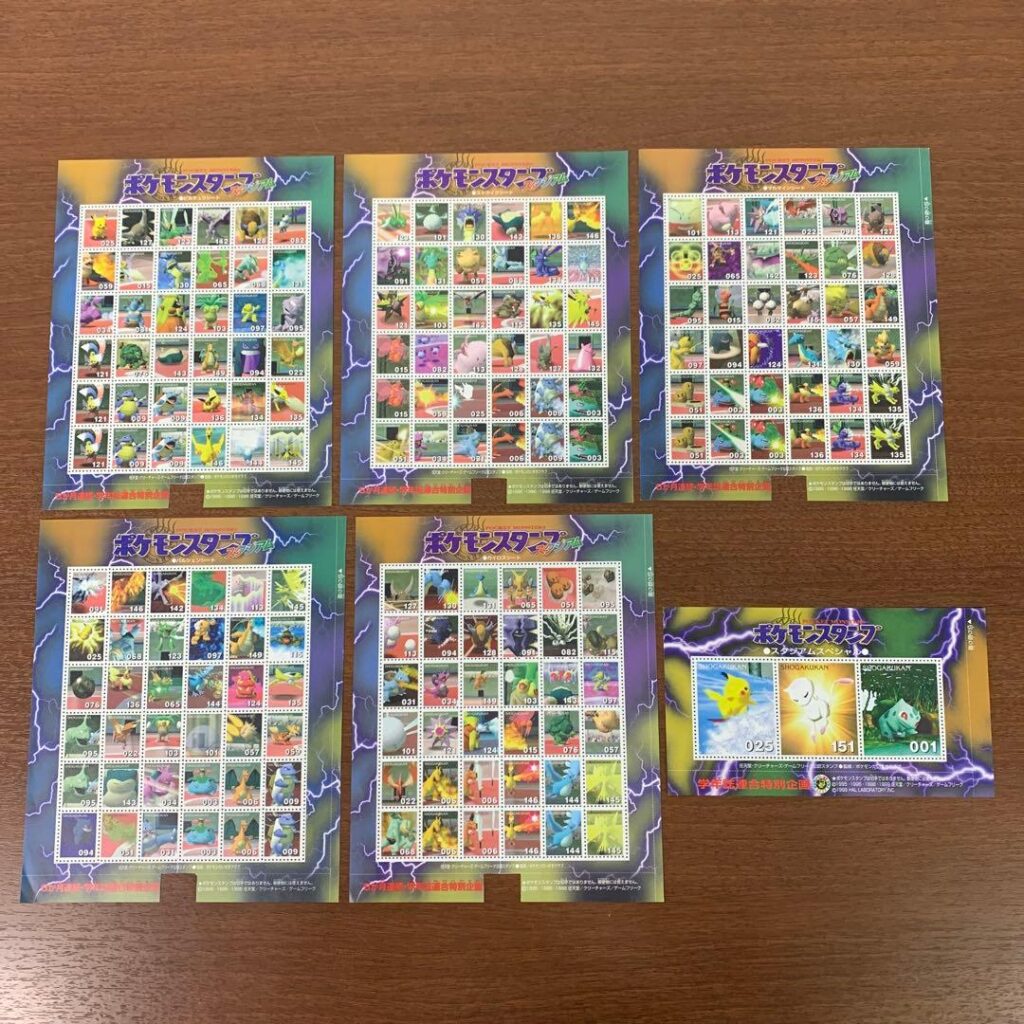
All 5+1 Stadium sheets. Note how the Club Marks are missing – evidently, the sheets’ original owner submitted for a Trainer Card.
Stadium’s Stockbook DX
Ah, the stockbook. Or rather, the ultra premium Stockbook DX. A visual and informational upgrade over Complete‘s flipbook, DX’s engaging presentation of Stadium’s action-stamps, the inclusion of historic Pokéstamp metadata, and its vertically-oriented, pocket-size, ring-bound form factor all combined to give it a lovely encyclopedic character. In terms of design quality, DX blew the floppy booklets before it out of the water. So let’s study it some.First, DX’s Stadium portions. As we saw above, the stockbook grouped together each Kanto Pokémon’s four stamps on a dedicated page to make for what I can only describe as “microgalleries of battle prowess”. In turn, each of these 20-some double-sided pages also contained eloquent flavourtext that hyped up the specific Pokémon and its stamp designs while overtly marketing the N64 Stadium videogame. Take Charizard, whose description read:
“Enjoy watching Charizard battle with unmatched grandeur in these four stunning, breathtaking stamps! When you have them all, it’s truly impressive! I hope you will experience it soon too!”6「リザードンがいさすがにさましく戦う姿が楽しめる、 美しく迫力満点のこの4枚! それがすべてそろった時は感動もの! キミたちにも早く体験してほしいわい!」
Or Articuno, whose blurb stated:
“A storm of colorful bubbles engulfs the screen through Bubble Beam! This terrifying yet beautiful PokéStamp is pure artistry! Don’t miss out on this mesmerizing shot!”7「色のシャボンが嵐のごとく蔽におそいかかる「バブルこうせん」!! その恐ろしくも美しいポケスタは、まさに芸術的!! この魅惑の1枚、とり逃すなよ〜!!」
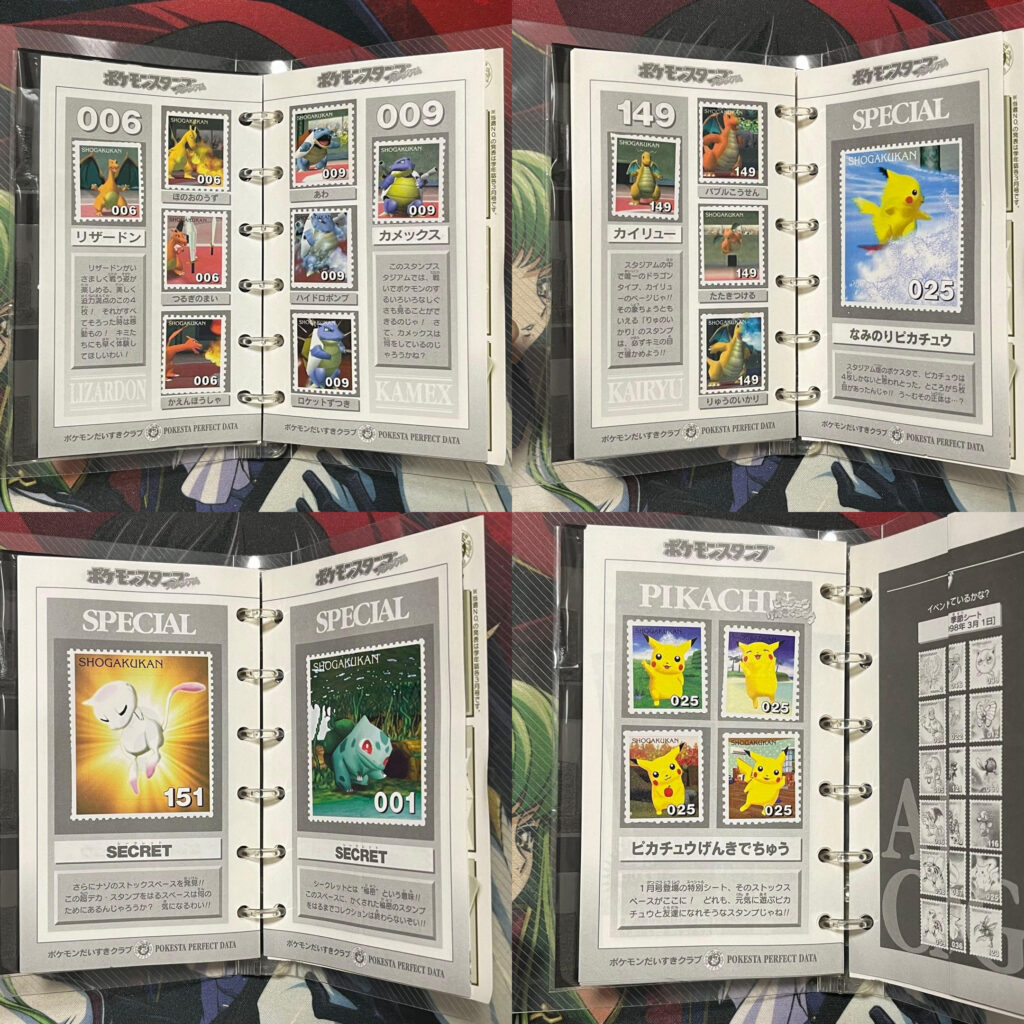
Selection of completed pages from the Stadium Campaign’s stock book.
I have to admit, if there’s any single campaign’s stockbook I’d like to own, it’d be Stadium’s. There’s just something viscerally impressive about it. Even across space and time, one can sense that this Stadium compendium succeeded in replicating the wow-factor of trawling a 3D Pokédex without, of course, actually subjecting fans to the gruesome slog of completing a Pokédex. If I had to draw a comparison, I would imagine that the giant animatronic Pokédex at the erstwhile PC New York gave fans a similar sense of wonder. No mean feat for a stamp collection to even invite the comparison!
In any case, stockbook DX did much more than to tickle imaginations, for it also stimulated the collector brain by including a veritable treasure trove of Pokéstamp metadata. In what was labelled “PokeSta Perfect Data”, DX’s supplementary pages chronicled – it would seem – every Pokémon stamp sheet released up to that point by providing sheet name, release date, and grayscale sample illustrations. Not since Pokémon Wonderland 1997 its “PokeSta Perfect History” and “All Sheets Collection” had any specific source attempted to exhaustively document the myriad primary and auxiliary PokéStamp sheets that came out willy-nilly throughout the late 1990s.8Pokémon Wonderland Vol 1, released August 1997, had provided historical stamp data through to October 1997. A collection checklist was included in the back. And lastly, the ring-bound Stadium album stated an intention to stay relevant and future-proof, noting how “future events” were to come with addable stock pages. Whether this promise of expandability was borne out in practice, however, I’m not sure – I’ve never seen any bundles of post-1999 pages for the stockbook DX appear on online marketplaces, and Y2K’s Gold & Silver Campaign moreover sported its very own flimsy, classic-style stockbook. Occam’s Razor says that Shogakukan did not support DX for very long, if at all.
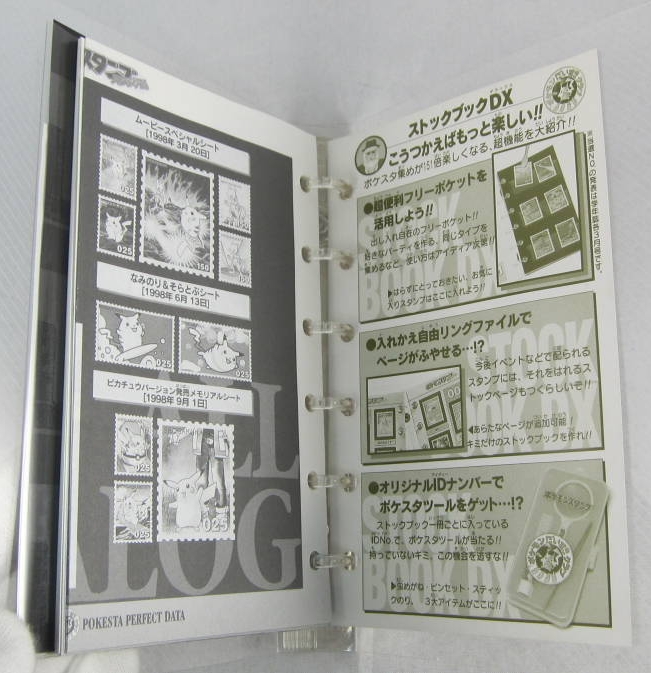
A page of PokeSta Perfect Data (left) showing FlySurf Pikachu, among others. Prize information for tweezers, stick glue and a magnifying glass is on the right.
How, then, were collectors to acquire this special Stadium album? In contrast to the original three Shogakukan stamp campaigns, Stadium’s exquisite stockbook was not tied in with any specific GSLM issue. Rather, it appears that GSLM December 1998 offered stamp collectors the option to purchase a copy as a “service” (サービス). This set it apart from previous stockbooks, which had come as free-of-charge “gifts” (プレセント) in any given campaign’s second GSLM issue. Incidentally, this makes the presumed sequential numbering of Stadium stockbooks an unreliable indicator of overall interest and participation in the Stadium campaign, but more on that later.
Interestingly, the most junior GSLM magazine to participate in the campaign – Learning Kindergarten – offered a lightweight alternative to the stockbook DX: a “Pokémon Encyclopedia of Eternal Stars”. Best identified, less gloriously, as two collection posters.9Learning Kindergarten December 1998 and January 1999 appear to have included these particular posters. See audiovisual section for images. Their primary purpose was much the same as the stockbook DX – to paste all of Stadium’s stamps and marvel at the complete collection – but came bereft of the complex additional information that, quite possibly, might be off-putting to the youngest of participants. This way, the Stadium Campaign was kept accessible for all ages despite a more mature bent. Or so was the idea, anyway.
Premium Prizes
The stream of goodies didn’t stop there, for additional rewards came in two tiers. First, the everyman’s prize. By collecting each of Stadium’s unique sheets and affixing the campaign’s five brightly coloured Club Marks to a pre-prepared postcard to be mailed out by March 2, 1999, participants guaranteed themselves a Trainer Card (TC). And not just any piece of plastic: This was to be a bespoke TC reflective of the applicant’s wishes. How, you ask? As the Fan Club Chairman explained in GSLM March 1999, Shogakukan’s submission paperwork had readers pick their “Stadium favourite” species out of the videogame’s 151, think up a nickname for said Pokémon, determine its level (1-100), and put down a preferred trainer name. (Nothing inappropriate, please!) All of these data points would subsequently appear on the reader’s personal Trainer Card beneath a stampified mugshot of their chosen Pokémon. Cool, huh!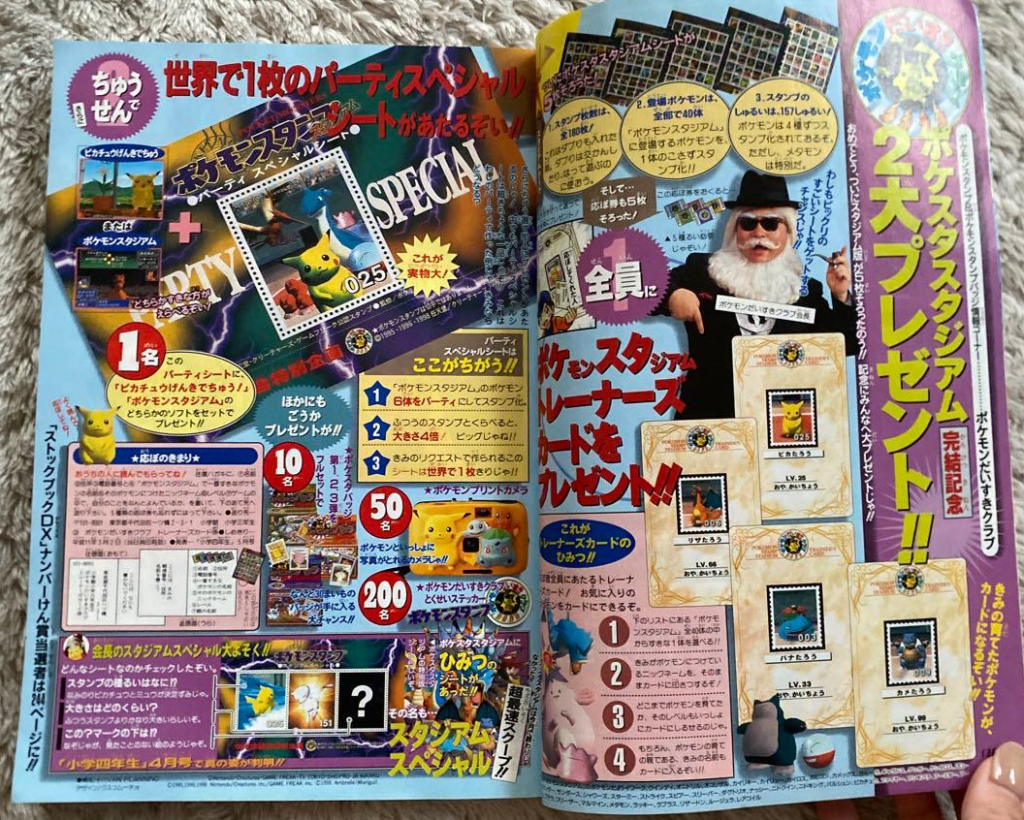
The Kaichou presents: Custom Trainer Cards and a cornucopia of prizes. GSLM March 1999, Year 3.
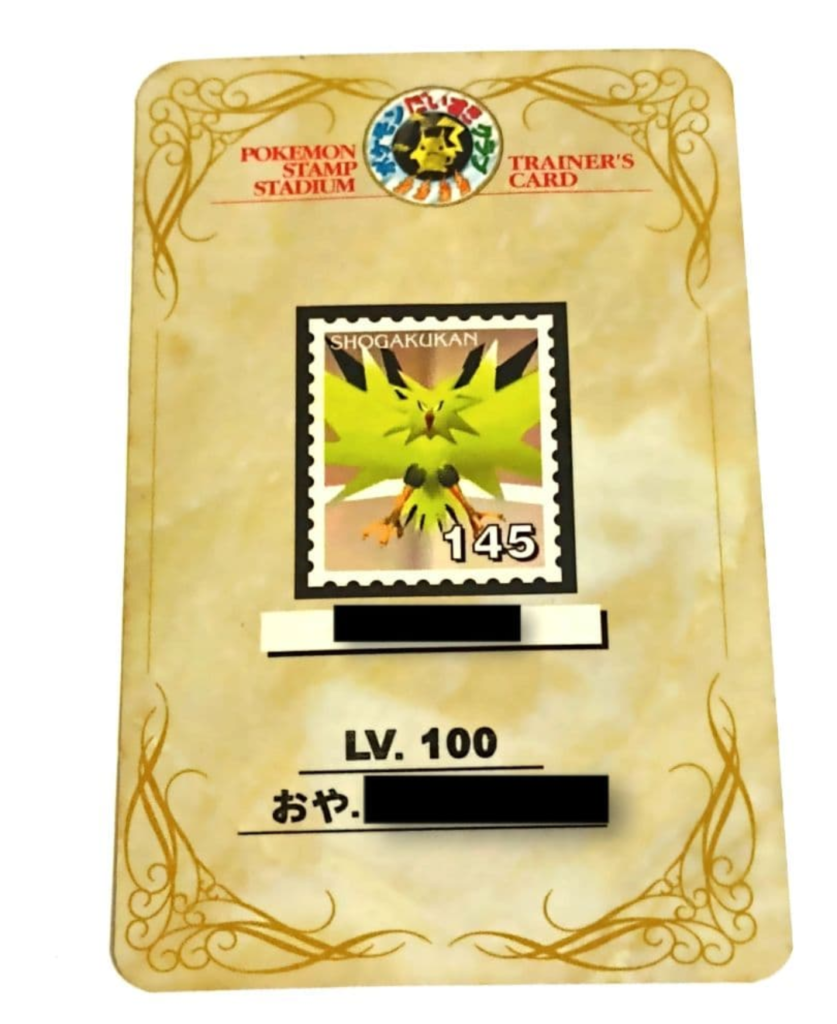
Zapdos Stadium Trainer Card.
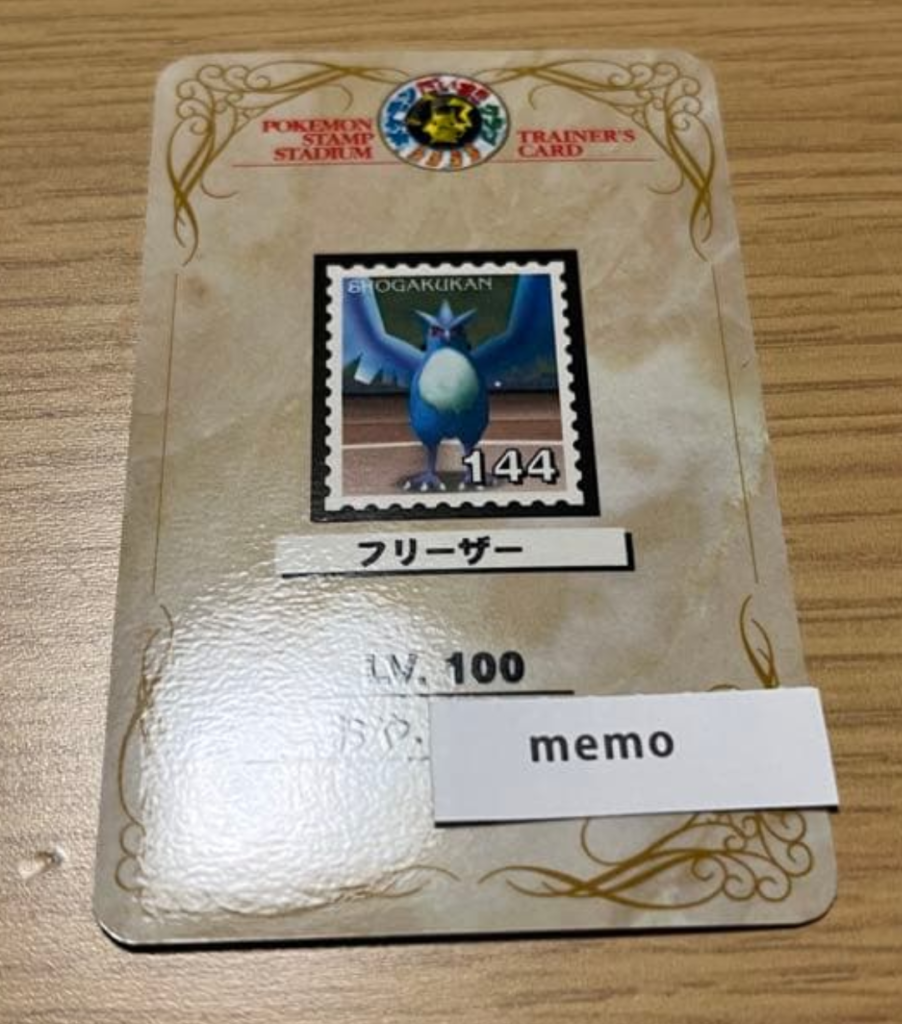
Articuno Trainer Card
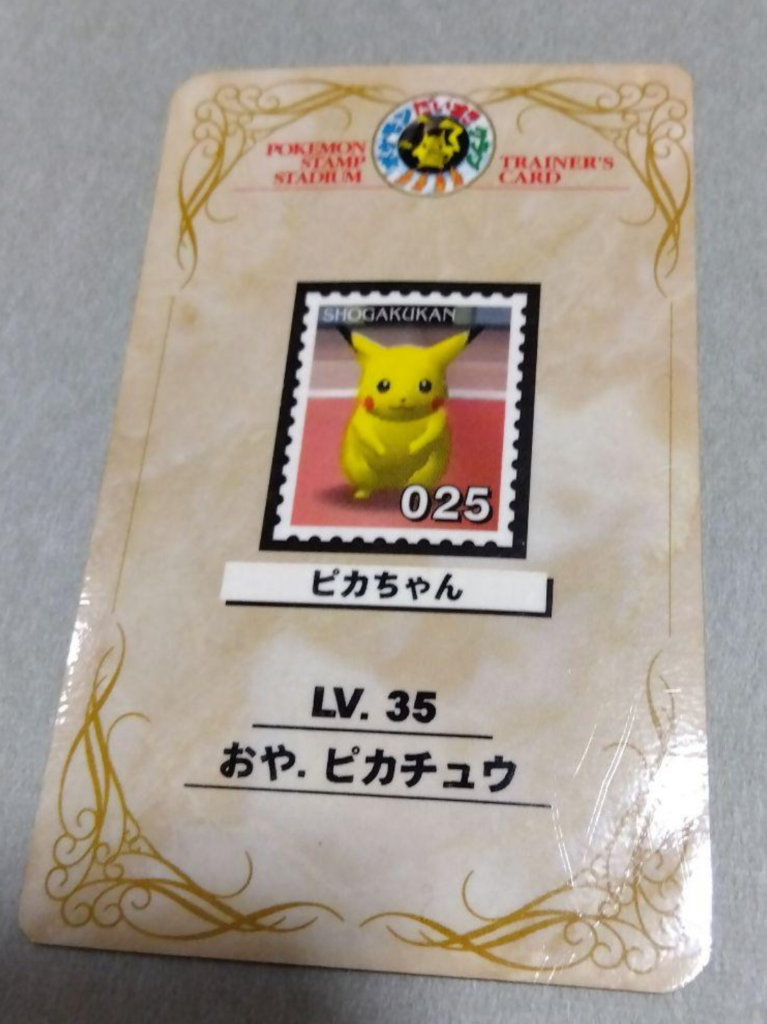
Stadium Trainer’s Card ft. “Pika-chan”.
For whatever reason, surviving examples of these cards aren’t many. In fact, I’ve seen only three: a Lv.100 Zapdos with all of its identifiers blurred out, a nickname-less Lv.100 Articuno with its trainer name similarly censored, and a Lv.35 Pikachu that the applicant chose to endearingly nickname “Pika-chan”.10A nod, perhaps, to the then-recent release of N64’s Hey You Pikachu and inevitable commemorative stamp sheets that could, by the way, also be added to the stockbook DX. Cute. I can’t help but wonder whether GSLM’s youngsters, bug catchers and bird keepers showed Rattata, Caterpie and Pidgey any love. Do you reckon that between all applicants, a complete Stadium TC Kantodex was created? Maybe someday we’ll have enough samples to start a proper image gallery. In any case: In a break with the past, the back of these Trainer Cards was all purplish swirls without as much as a Kaichou portrait. Odd.
Equally unusual was the secondary bounty of Poké-goodies that consisted of some rather premium, even one of a kind items. To be sure, how exactly winners were selected – via raffle or otherwise – is presently unknown. It is apparent, however, that the lineup of prizes across all grade-years from Learning Kindergarten to Year 6 was as follows:
– Daisuki Club stickers (200 winners)
– Pokémon-themed instant camera (50 winners)
– Pokémon stamp badge series 1-3 full sets (10 winners)
And to top it all off, a grand prize… One copy – and one only – of what GSLM billed the Pokéstamp “Special Party Sheet” (パーティスペシャルシート). The kicker: The prize winner got to decide how exactly this stamp would look.
To potentially co-design and earn a tailor-made Pokéstamp was a remarkable prospect. Never again would Shogakukan offer to customise any stamp, sheet or booklet to a winner’s liking. Quite naturally, the publishing house understood the very large carrot it was dangling in front of passionate philatelists – your very own sheet! – and it fully attempted to get collectors’ senses tingling over this tremendous opportunity. GSLM March 1999, Year 3 for example pitched to readers why this 1/1 sheet was worth being excited about:
“Here’s what makes the Party Special Sheet so special!!
1. Create a party of six Pokémon from “Pokémon Stadium” and have it made into a stamp.
2. Compared to a regular stamp, it’s four times bigger—that’s huge!!
3. This sheet, created just for you, is the only one of its kind in the world!!”11パーティスペシャルシートはここがちがう!!
1「ポケモンスタジアム」のポケモン6体をパーティにしてスタンプ。
2 ふつうのスタンプとくらべると、 大きさ4倍/ ビッグじゃね!!
3 きみのリクエストで作られるこの シートは世界で1枚きりじゃ!!
A true one of one designed by, for, and of the winner… You’ve got to wonder if it’s still out there, somewhere. We may assume that Shogakukan contacted the lucky guy or gal personally to enquire what six ‘Mons should feature on the stamp. It’s an open question whether an image of the final product and / or the winner’s name was published in GSLM at all – perhaps in the magazine’s May 1999 issues. If not, then both the winner’s identity and the composition of the special sheet may forever be a mystery.
Overshooting the Mark
How well, then, did the Stadium Campaign do? Unfortunately, it’s difficult to judge. Our trusted methods are of no use here – I’ll explain. The five campaigns that bookended Stadium – from Original through Ruby & Sapphire – allow their popularity to be measured by Trainer Card proxy. That is to say, because each end-of-campaign applicant’s TC bears a unique, sequential six-digit number, we can make campaign-to-campaign comparisons of maximum ID# to get a sense of both the absolute and relative popularity of any given stamp drive. For example, Original’s highest known TID is 608018, which implies that at least six-hundred thousand GSLM readers successfully collected all of that campaign’s Club Marks. But since Stadium offered ultra-cool, TID-less custom Trainer Cards, this avenue of comparison runs dead.Can we make any determination at all, then? For Stadium, our sole popularity proxy is the unique ID number printed on the inside cover of each Stockbook DX. But you’ll sense the apples-to-oranges problem: Not only was Stadium’s stockbook a paid-for mail order item, it was also available to anyone who filled out the relevant forms and forked over cash. In other words, one could purchase DX and do precisely nothing with it, thus telling us more about the quality of Shogakukan’s advertising than persistent campaign participation rates. For the record, the highest known stockbook ID is #54833. Which, the attentive reader will note, is a more than tenfold decrease from the 600.000+ TIDs on record during the Complete Campaign (highest known: 603749). Did one in three participants purchase a mail order stockbook? One in five? One in 10? Or even one in 20? It’s anyone’s guess.
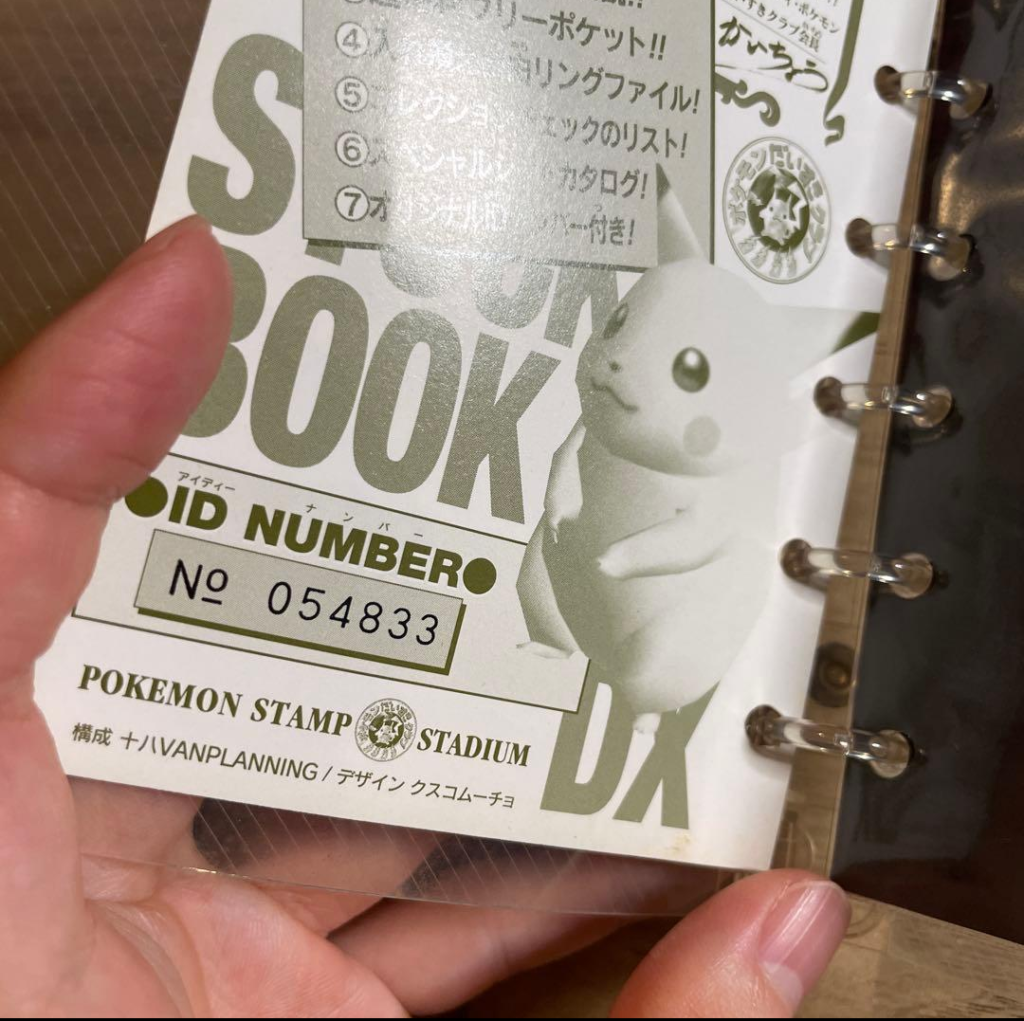
The Stadium stockbook highest ID No.: #54833.
Taking a broader view, I do consider it probable that some degree of Pokéstamp fatigue set in after two years of practically continuous campaigns. Not only that – my sense is that Stadium was a touch too arcane and inaccessible to the average young GSLM reader. Take the stockbook, which required an additional purchase and waiting time to acquire – insurmountable obstacles, quite possibly, for the average gradeschooler and their understandably limited attention span.12It should be noted that the stockbook DX was the gateway to even more, albeit minor, prizes. Successful applicants were automatically entered into a lottery to win a boxset containing a magnifying glass, flathead tweezers, and a PokeStamp-branded stick of glue. Geeky. While perfect for adult philatelists, the stockbook DX was arguably too intricate for young Pokéfans who simply wanted to haphazardly stick cool illustrations into booklets, not caring about meta-stamp information or even condition. (There’s a reason why so many Original, Blue and Complete stockbooks listed on digital marketplaces are unfinished yet rich in hastily applied sellotape.) Zeitgeist aside, early stamp campaigns found success thanks to a low barrier to entry that cast the widest possible net. Driven by a desire to innovate, Stadium somewhat overshot this mark: It delivered a cool-as-beans campaign, but in doing so lost sight of the need for simplicity to engage and captivate its core audience – schoolkids.
As such, it’s tempting to conclude that Stadium’s performance shook Shogakukan, for the campaign’s innovations notwithstanding, the publisher returned to a perhaps more tried and tested stamp format for the fifth campaign in the series: Gold & Silver. But first, let’s take a quick look at the mini-campaign that preceded it, ie. the mid-1999 Gold & Silver “Pre-Sheet” intermezzo.
NAVIGATION:
Complete Campaign < > GS”Pre-Sheet” Intermezzo
Audiovisual
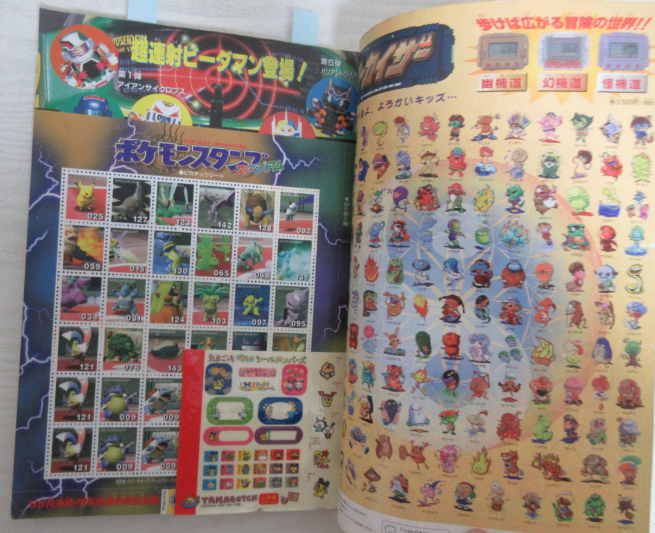
Pikachu Stadium sheet. GSLM November 1998, Year 3.
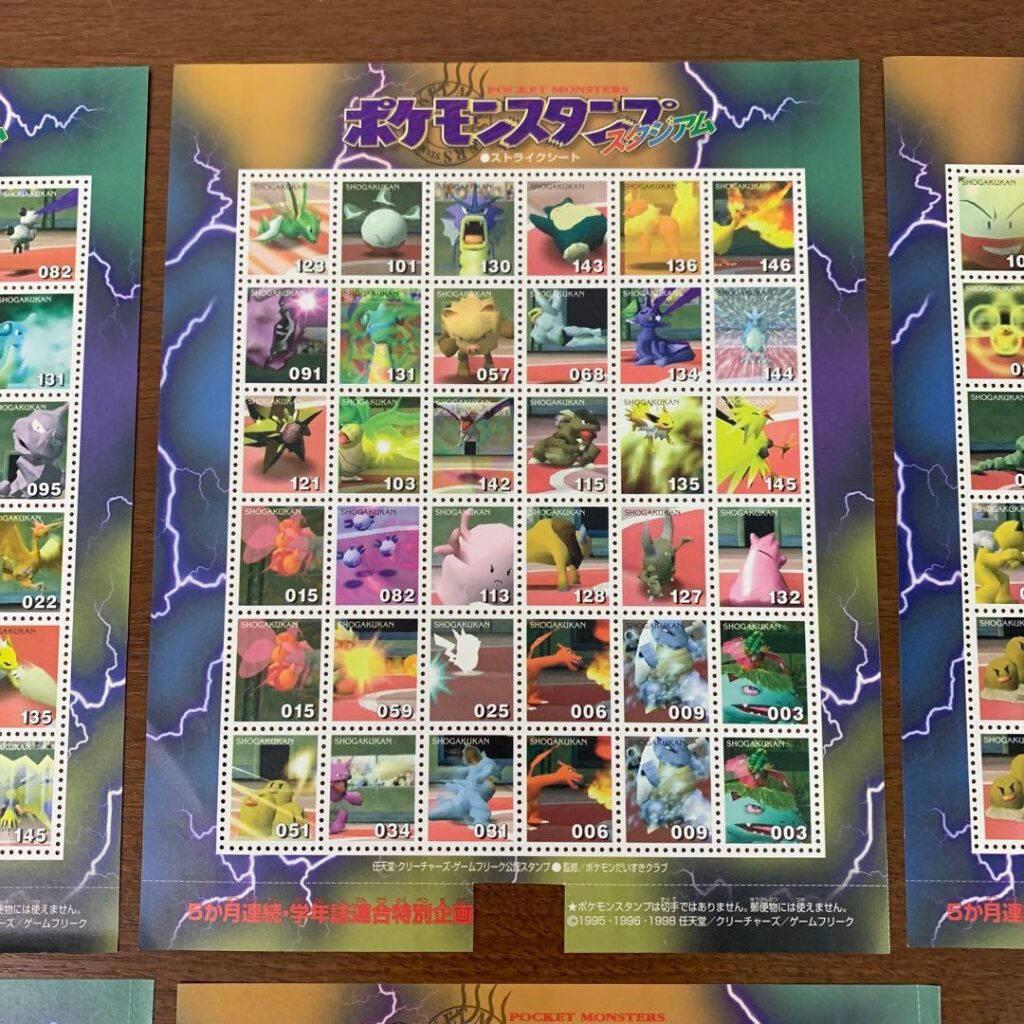
Stadium Scyther sheet.
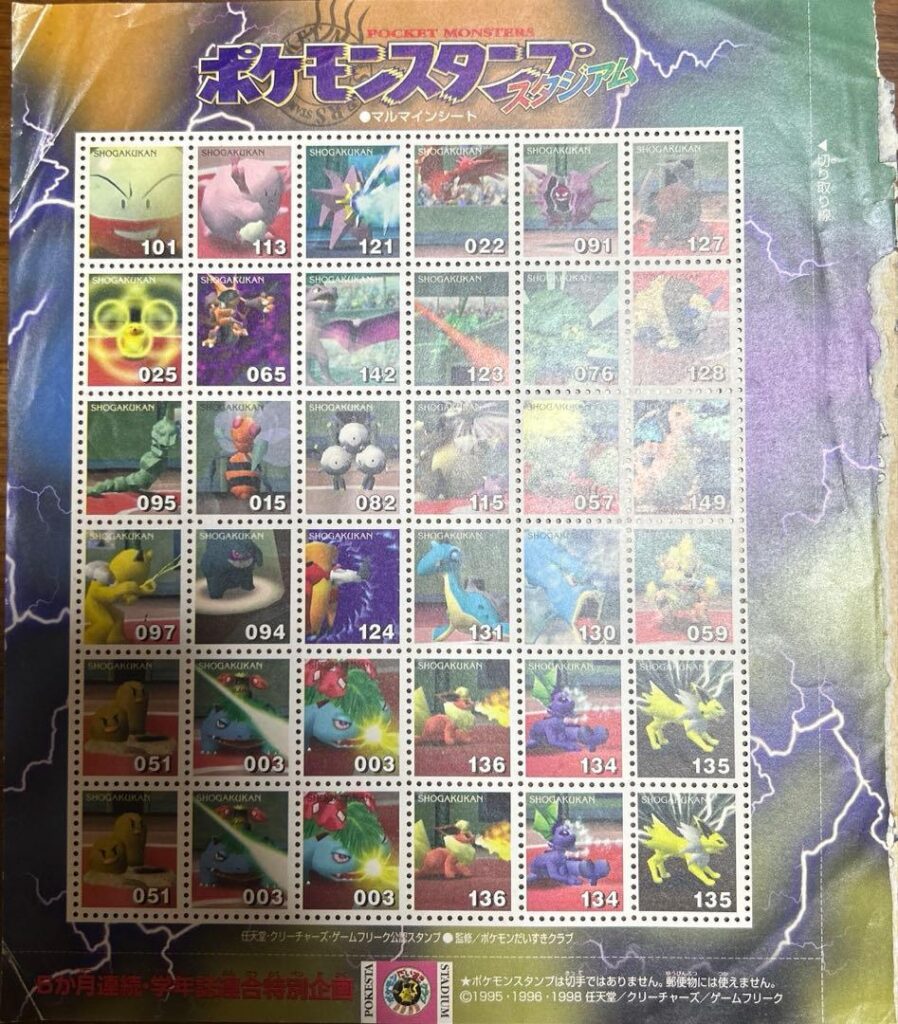
Stadium Electrode sheet.
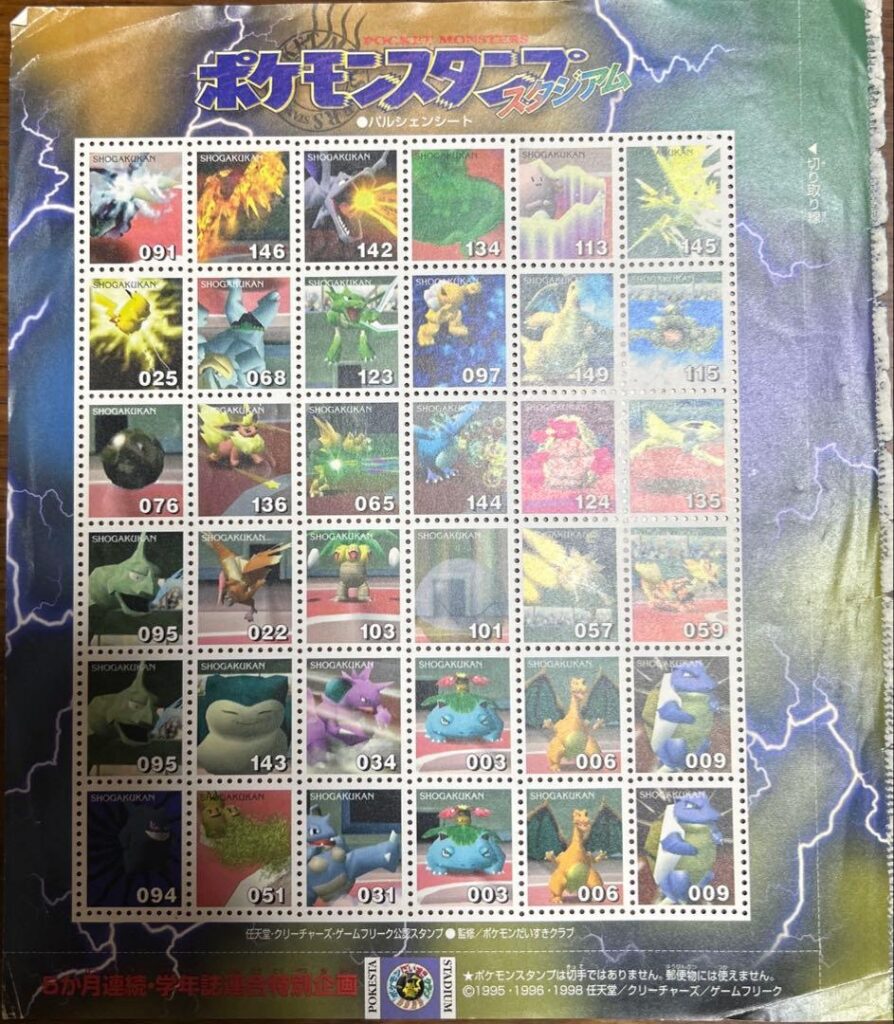
Stadium Magneton sheet.
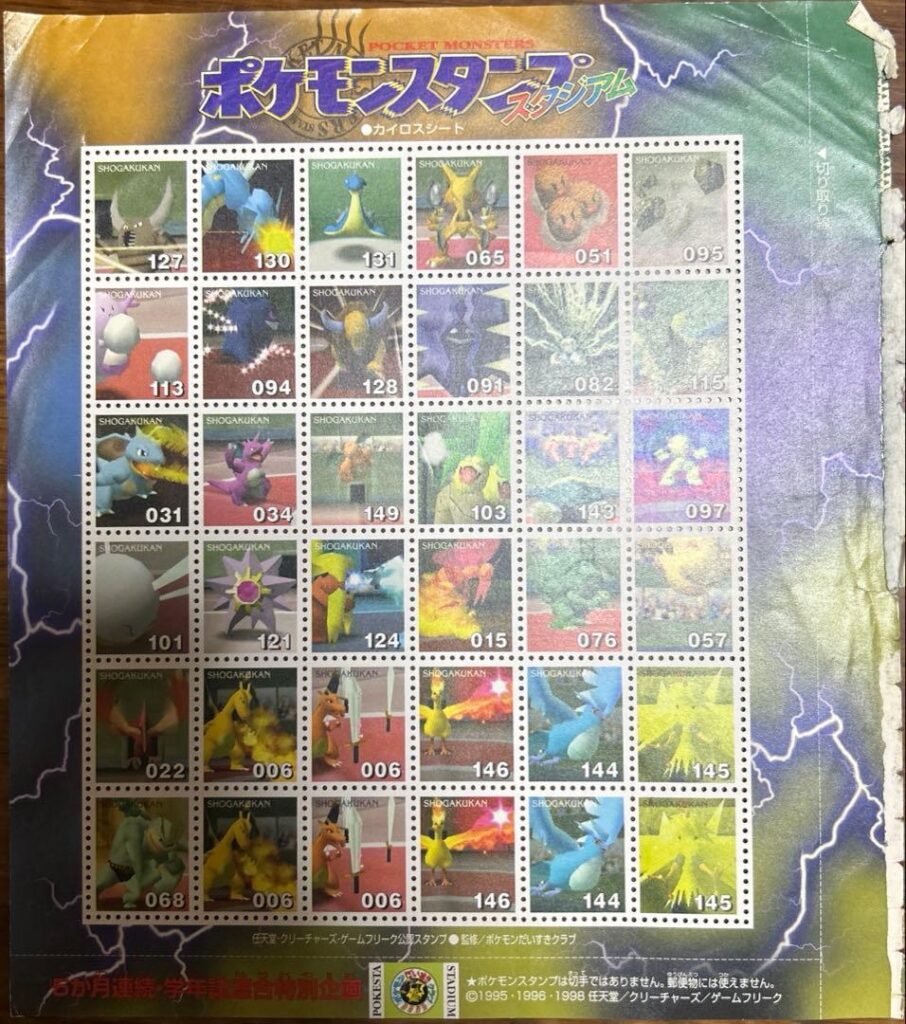
Stadium Pinsir sheet.
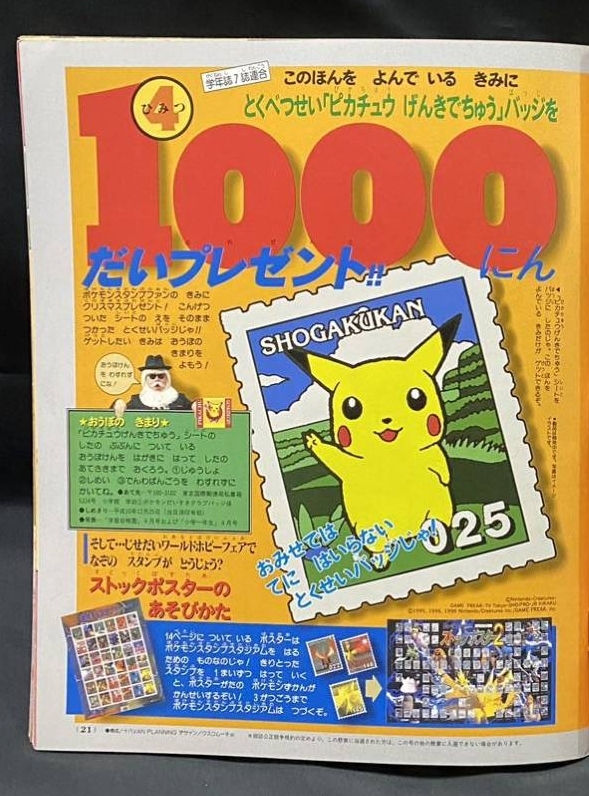
The Stadium “Stock Poster” is shown in the blue inset at the bottom. GSLM January 1999, Learning Kindergarten.
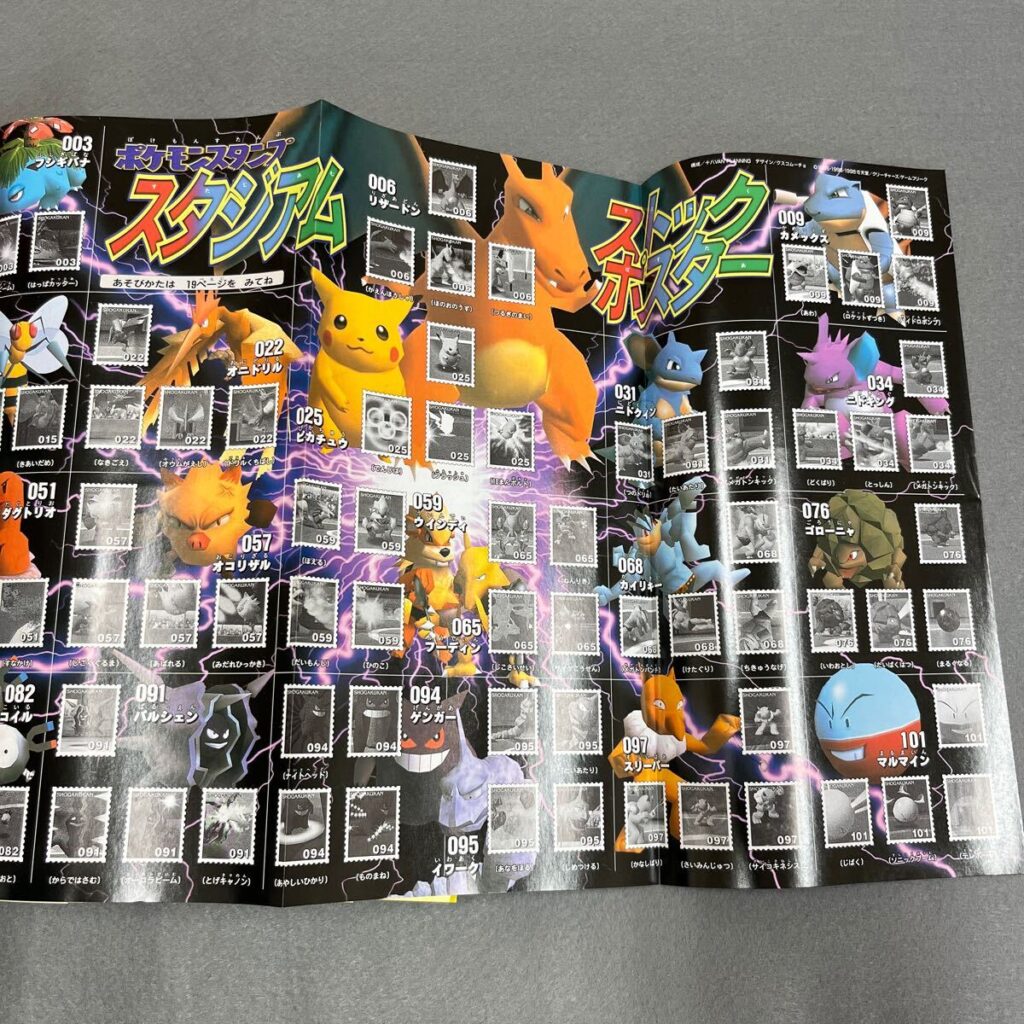
Stadium stock poster. GSLM December 1998, Learning Kindergarten.
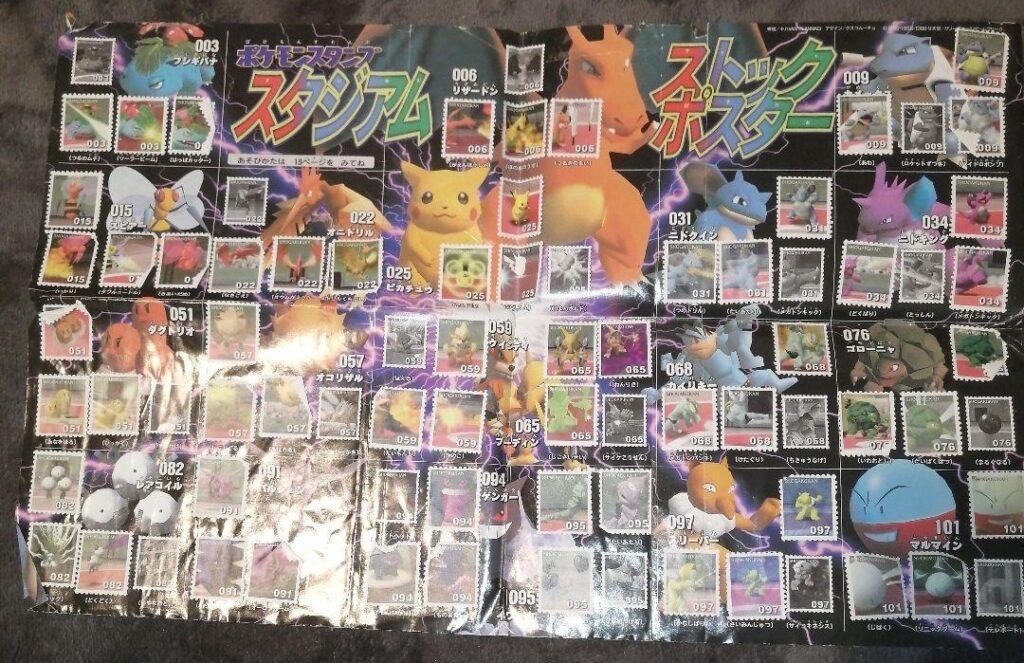
Completed Stadium stock poster #1.
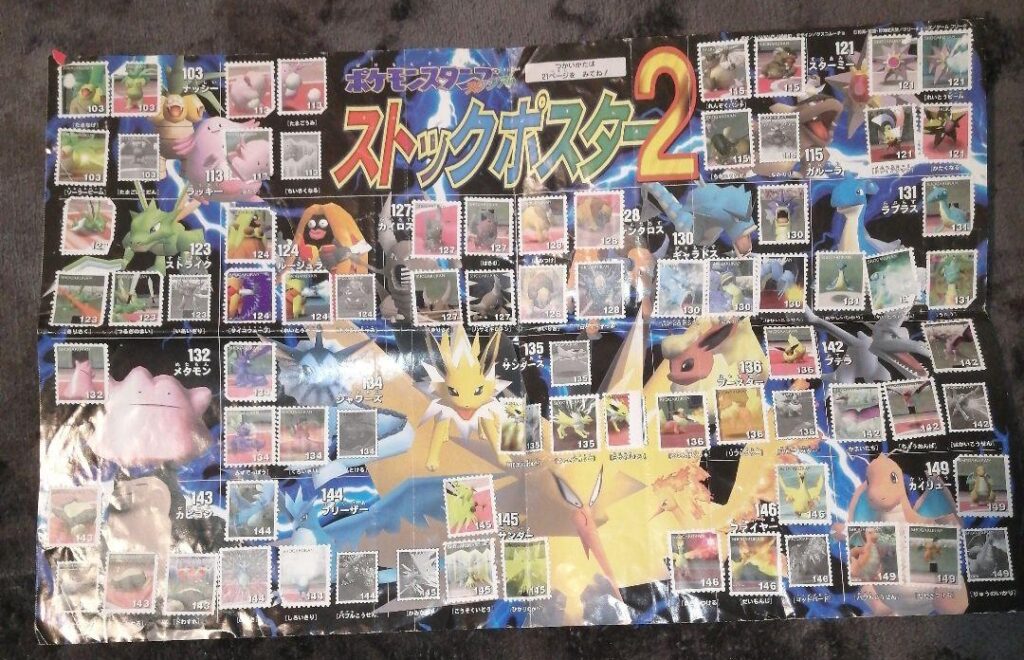
Completed Stadium stock poster #2.
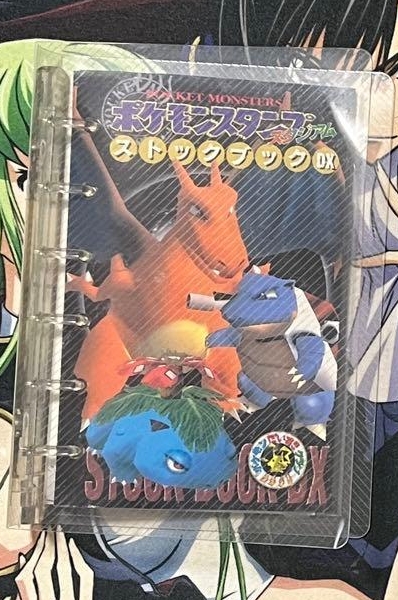
Stadium Campaign binder-form stock book, cover.
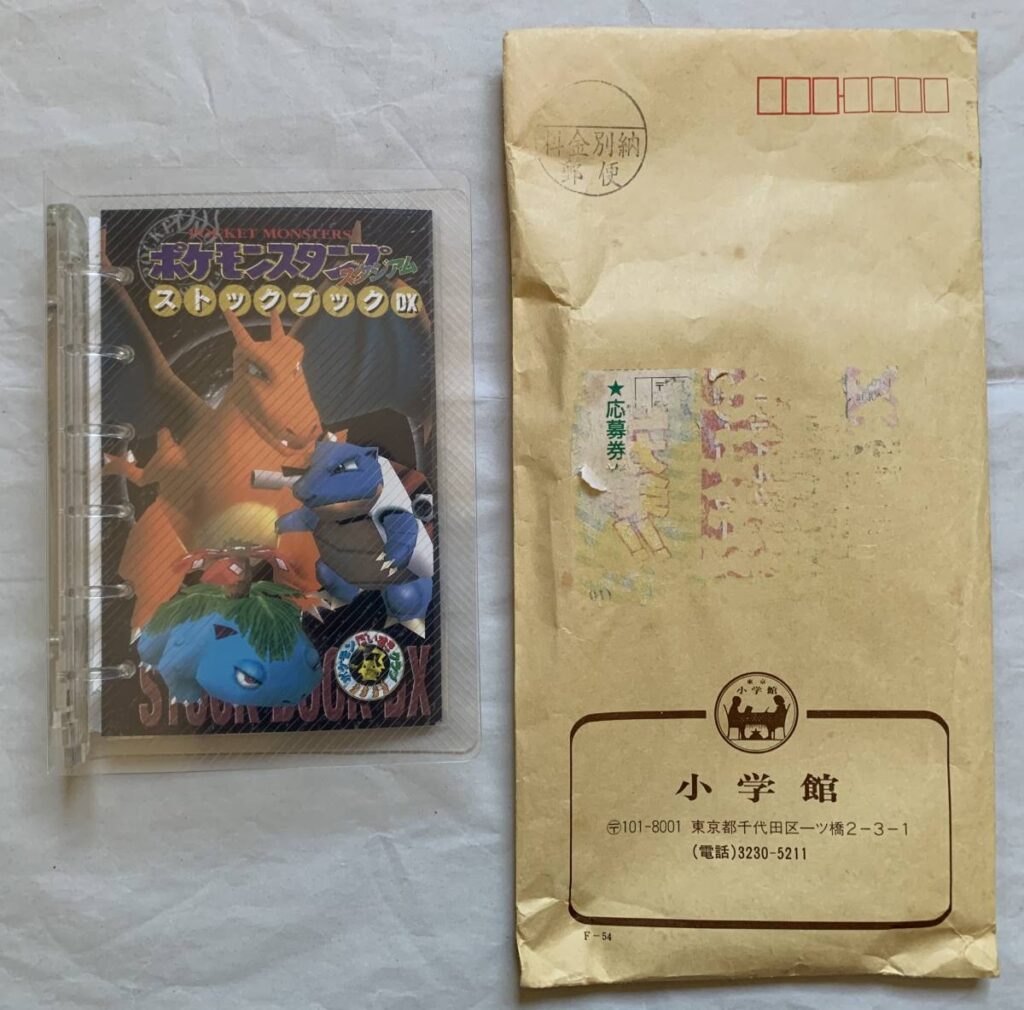
Stadium stockbook and the Shogakukan envelope it came in.
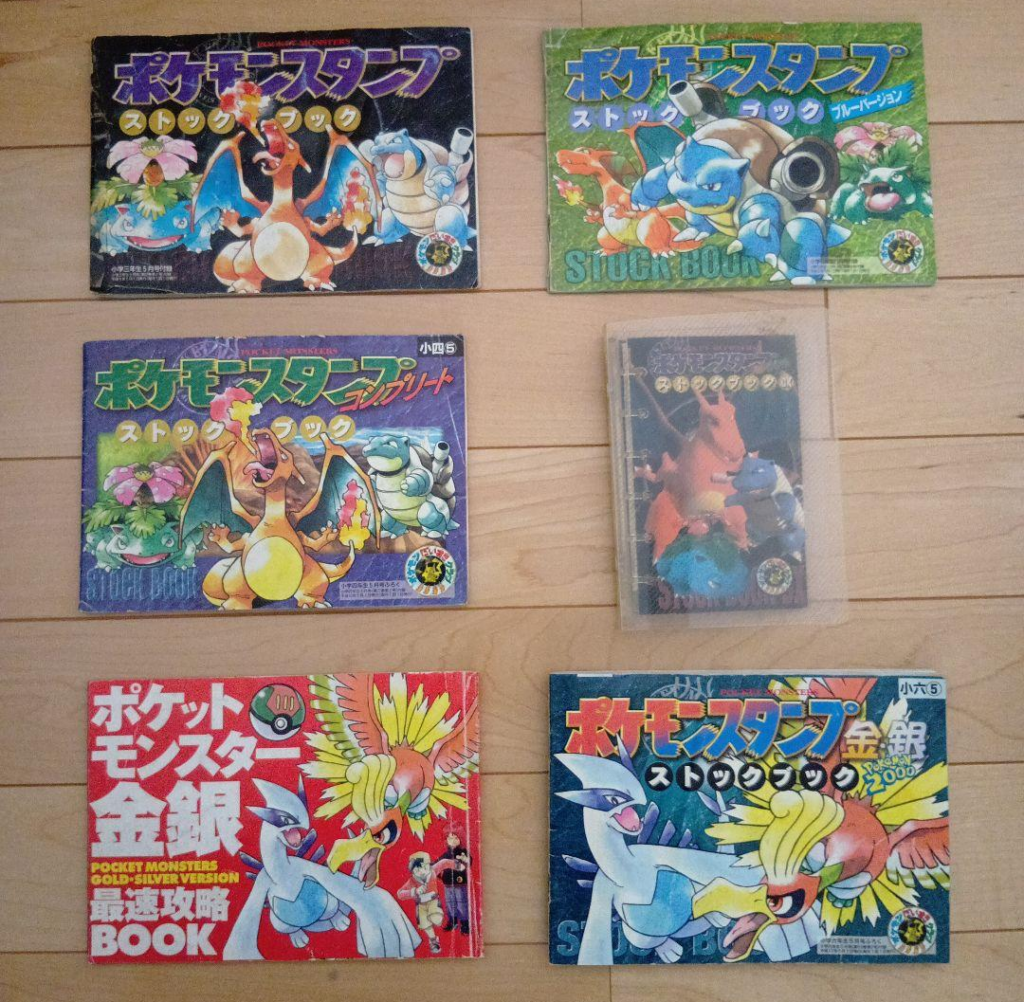
Years 1997-2000 stamp campaign stockbooks. Note Stadium’s small form factor.
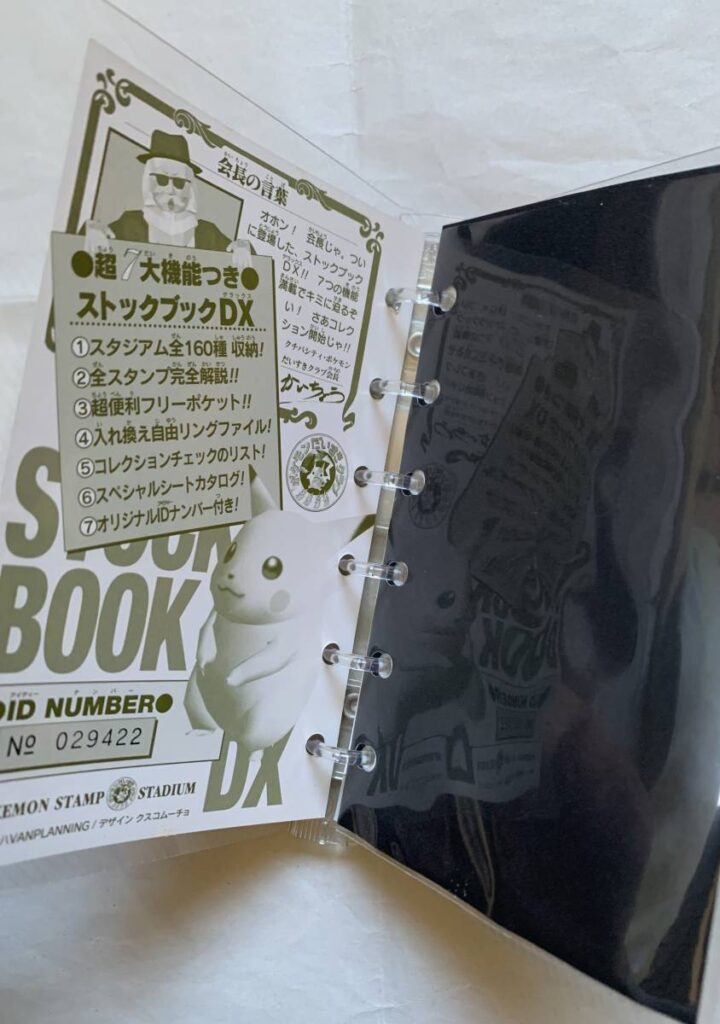
Kaichou presents the Stadium stock book. Note ID #029422.
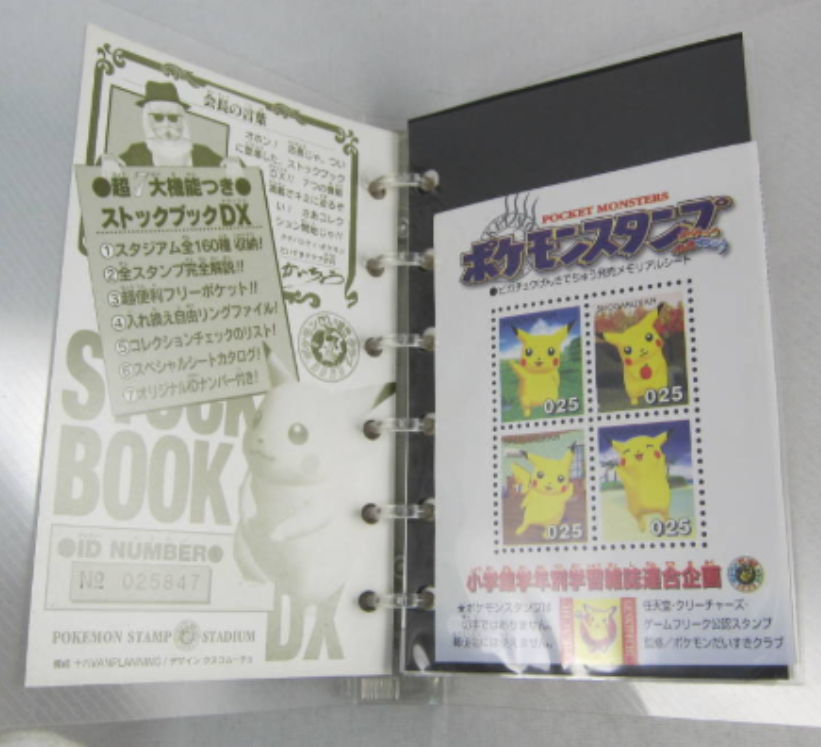
Stadium stock book. Note ID #025847 – different from above.
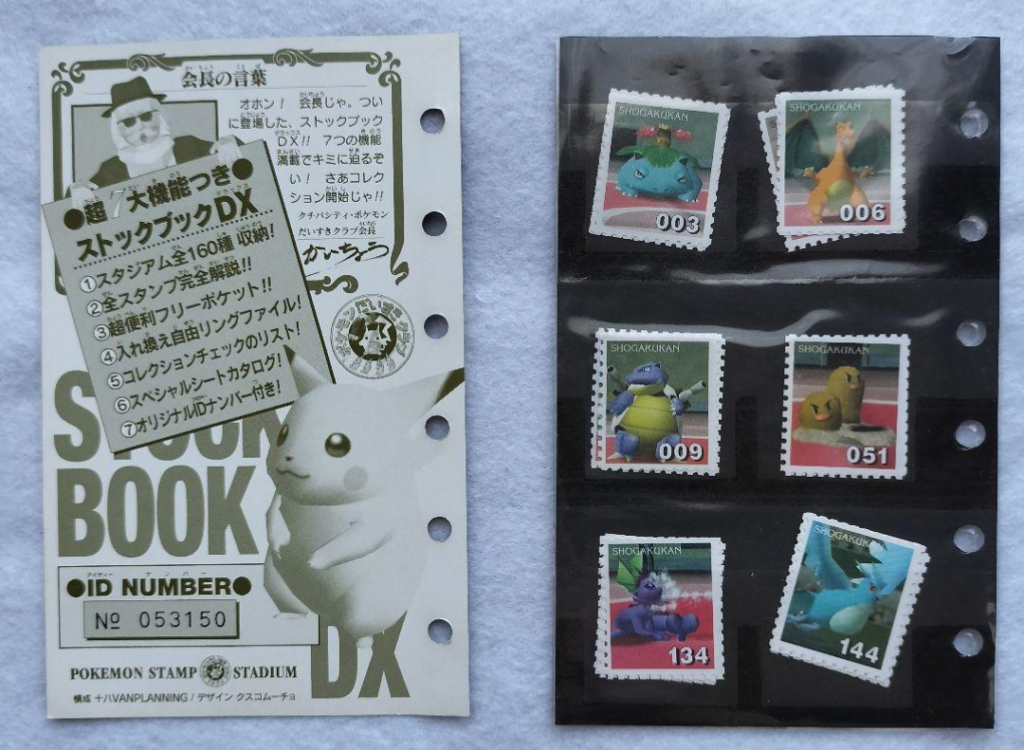
Yet another unique Stadium ID#: 53150.
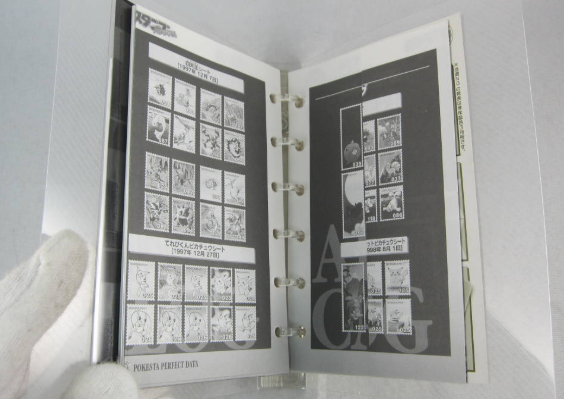
Stadium stock book showing past sheets as part of its “Pokémon Stamp Perfect Data” section.
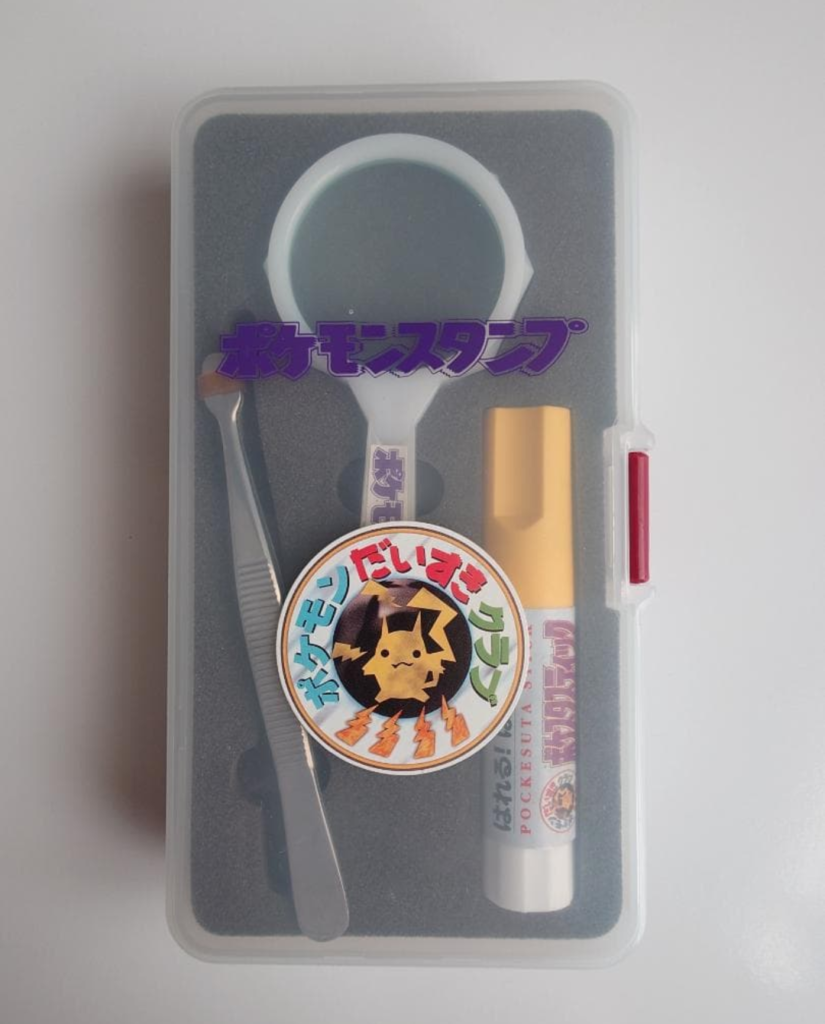
Stadium prize boxset containing a magnifying glass, flathead tweezers, and a PokeStamp-branded stick of glue.
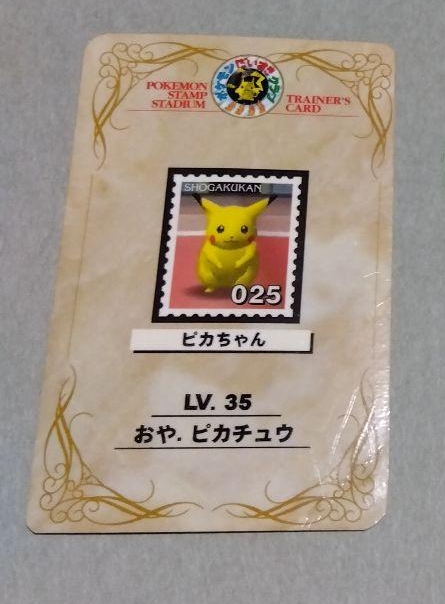
Stadium Campaign “Trainer’s Card” graced by a portrait of LV.35 “Pika-chan”.
