
Gold & Silver Campaign, April 2000-January 2001 (9+1+1 sheets)
Ah. Gold & Silver Pokéstamps. Ambitious. Traditional. And somewhat enigmatic. We might rightfully consider 2000-01’s Gold & Silver (G&S) the final campaign of the Shogakukan stamp non-stop era, for beyond Johto, gaps between campaigns are measured not in months but in years. We can debate why – and will, at the close of this article – but for now it is important to note that although G&S outshone everything before it in terms of sheer scope, it simultaneously abandoned Stadium’s innovations to instead cautiously toe the line laid down by the Original, Blue and Complete campaigns. Fascinating, isn’t it? So, let’s get stuck in and examine what Gold & Silver looked like in practice.
Note: I’d like to preface this analysis by saying that at present, there’s still a lot about the G&S Campaign that’s unclear. While images of its stamp sheets abound, peripheral information to contextualise the campaign is oddly scant. I fully expect to flesh this article out over time as more sources surface, so kindly consider the piece in its current form a placeholder until we acquire the necessary materials to fill in the gaps.
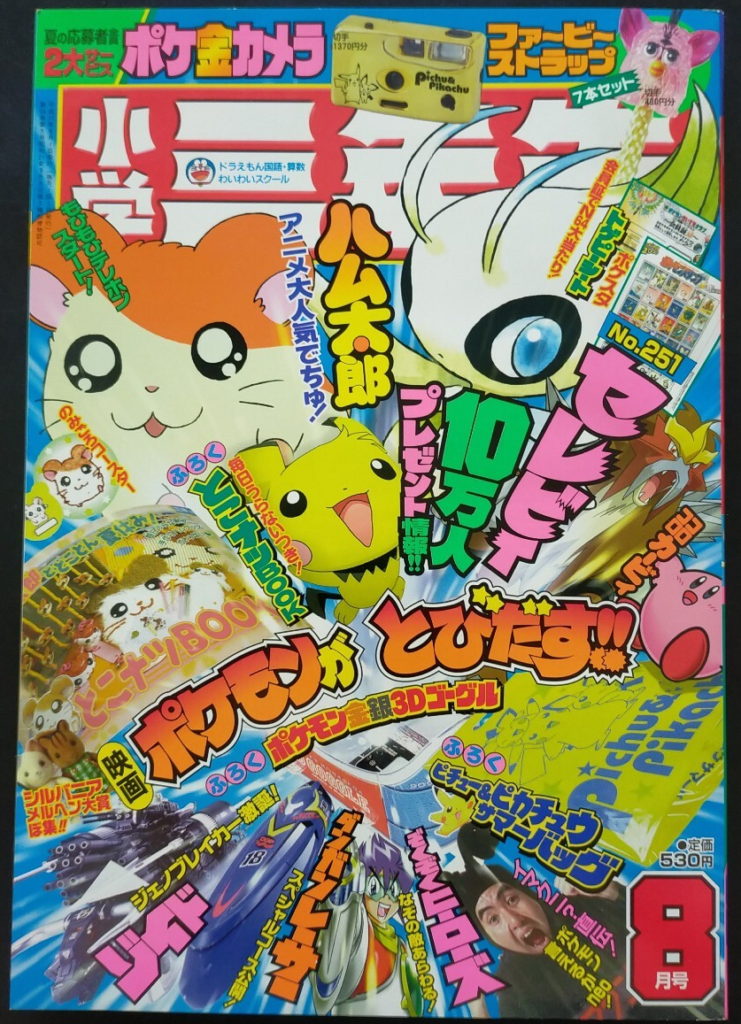
GSLM August 2000, Year 3, highlighted the arrival of Celebi and inclusion of the “Togepi” G&S stamp sheet.
As the vastest of all Shogakukan GSLM Pokéstamp campaigns, Gold & Silver was a protracted affair. Starting April 2000, GSLM Years 1-6 included sheets of Pokéstamps for an incredible ten consecutive issues that culminated in a grand, Mythical-rich finale in January 2001. You’ll understand that the unusual length of this campaign was partially a function of Johto’s expanded Pokédex. With the Pokémon pantheon now tallying not 151 but 251 creatures to collect in stamp form, G&S stretched the attention spans of its youthful target demographic to their limits – this despite effectively splitting the campaign in half by offering prize submission midway through, and then again at the end. In terms of magnitude, then, G&S had a distinct “campaign to end all Pokéstamp campaigns” vibe. We might say that it was publisher Shogakukan’s proverbial last dance before Japan’s postal services finally… Ahum. Later.
It makes intuitive sense that a year-long campaign intended to wow the masses with Pokémon stamps one final time would have a large marketing campaign drive backing it. Yet to the extent that Shogakukan hit its promotional beats, I haven’t found much evidence of an attempt to raise awareness that something grandiose was going down in the narrow confines of GSLM. Sure, it’s confirmed there was a website – not at all a given in the year 2000 – although I haven’t been able to locate it.1Such a website is summarily mentioned in GSLM October 2000, Year 2, p.18-19. But beyond this… Was there was a television advert to rival the OG and Blue Campaigns? If there was, I’ve not seen any such thing preserved on any media platform. Similarly, I expected at least a modicum of CoroCoro Monthly cross-promotion – a slight leg-up from GSLM’s parent magazine nudging readers in the right direction. Yet here too, I’ve found no evidence to that effect in the wonderful CoroCoro archives over at zoidsland.com. It’s tempting to conclude, then, that Shogakukan made no effort to pitch the G&S Campaign to anyone but its usual core audience. Which, incidentally, makes for a contributing explanation as to why thorough participation in G&S – ie. to the point of acquiring campaign prize(s) – was relatively muted. But we’re getting ahead of ourselves again; we’ll examine campaign engagement, too, some paragraphs down.
Here’s where the waters get a little muddied. It’s obvious that the Fan Club Chairman made a triumphant return to anchor the Gold & Silver Campaign, having skipped involvement in the G&S Pre-Sheets to enjoy a well-deserved tropical sabbatical shilling spin-off “stamp badges”.2Stamp-shaped pins, essentially. We know for a fact that March 2000, Year 1 included an introduction to the upcoming stamp campaign because a Yahoo Auction image shows a sliver of such a page (here). I’m positive that elaborate introductions were crafted for all of the grade-years but since the Japanese magazine resellers on whom we rely for supporting images instead appear to be laser-focussed on stamp sheets themselves – and who can blame them – we don’t have much to go off. So what do we have?
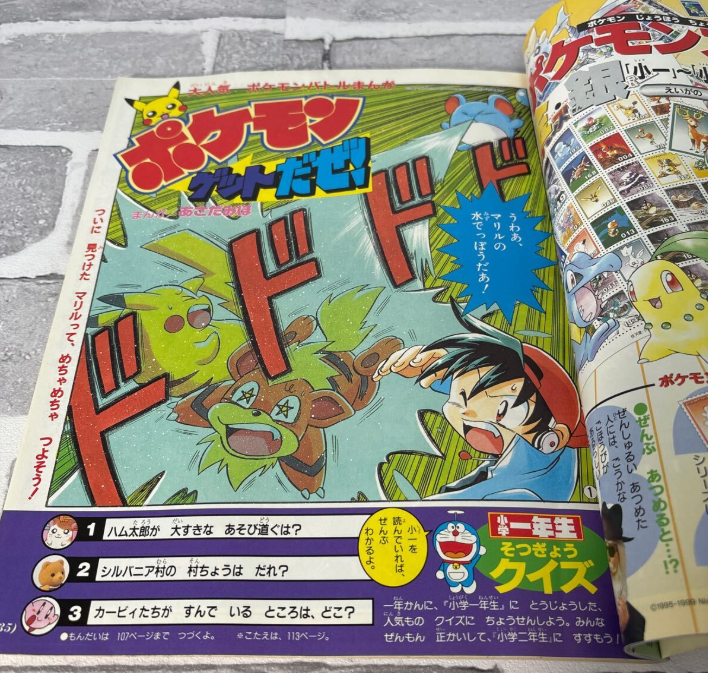
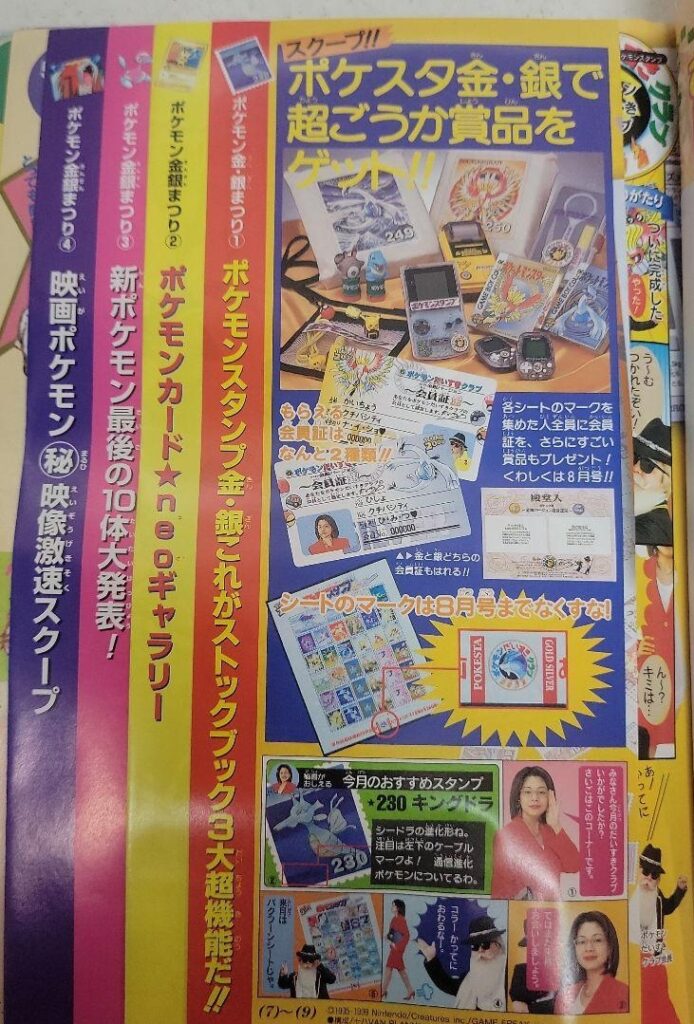
The Fan Club Chairman and Secretary Hisho pitch prizes. GSLM May 2000, Year 3.
A page in May 2000, Year 3 for example, where Shogakukan delivered a sneak peek at campaign prizes. (More on these below.) If Stamp Absol was a tale of two brothers, the G&S Campaign was a corporate collab, for it sported an official co-host in the form of the Chairman’s red-garbed secretary, Hisho (ひしょ),3GSLM January 2001, Year 6 states clearly that Hisho is the Chairman’s secretary (秘書) and not spouse as I had initially assumed. who aided and abetted the Kaichou in delivering stamp-related tidbits and revelations throughout the duration of the campaign. I’m frankly not quite certain where this character originated. Presumably, she was introduced to the magazine’s readership in the various March 2000 grade-years but, as is a common theme for this campaign, we sadly don’t have the relevant pages. Is Hisho, then, the personification of the clipboard-holding lady in RGBY Vermilion City’s Pokémon Fan Club – the one who endearingly states that “Our Chairman is very vocal about POKEMON”? I’m not sure. It’s conceivable that she made a named appearance in the Adventures manga alongside the Chairman, but to the extent that this is so, I haven’t been able to find it. Either way, G&S marked both secretary Hisho’s debut and, from what I understand, sole showing in GSLM.
These pages in the May 2000, Year 3 issue further saw fit to inject a little character into Hisho’s persona. A template Silver Member Card bearing the secretary’s likeness gave Hisho’s address as Vermilion City 「クチバシテイ」 but playfully, and quite wisely, provided no phone number, instead billing it a “secret” 「ひ・み・つ♥」. A missed opportunity there, Shogakukan, to set up a hot secretary trivia answering machine service at ¥100/minute! (I jest.) The Chairman was similarly confirmed to be a resident of Vermilion City per his Gold Member Card, his supposed phone number also kept back. While quaint, the point I’d like to make is this: Such small but significant details that helped to flesh out the Kaichou and his entourage were characteristic of the Gold & Silver campaign – of Shogakukan’s stamp campaigns at large, in fact – and in this particular instance, they reinforced the fiction of the Chairman and secretary Hisho as real people, fortified links with the Pokémon videogames, and subtly raised the appeal of the Member Card as a worthwhile campaign prize. It was a clever triple whammy, and throughout the campaign, G&S continually sought to emphasise the fictitious face(s) behind the Pokéstamps to forge a human connection between collector and overseer.4Fast-forward another two months to July 2000, Year 1, and we still find GSLM in the throes of G&S, the Chairman now flying solo in a Pokéstamp campaign explainer for the magazine’s most youthful readers. Since its content will be familiar, we won’t dwell on it here; find an image shortly below.
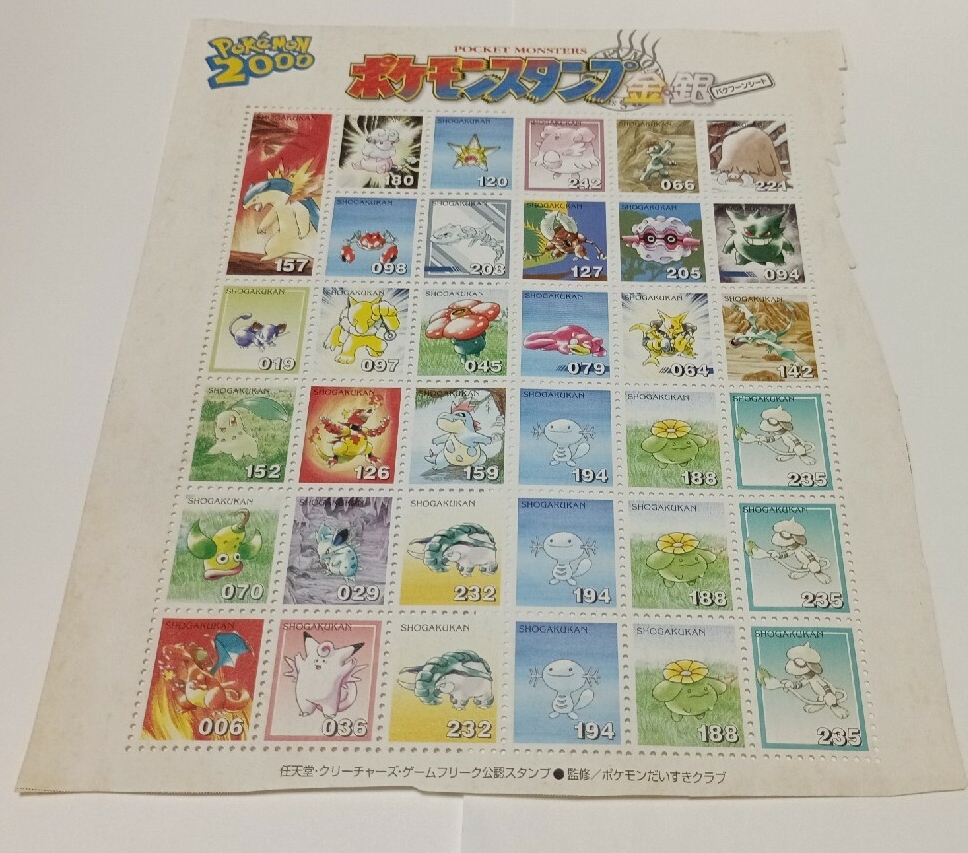
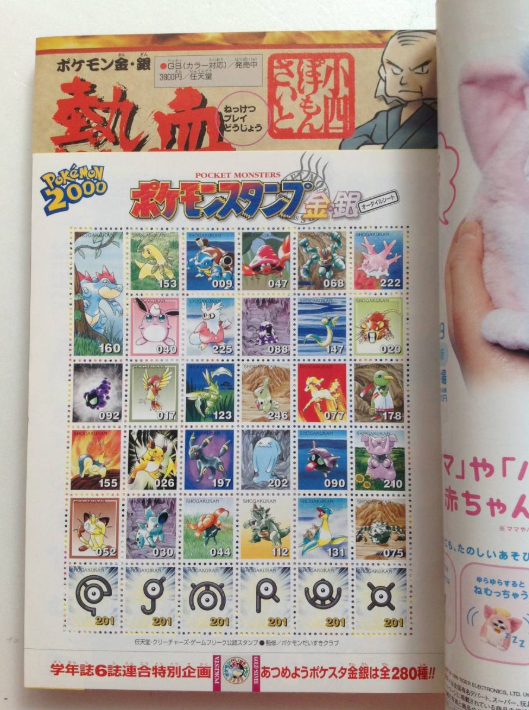
Then the Pokéstamp sheets themselves. Gold & Silver featured nine regular 6×6 stamp sheets, with a 2×1 titular “big size stamp” (ビッグサイズスタンプ) Johto Starter or Legendary Pokémon in the top-left, the list of which we’ll rattle off shortly.5Ho-Oh an Lugia even got 2×2’s. Additionally, G&S included a small-size, auxiliary Movie 2000 Entei sheet not required to complete the campaign’s Club Marks (and submit for a prize Member Card) but desirable regardless to complete the G&S stockbook. Finally, the campaign concluded with a special Celebi and Mew sheet in January 2001. Yes, I know. Mew again. Deja vu! And poor Entei, not hot – ha! – enough to merit his own 36’er. Interestingly, a Pokéstamp explainer for the magazine’s most youthful readers alluded to the Entei incongruence. Year 1 had up until then featured four Legendary Pokémon sheets – Ho-Oh, Lugia, Raikou, Suicune – but not the fiery gerbil, and it teased readers by rhetorically asking when Entei might ultimately appear, if at all.6GSLM July 2000, Year 1 (p.52), which read「見て! こん月てでんせつのポケモンは4たいよ! エンテイはいつ つくのかな?」The page further pointed out that Pokémon on stamps evolve and grow bigger “just like in the the games” (questionable) and for some silly reason highlighted Lanturn and its ability to illuminate ocean depths. (In every September 2000 issue, as it turned out.)
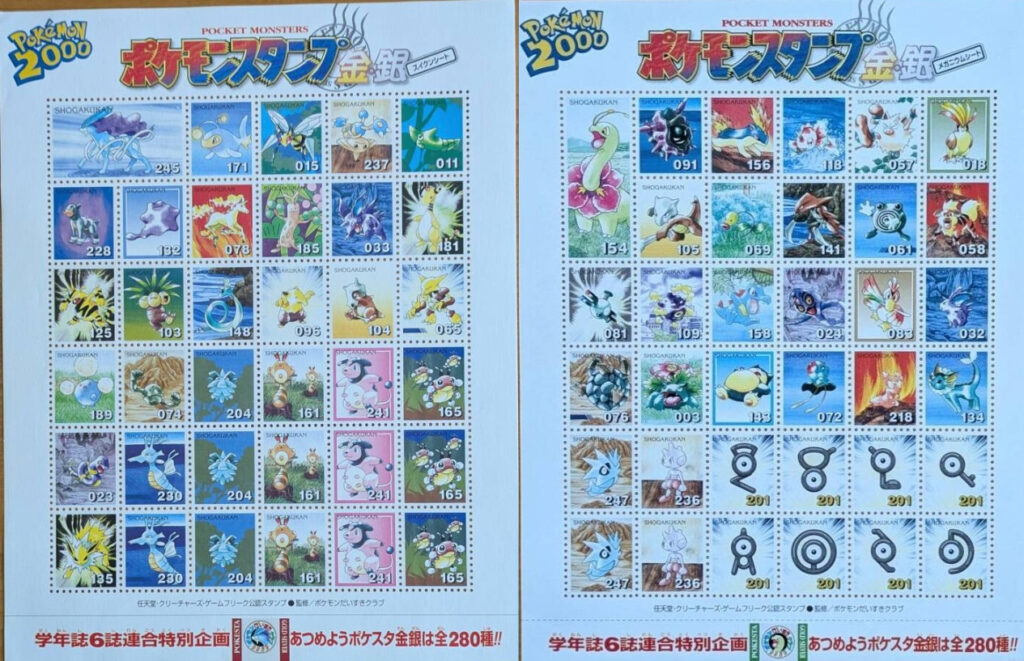
Suicune & Meganium sheets.
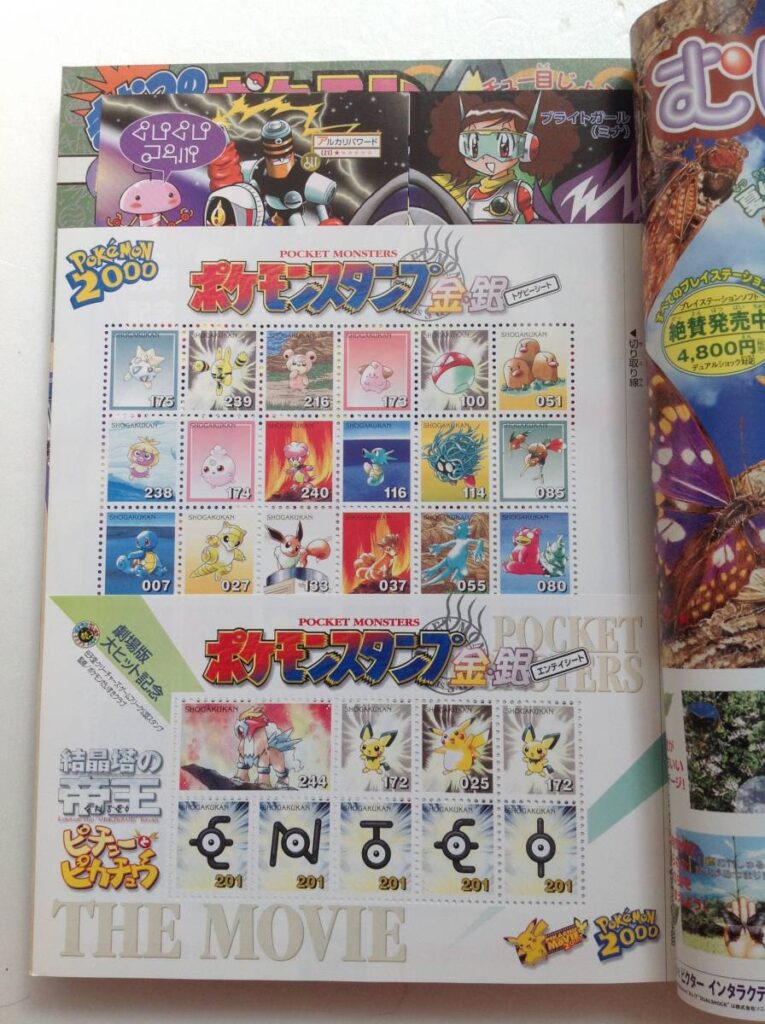
Gold & Silver’s bonus Entei Movie sheet on top of a regular Togepi sheet. GSLM September 2000, Year 2.
Altogether G&S counted 280 unique stamps – “varieties” as GSLM July 2000, Year 1 called them – across the aforementioned 11 sheets. By titular Pokémon, in Pokédex order, these were:
Meganium
Typhlosion
Feraligatr
Mewtwo
Togepi
Raikou
[Entei]
Suicune
Lugia
Ho-Oh
Celebi [Mew]
As you’ll notice from the sheets above, the auxiliary Entei sheet featured several of an enigmatic subclass of Pokémon: Unown. Twenty-six of these had debuted in Johto’s Ruins of Alph – Unown ? and ! weren’t yet a thing – and G&S saw fit to stampify them all. As such, the campaign’s Meganium and Togepi sheets each included 8 different letters of Unown, while Feraligatr had another six for a total of 22. The final four letters – E, N, T and I – came from, you guessed it, the September 2000 Entei movie promotional mini-sheet included in Learning Kindergarten upwards to Year 6. (See also Miscellany: Johto). These weren’t an afterthought: the G&S stockbook dedicated a separate section to these, while a “museum poster” presented by Kaichou and his secretary in GSLM January 2001 drew explicit attention to them. The poster as a whole, by the way, rather crudely categorised some of G&S its 280 unique stamps into rather arbitrary groups based on artistic similarities across evolutions or “rival” lines (Pinsir and Heracross, Tauros and Miltank). One gets the impression that Shogakukan’s writers were searching for Stadium-esque storylines that just weren’t there. But I digress.
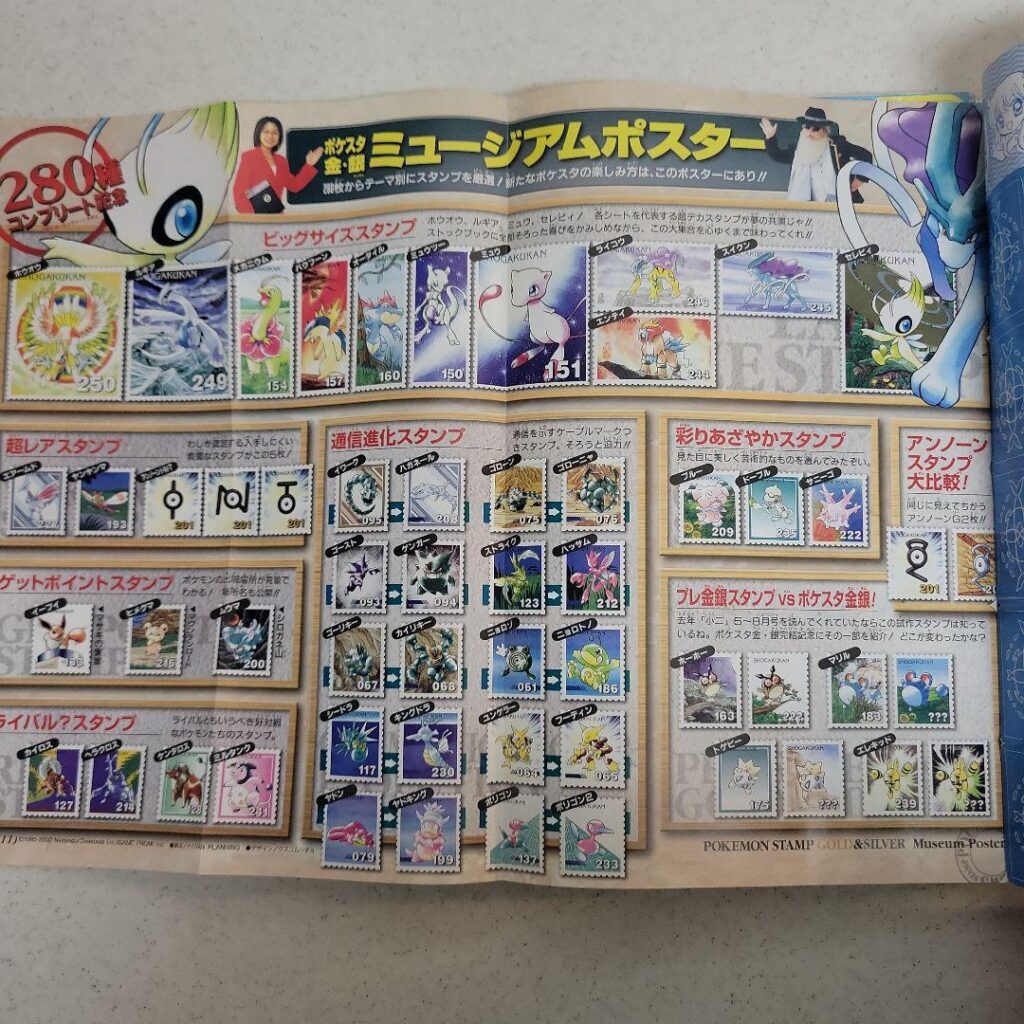
Pokéstamp “Museum Poster”. GSLM January 2001, Year 3.
To shepherd GSLM’s school-age readership through the meandering Gold & Silver campaign, each monthly issue of at least certain grade-years incorporated a “POKESTA TIMES” portion.7「ポケスタタイムズ」Only Year 2 is confirmed at this point. Which was, in plain English, a colourful one or two-pager filled with interactive content and engaging deep-dive information about the goings-on in stampland. GSLM September 2000, Yr2 its “PokeSta Vol.6” for example impressed readers with factoids about that month’s Entei/Unown Movie2000 sheet as well as pitching the Top Confectionary G&S cross-promotional sheets (see below). PokeSta Vol.7 in October 2000, Yr2, on the other hand, taught readers various stamp sheet “secrets” and quizzed them on that month’s Meganium sheet. In this manner, Shogakukan attempted to turn Gold & Silver into an experience richer than the mere cutting and pasting of stamps into a stockbook for the now fifth time (after Original, Blue, Complete, and Stadium).
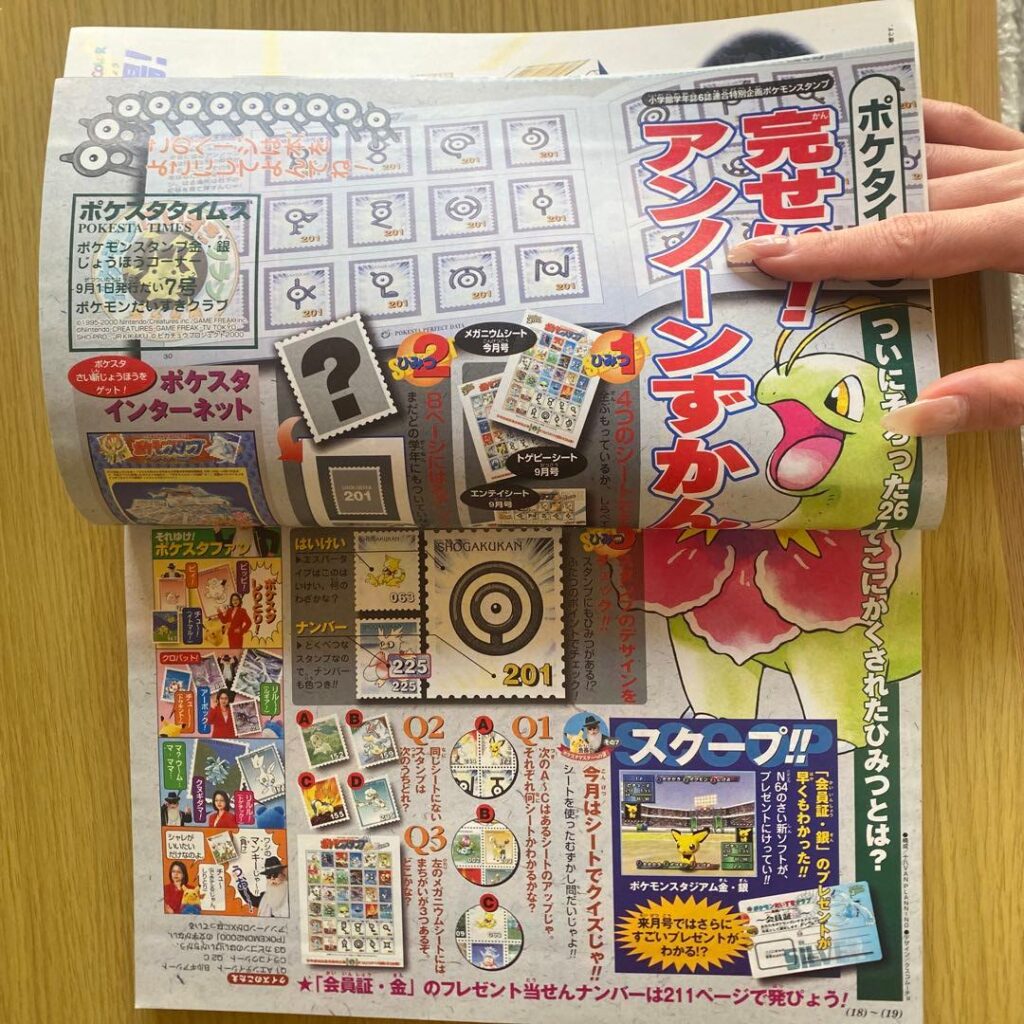
POKESTA TIMES Vol.7. GSLM October 2000, Year 2, p.18-19
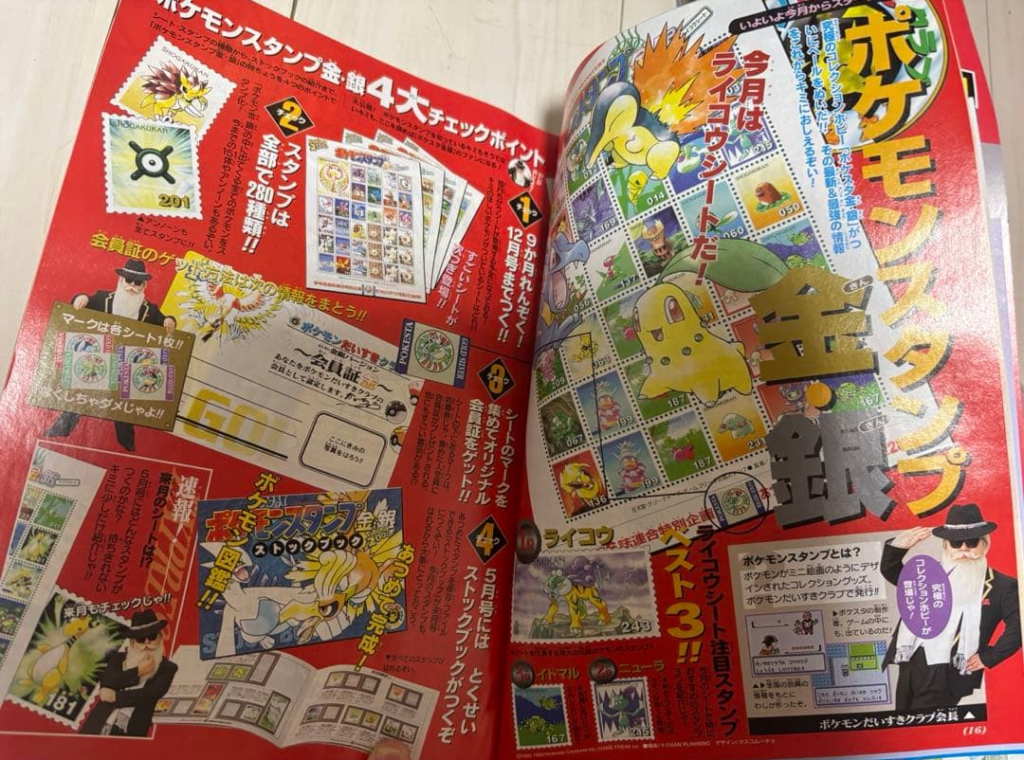
GSLM April 2000, Yr3.
Alright. Let’s do some lightning comparative analysis on the broad parameters of Gold & Silver’s stamp design. In the opening paragraph to this article, we hinted at the campaign leaving Stadium’s experimentality behind and re-embracing the basics. Which, we may conclude, meant a return to depicting Pokémon in a classical portrait-style. G&S didn’t quite emulate the simple pictures of the earliest stamp campaigns though, as its style of portraiture was markedly more action-posey in a bid to highlight a Pokémon’s perceived traits or characteristics. Indeed, GSLM itself on at least one occasion marketed them as collectable “mini paintings” (ミニ絵画).8GSLM April 2000, Year 3. If we study G&S’ Meganium sheet for example, we find a stamp that shows a giddy Totodile leaping into the water, a menacing Growlithe that snarls at its out-of-frame artist and a Slugma lounging on a rock in what I can only imagine are the fiery innards of an active volcano. In another two stamps, we see a lazing Snorlax look exceptionally comfortable, while Tyrogue radiates the sorrowful energy of a lost child forlornly wandering the aisles at IKEA. Admittedly these uncomplicated scenes had nowhere near Stadium’s CG levels of personality, but as they were, the more vivid portraits stood a step above the – although charming – quite classically Sugimori presentation of OG and Blue.
In terms of GSLM involvement, grade-years 1-6 took part in the G&S Campaign with the most junior magazines Learning Kindergarten and below sidelined like they had been during every stamp drive but Blue. And as in all late-90s campaigns before Gold & Silver, GSLM’s monthly issues cycled their thematic stamp sheets so that no grade-year carried the same one in April, May, June and so on. It’s a real challenge to elucidate the complete pattern for six different grade-years across the space of 10 months. But amazingly, we’re able to deduce G&S its full rotation based on the limited information available to us. Specifically, while we don’t have the complete records, we do possess sufficient data to compile an incomplete rotation table and logically impute the remainder. The result reveals a shifting pattern across grade-years without any monthly duplication with the exception of Mewtwo’s sheet, which was in every December 2000 issue, and Celebi & Mew, in every January 2001 volume. A smidgen of uncertainty remains with regards to GSLM Year 4 virtue of its lower circulation and thus elusiveness. Still, overall confidence in the rotation as presented is high.
Gold & Silver Rotation - ©PokemonHistorian.com
| APR | MAY | JUN | JUL | AUG | SEP | OCT | NOV | DEC | JAN | |
|---|---|---|---|---|---|---|---|---|---|---|
| YR1 | H | L | R | S | Ty | F | To | Me | M2 | C |
| YR2 | L | R | S | Ty | F | To | Me | H | M2 | C |
| YR3 | R | S | Ty | F | To | Me | H | L | M2 | C |
| YR4 | S | Ty | F | To? | Me | H? | L? | R | M2 | C |
| YR5 | Ty | F | To | H | L | R | S | Me | M2 | C |
| YR6 | F | To | H | L | R | S | Ty | Me | M2 | C |
Shortcodes are Meganium (Me), Typhlosion (Ty), Feraligatr (F), Togepi (To), Raikou (R), Suicune (S), Ho-Oh (H), Lugia (L), Mewtwo (M2), and Celebi (C).
Okay, shifting gears. Weirdly, there was a second, alternate way to source a selection of G&S Pokéstamps. Throughout Y2K, Japanese sweets brand Top Confectionery (トップ製菓) collaborated with Shogakukan to bring children Pokéstamp-sheets as, we may assume, candy purchase bonuses. (Presumably this was a buy-at-your-cornershop affair and not an early instance of e-commerce, but I’m not quite clear.) From what I understand, twenty-eight unique sheets were on offer across two series, and its stamps included even the larger 2×1 specimens such as Mewtwo and Feraligatr.9See the Miscellany: Johto article for more information. To top it off, kids could acquire a small “POKEMON STAMP MINI ALBUM” complete with introductory text by, and portrait of, the Fan Club Chairman. This was official stuff.
And it’s also all a little puzzling. On one hand, this partnership with Top Confectionery can be construed as generous towards collectors, for it provided a fallback method to complete (part of) one’s stockbook – it is, after all, easy to miss a beat or two over a 10 month period. Yet at the same time, I struggle to understand why GSLM publisher Shogakukan allowed this collaboration to exist short of Top Confectionery offering the publishing house a particularly large bag of money for the privilege of partaking in this Campaign. To the extent that by Summer 2000, stamp campaigns still drove interest in GSLM as they had demonstrably done throughout 1997-8, it’s conceivable that the Top cross-promotion negatively impacted GSLM sales. And since Top’s mini-sheets offered no Club Marks at all – required to submit for G&S’ end-of-campaign prizes – this outsourcing of Pokéstamps may be partially responsible for what appears to be a low-ish number of successful Trainer Card applications. But more on that shortly.
Quite naturally, these Gold & Silver stamp sheets – whether acquired through GSLM or Top – could be cut into individual stamps and pasted into an official mini-album, a so-called “stockbook”. As was common practice during each GSLM Pokéstamp campaign, G&S’ stockbooks were made available to collectors two months in. For G&S, this meant that it was enclosed with May 2000’s grade-years 1-6. As for its design, the Gold & Silver stockbook featured Ho-Oh, Lugia, and the Pokémon 2000 logo on its front cover, with the booklet being A5-sized like the ones before it and reasonably hefty.
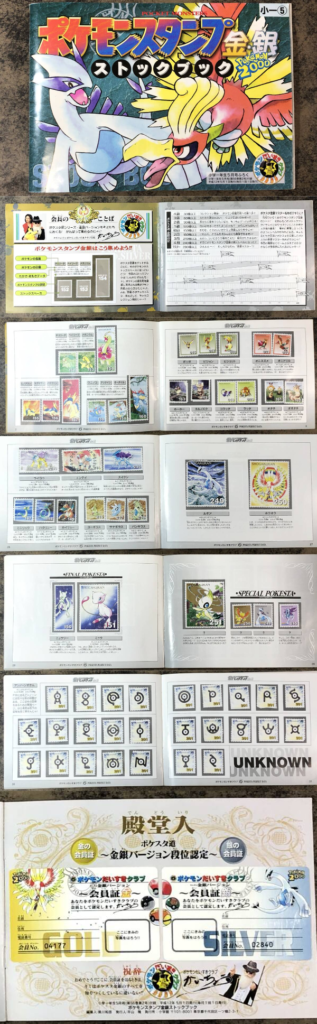
Selection of pages from the Gold & Silver stockbook.
Overleaf, readers discovered a portrait of the Kaichou holding a Chonkachu plush with Secretary Hisho by his side, accompanied by a message of encouragement from said Chairman.10Translated: “We’re bringing you the new Pokéstamp series: Gold and Silver versions! Do your best to collect them all!” The page further touted what it claimed to be a stockbook innovation: like Stadium’s, Gold & Silver’s album was to be a true miniature Pokédex:
“Every time you catch a Gold or Silver Pokéstamp, add it to that Pokémon’s stock space! This stockbook features “New-Style Pokédex Mode” – a new way of organizing the Pokédex based on Pokémon’s evolutionary lines. So, aim to become the ultimate Pokéstamp Master and start your collection now!”11「ボケスタ金銀をゲットするごとに、そのポケモンのストックスペースにはっていこう! 今回のストックブックは「しんがたすかんモード」。ポケモンの進化形を基準に表示される新ポケモン図鑑のならびかたじゃよ。さあ、究極のボケスタマスターをめざして、キミもコレクション開始じゃ~!」
Concretely, this “new way” entailed five data points per entry: Pokémon name, type, height and weight, a brief Pokémon and/or stamp description, and finally the stamp itself. And although one all but needed a magnifying glass to read said descriptions (remember that handy Stadium campaign prize!), I admire the effort of cramming lots of interesting Poké-information into minimal space to try and truly replicate the feeling of browsing a National Dex. Great work, Shogakukan!
Finally, then, campaign prizes. Divisible into two tiers, there was the everyman’s prize – official G&S Fan Club Member Cards – as well as several grand prizes winnable by a lucky few. We’ll discuss the Member Cards shortly; here, let’s home in on the array of Poké-goodies distributed by lottery amongst all applicants that had successfully submitted a full grid of nine G&S Campaign Club Marks. We know that these special prizes exist thanks to their reveal in May 2000, Year 3 – a page we reproduced earlier in this article. Its sneak preview showed a wondrous cornucopia of tantalising goods: Pokémon Minis, a Club Mark keychain, copies of Pokémon Gold & Silver, a Gameboy printer, giant Lugia and Ho-Oh stamp badges, Poké-figurines and what looks like a stamp-themed pouch of some kind. And, to top it all off, the presumed top prize: a Pokéstamp-themed Gameboy Colour. Mind you, these were first half, five-month “Gold” submission prizes; less impressive prizes were again awarded on campaign close in January 2001. As December 2000, Year 5 tells us, “Silver” moeity applicants stood to win Pokémon Crystal (120 winners across all grade-years), Pokémon Stadium Gold & Silver (60 winners), Japanese TCG Neo Packs (300),12 I’m not quite certain what Neo set, or how many packs. The magazine shows Neo Discovery’s pack art, but the adjacent Mantine and Smeargle cards are from different sets (Neo 1 and Neo 2), and the severely blurry flavourtext seems to say something about either three packs, or set three, but I can’t quite make it out. Daisuki Club stickers (600), and Poké-themed notepads (60).
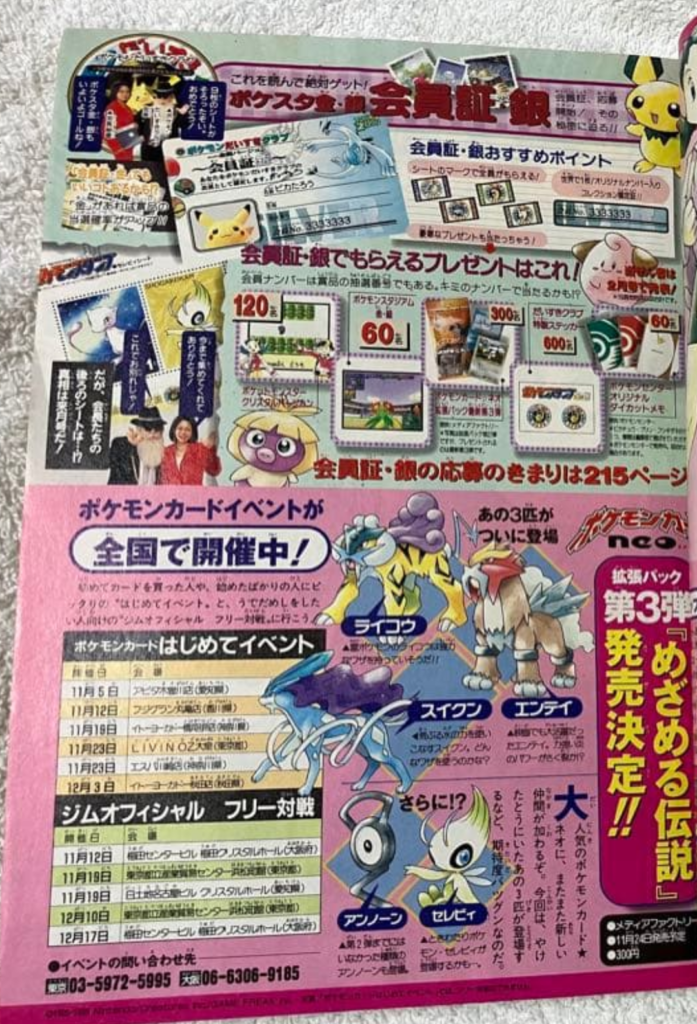
Silver Campaign prizes, in: GSLM December 2000, Yr5, p.53.
Now, it’s hard to say whether the Stampboy constituted an actual custom GBC or a standard one that Shogakukan and/or TPC plastered with Fan stamp-themed marketing stickers. For one, the top sticker that reads “Pokémon Stamp” appears to be in an inconvenient spot, obscuring as it does a portion of the handheld’s display. I unfortunately couldn’t locate this potential console variant on consolevariations.com. And it doesn’t help that at present, we don’t possess GSLM’s submission pages as printed in, presumably, its August 2000 issue that unquestionably provided more prize information such as prize totals (cf. Kaichou Absol). So the Stampboy is TBD until more information comes to us, I suppose.
As for the dual Gold & Silver Fan Club Member Cards: Provided that participants successfully completed both halves of the G&S Campaign, they received both. As hinted at before, there were two Club Mark submission moments: One, we think, in August 2000, and another in January 2001. The first awarded a Gold Member Card, the second a Silver one.13I had been somewhat puzzled why erstwhile participants who advertised their G&S cards online seemed to possess different Gold / Silver TIDs. Because surely, one submission would result in identical TIDs across both cards, right? The split submissions explain it. Details of the first application process were, per GSLM May 2000,14Reading as it did: “Everyone who collects all the marks on each sheet will receive a Membership Card an amazing prize! Details in the August issue!” (GSLM May 2000, Yr3, p7-9) given in that year’s August issue – which of course we don’t have. As explained above, details of the second application were in GSLM December 2000, p.215, that we also don’t have. Much, then, remains to be clarified. Either way, when placed horizontally adjacent to one another, the Gold & Silver cards formed a connecting image. Cool. The front of either card certified successful applicants as members of the Pokémon Fan Club, while their backs confirmed the campaign’s bifurcation, with Gold’s card reading, translated:
“To you, who collected Pokémon Stamps Gold and Silver for five months, we present this proof – the Gold Membership Card – and officially recognise you as a member of the Pokémon Fan Club! Congratulations! […] Now that you’ve earned your Gold Member Card, let’s aim to get the Silver Member Card next!”
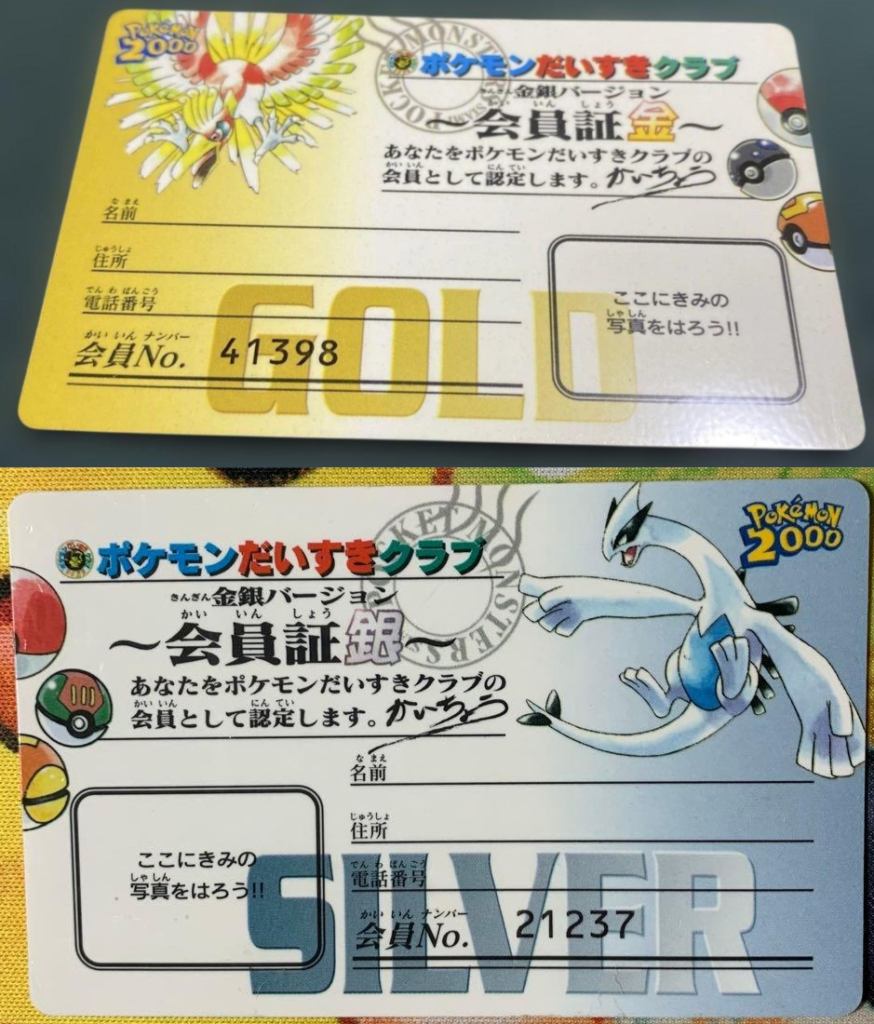
Gold & Silver Member Cards
Let’s quickly examine TIDs. As explained elsewhere in this article series, throughout seemingly every Shogakukan stamp campaign, Member Card ID# were issued sequentially in order of (successful) applications. Which, in turn, means that those digits tell us something about popular participation in any stamp campaign: The higher the numbers, the greater readers’ commitment and uptake. So how do Gold & Silver’s numbers compare to the hundreds of thousands of Member Cards minted during each of the Original, Blue and Complete Campaigns?
Well. They tell us that fan uptake was… Passable, really. Gold’s highest known TID is 41398, while Silver’s is 21237 – a far-cry from Complete’s 600k+. It’s not difficult to hypothesise the reason(s). To be sure, Johto as a generation was largely blameless: Fuelled by a relentless stream of tips-and-tricks coverage in CoroCoro Monthly and a new anime arc, the games sold like hotcakes and boasted immense popularity. Rather, I suspect that Shogakukan’s stamp drives began to feel the squeeze from another class of Pokémon collectible, the TCG, which had well and truly taken off and was now moving into the glitzy Neo era. Why do I think this? Well for instance, the publisher’s flagship magazine CoroCoro Monthly was routinely jam-packed with Pokémon TCG promotions. Even GSLM itself sometimes allotted more cover space to the trading card game while the stamp campaign was ongoing (June 2000, Year 1 is a particular example).
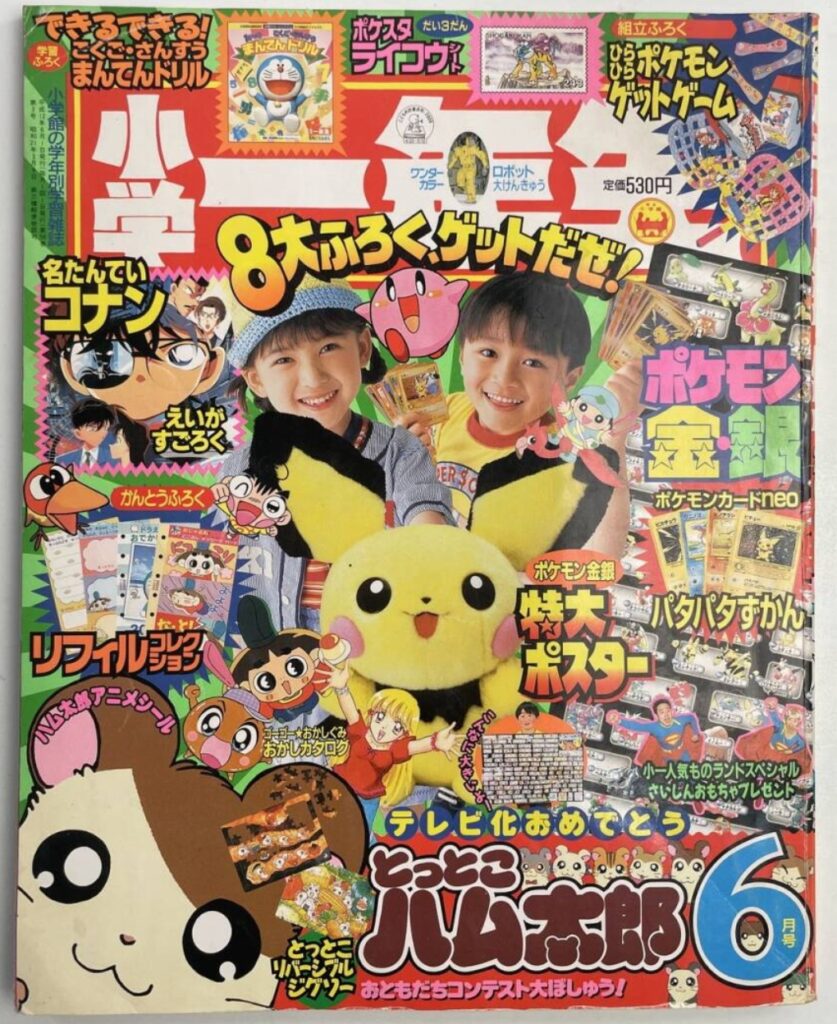
What was more important: Pokéstamps, or the TCG? GSLM June 2000, Year 1.
By comparison, Pokéstamps must have increasingly seemed like a sideshow, a pleasant distraction for the still wet-behind-the-ears kid brother but less appealing to the genwunners fast moving into their teens looking for a more sophisticated Poké-thrill. In other words, Shogakukan’s stamps lost their status as the hot Pokémon item to collect and with it disappeared the resulting all-ages mass appeal that stamps had enjoyed in 1997-8. Remember how OG Member Cards had been shove-in-your-face cool? Yeah, none of that no more. Add the fact that ten straight months of campaigning was an absolute eternity for a young child and Top Confectionery’s confusingly injecting itself into the campaign, and you have a recipe for ultimately disappointing TID numbers. I’m not surprised that Gold’s highest known TID exceeds Silver’s – ten months was simply too long.
So! In retrospect, it’s evident that Gold & Silver proved to be the swan song of the original era of Pokéstamps. How so? Great question. Obviously, it’s tempting to conclude that G&S’ limited success factored into it. Shogakukan’s commendable attempt to woo and court Pokéfans for ten straight months had, if nothing else, shown that interest in the Pokéverse was migrating to other branches of that mighty Pocketmonsters tree. But there is, I think, another reason. It is said that Japan’s national postal service loathed the Gold & Silver Campaign and Top’s sheets in particular, for the latter closely resembled genuine postage stamp sheets. And in an absolute headache for Japan Post, children who were blissfully oblivious to the difference innocuously kept trying to send pals and relatives real physical mail “paid for” with fake Pokémon stamps. If G&S’ substandard performance wasn’t sufficient to persuade Shogakukan to pull the plug on Pokéstamps, then repeated postal service complaints and, quite possibly, the threat of legal action surely must’ve sealed their fate. As such, not until 2003 did Shogakukan see fit to revive the Pokéstamp formula, beginning with the Ruby & Sapphire Campaign.
NAVIGATION:
GS “Pre-Sheet” Intermezzo < > Ruby & Sapphire Campaign
Audiovisual
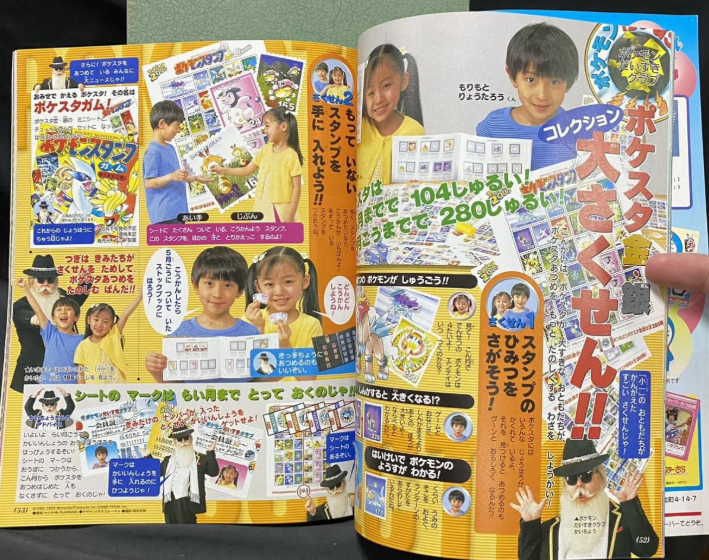
The supervising Daisuki Club Chairman (or Kaichou) explains how to participate in the G&S Campaign. GSLM July 2000, Year 1, p51-52.
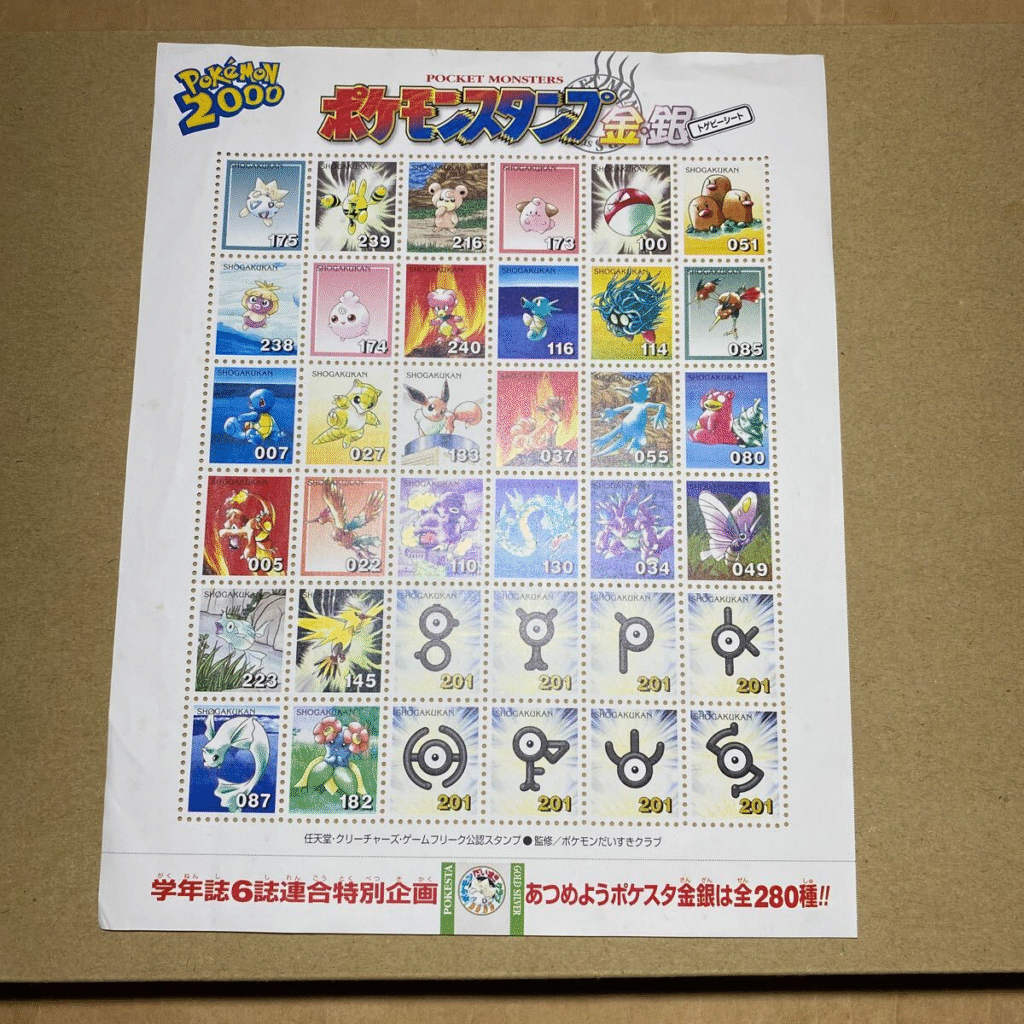
Feraligatr Gold & Silver Campaign sheet. GSLM June 2000, Year 4.
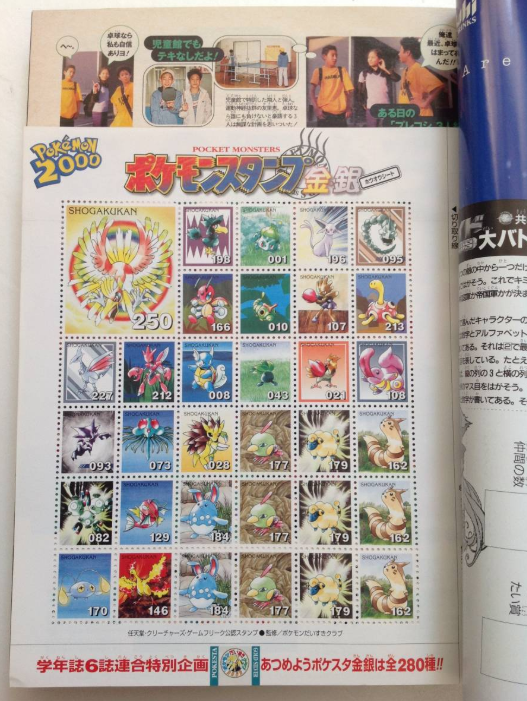
Ho-Oh Gold & Silver Campaign sheet. GSLM July 2000, Year 5.
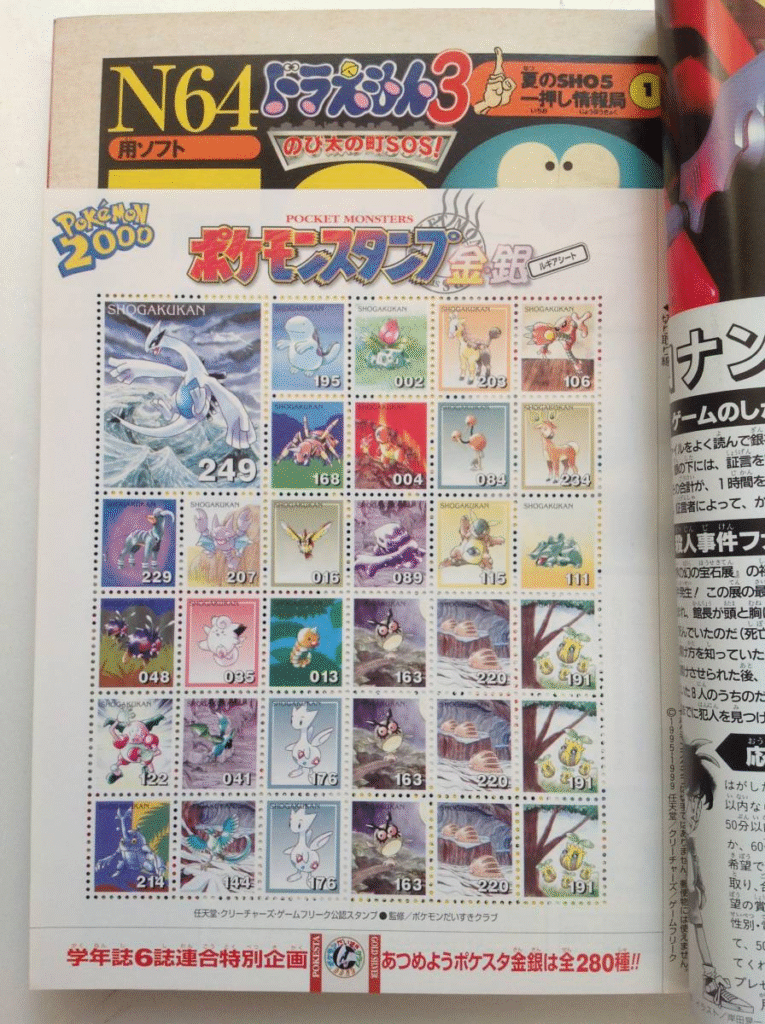
Lugia Gold & Silver Campaign sheet. GSLM August 2000, Year 5.
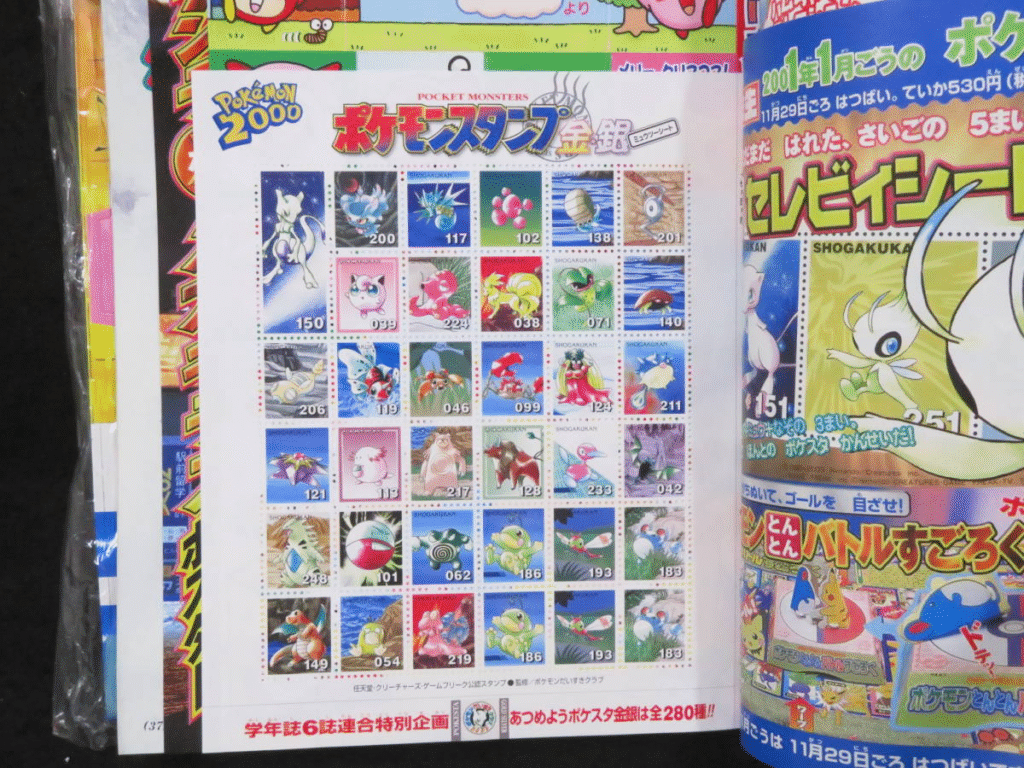
Mewtwo Gold & Silver Campaign sheet. GSLM December 2000, Year 1. January 2001’s Mew and Celebi stamps are teased on the right.
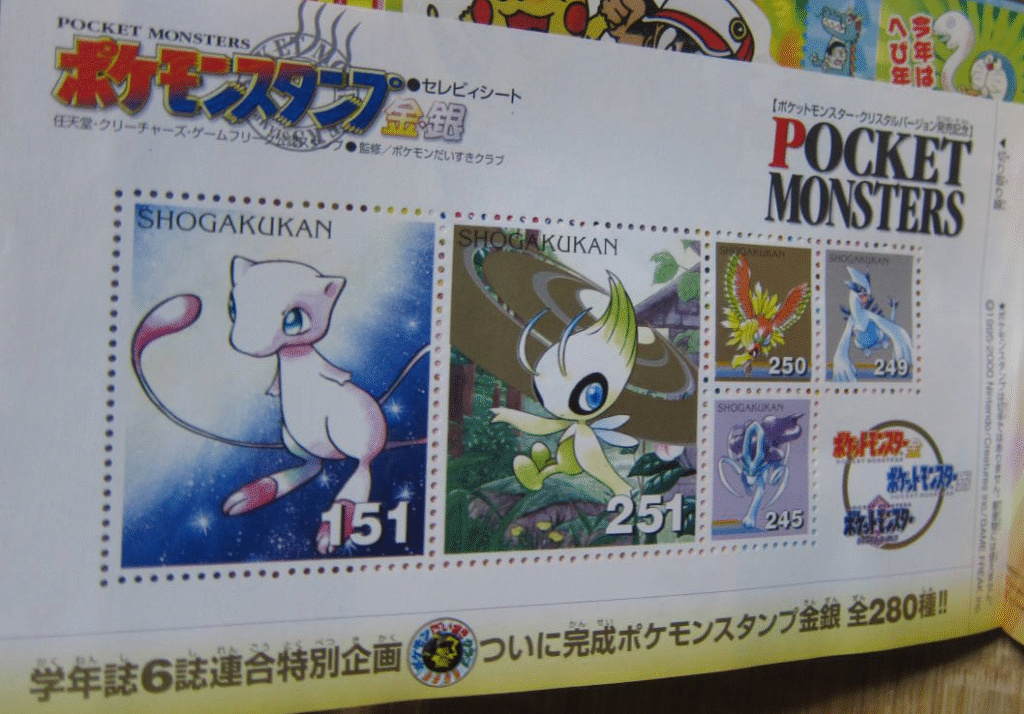
Gold & Silver campaign-closing Mythical stamp sheet. GSLM January 2001, Year 2.
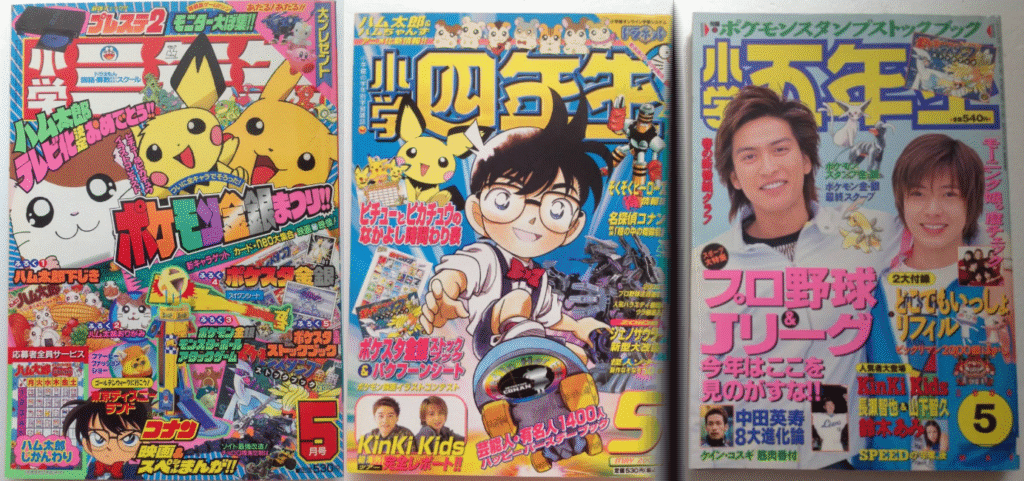
GSLM May 2000, Years 3, 4 and 5 all show the enclosed G&S stock book on their magazine covers.
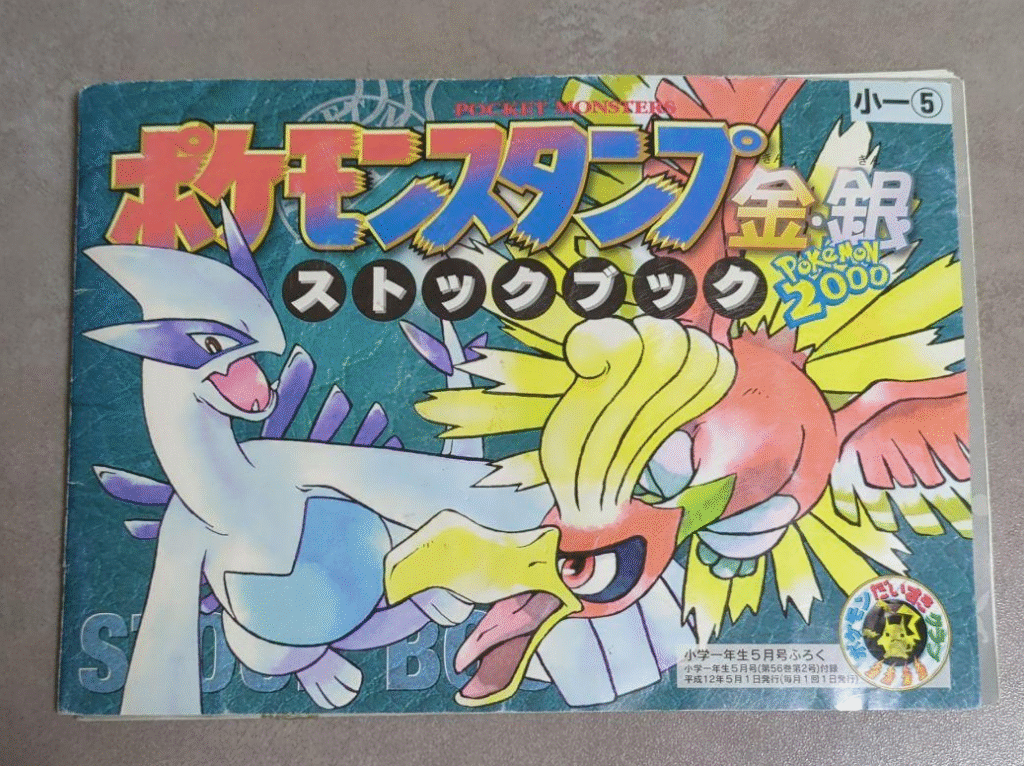
Gold & Silver Campaign stock book, front cover. Included in GSLM’s May 2000 issues.
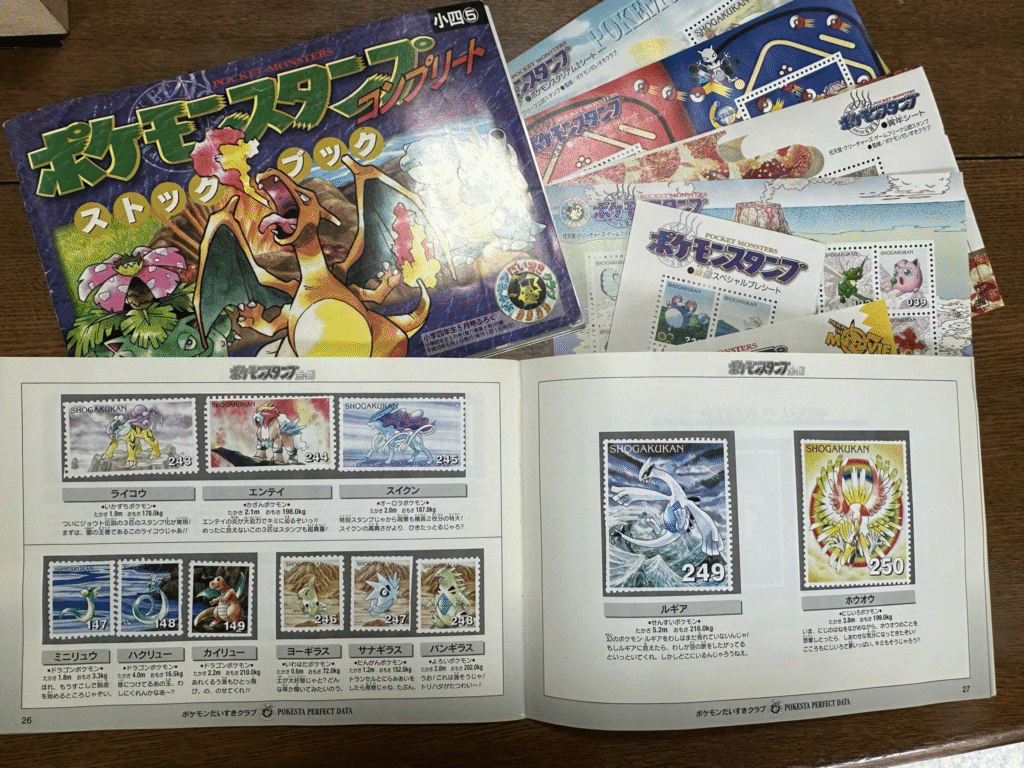
Gold & Silver Campaign (2000-01) stockbook. Charizard-themed stock book, Complete Campaign in the background.
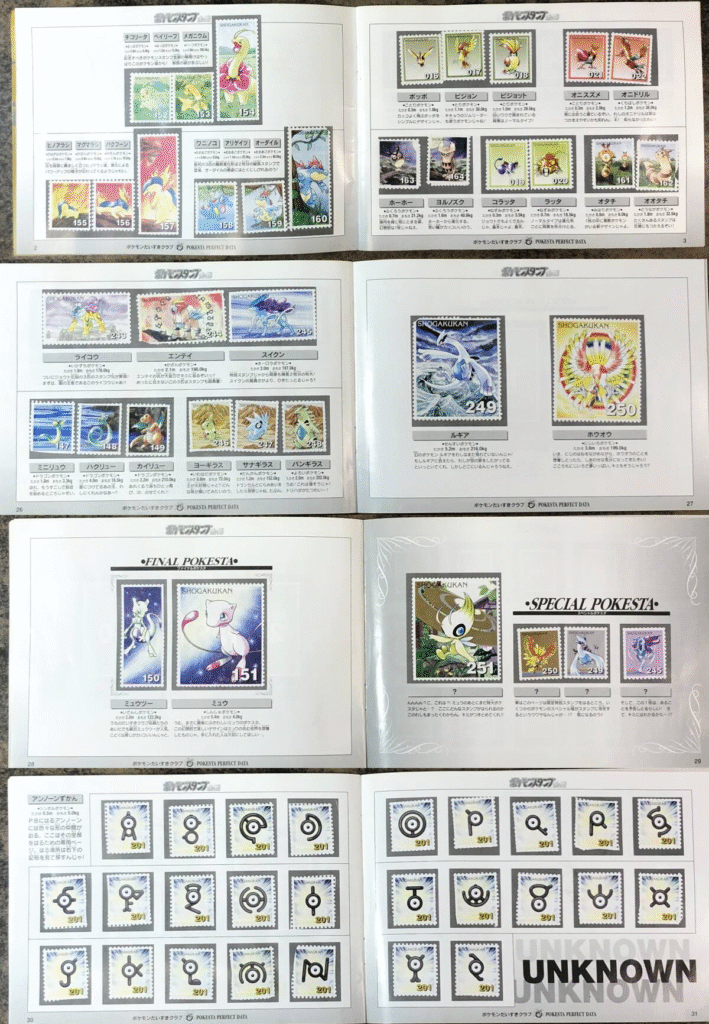
Selection of completed pages, GS stock book.
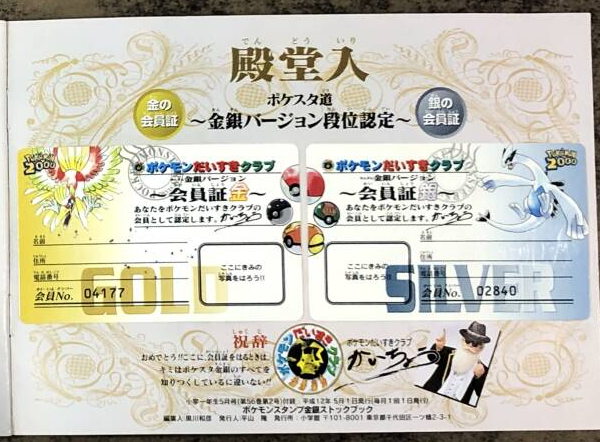
Stock book final page displaying the Gold and Silver Daisuki Club Member Cards awarded by Shogakukan to successful stamp contest applicants. Note the (very) early card ID numbers 04177 and 02840, which suggest a fast-submitting, motivated participant.
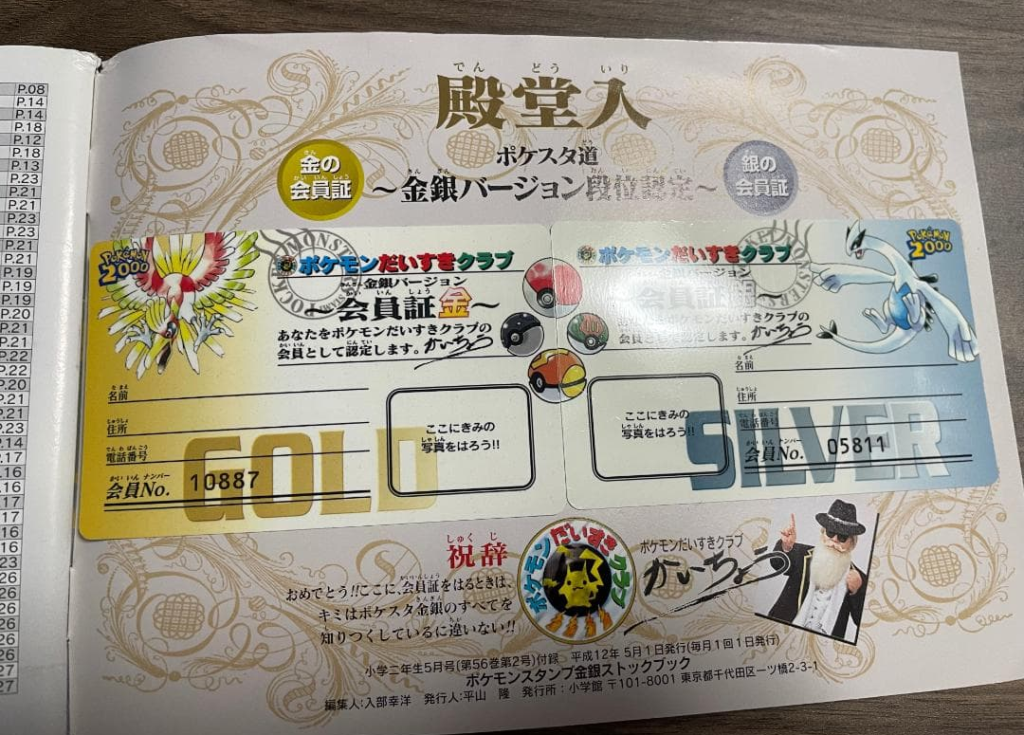
Another set of Gold & Silver ID#: 10887 (Gold) and 05811 (Silver).
