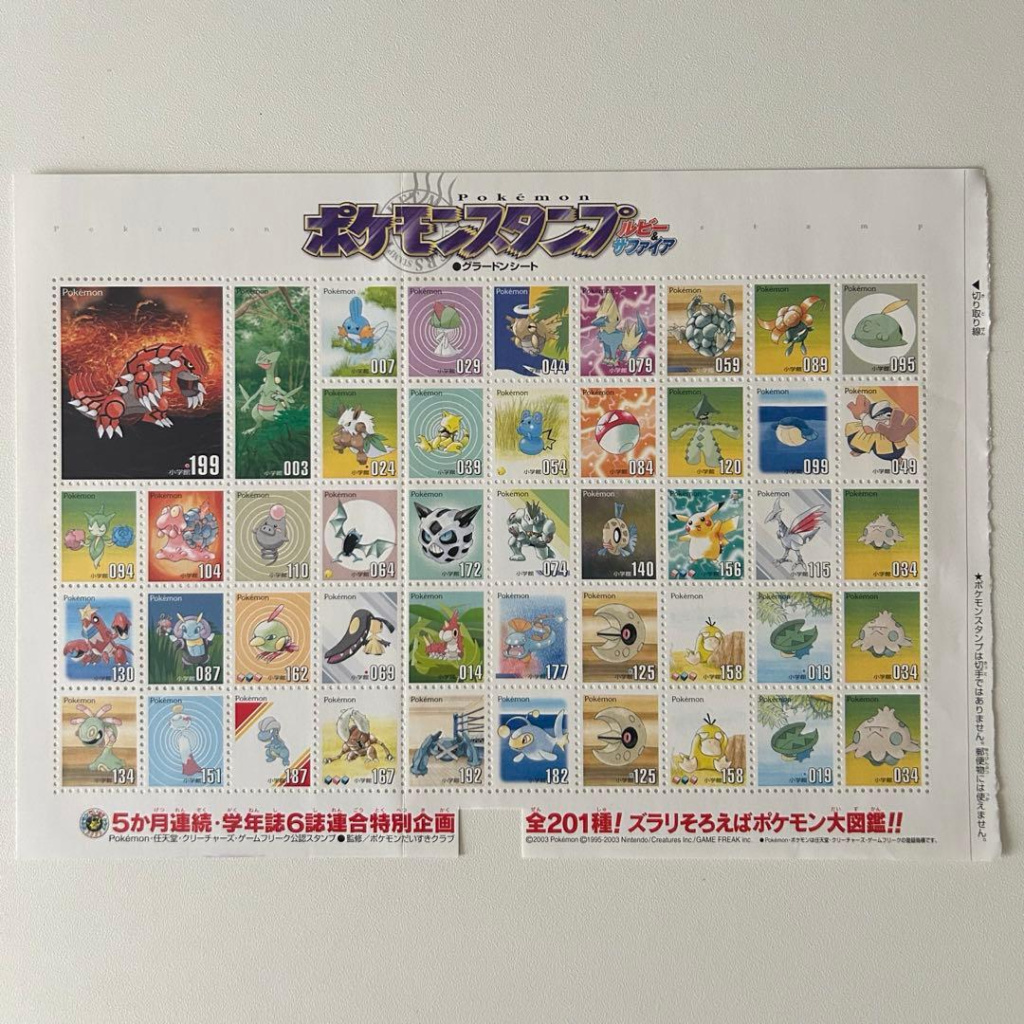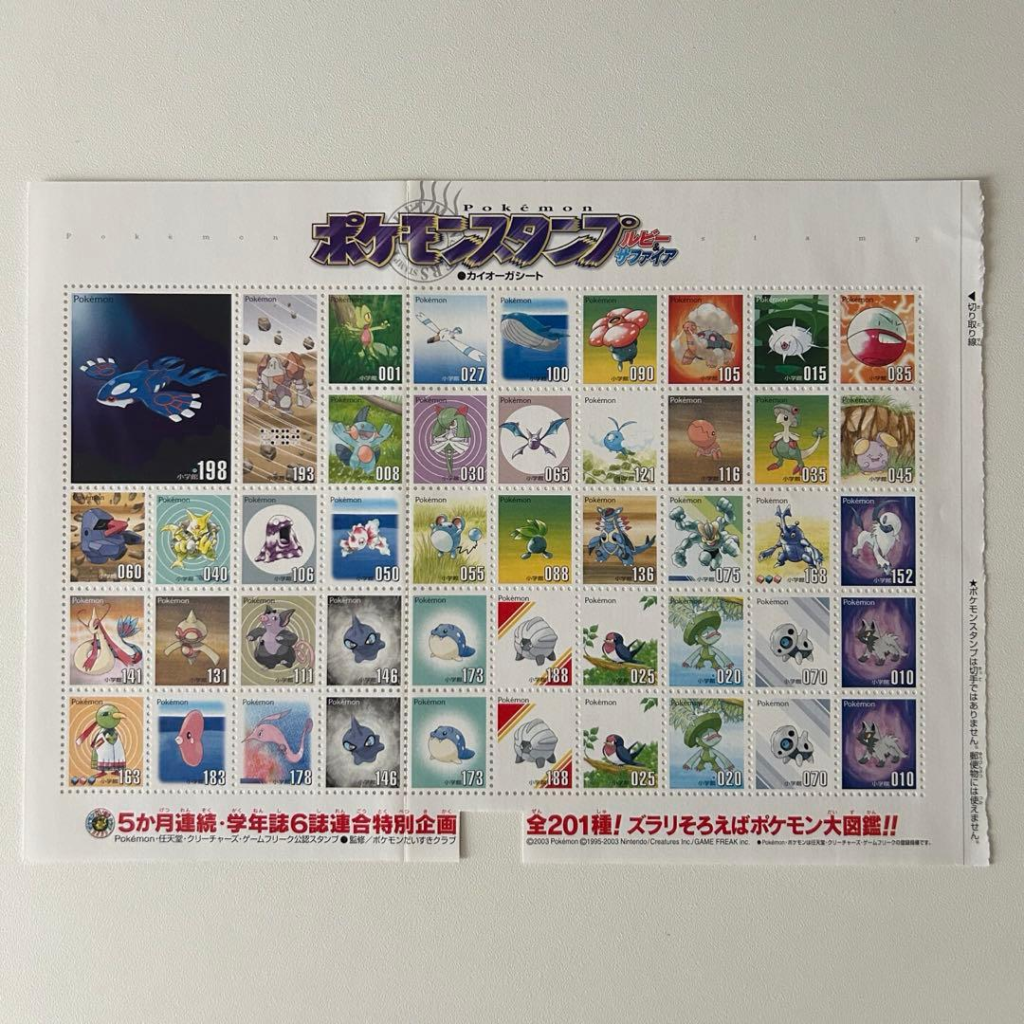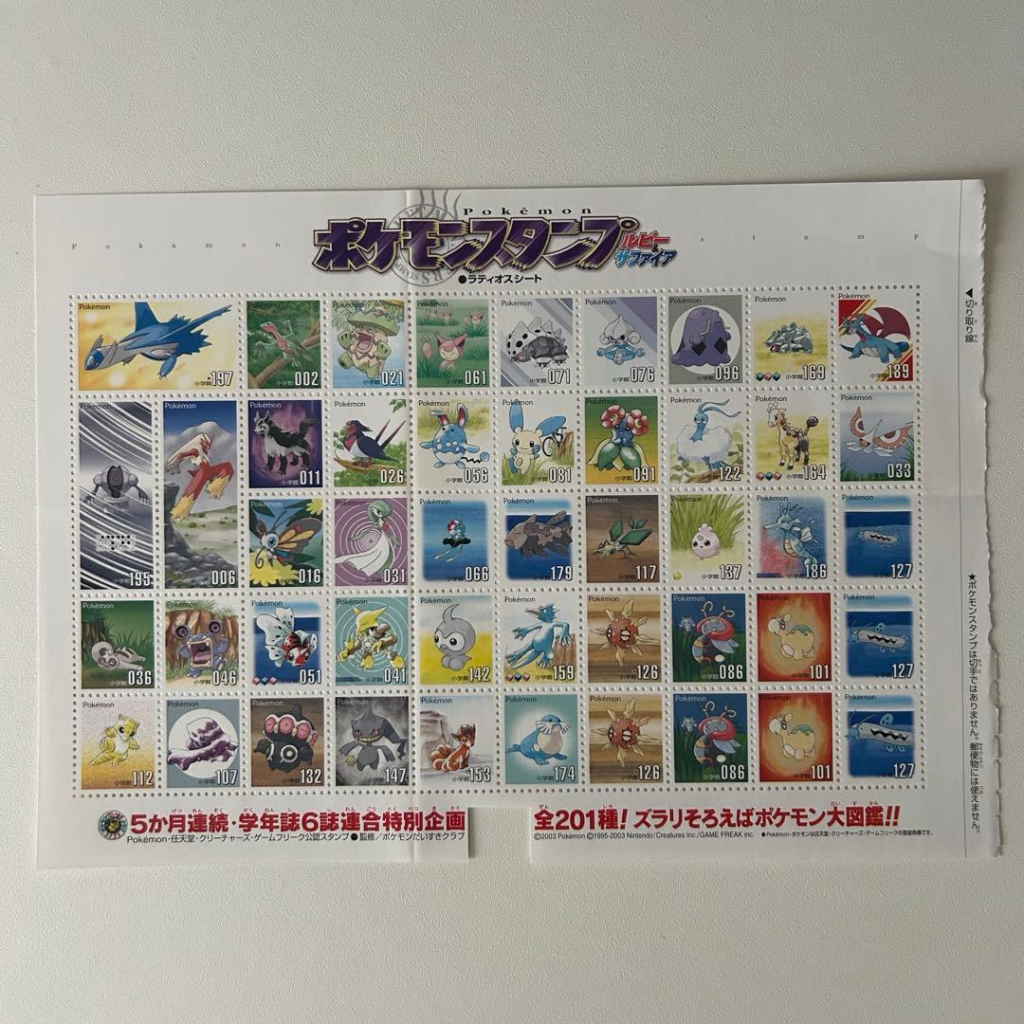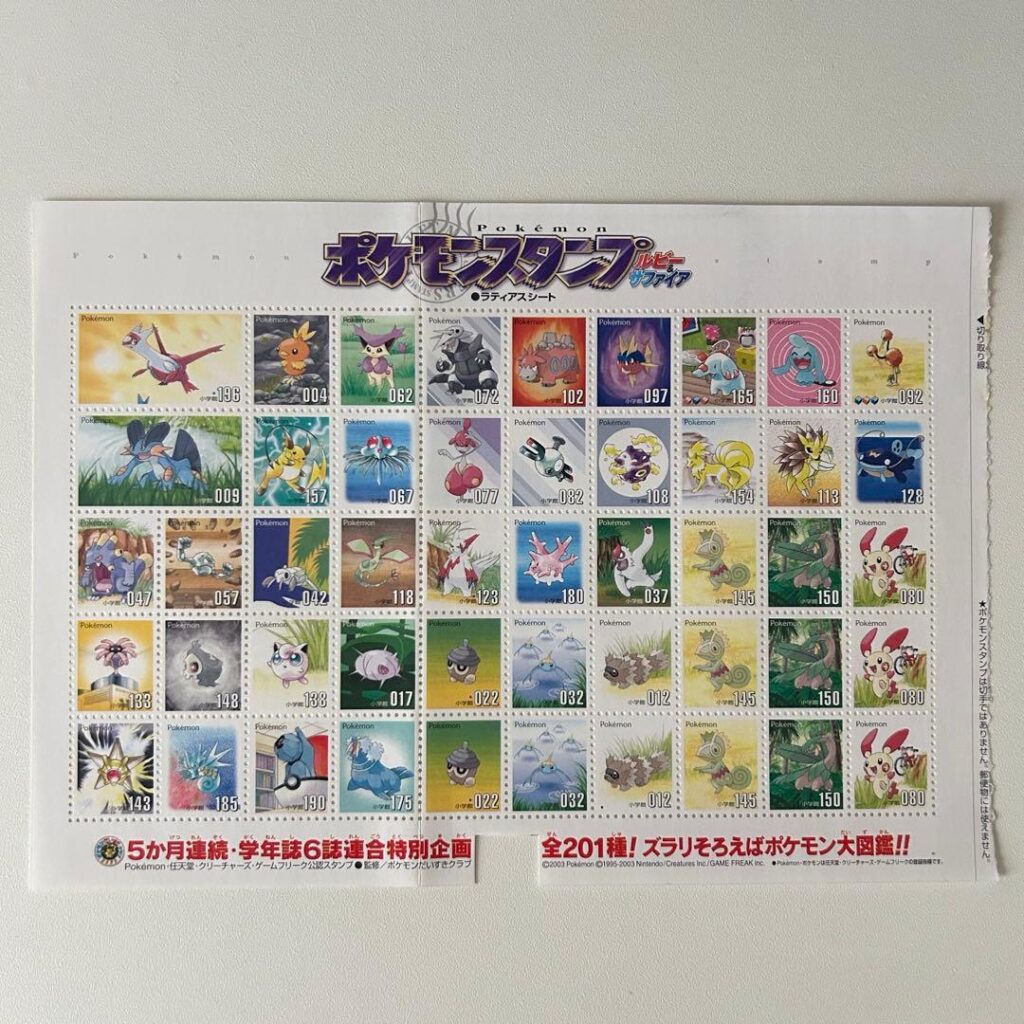
Ruby & Sapphire Campaign, May-September 2003 (5 sheets)
Total radio silence. After publishing house Shogakukan’s last major Pokéstamp drive, Gold & Silver, wrapped up in early 2001, not a peep was heard about monthly Pokéstamps for over two years. The format seemed all but dead, until suddenly in May 2003, in a bolt from the blue, the unexpected call to action came. With fresh generation Hoenn as its focal point, Grade-Specific Learning Magazine (GSLM) would once again play host to a Pokémon stamp drive. A total of 201 unique Pokéstamps and myriad Poké-themed prizes awaited dedicated young philatelists. How exciting!Now, twenty-eight months of nothingness is a long time. Surely, then, GSLM publisher Shogakukan had used this interlude to assess the good and bad of prior initiatives, rectify their shortcomings, and dream up a captivating monster campaign to eclipse all that came before. It would only be right to return with a bang. And yet… Clinging to what had worked so well before, Shogakukan understandably dusted off the familiar “collect, paste and win” formula, but in printing from an old instruction manual, Ruby & Sapphire‘s traditional presentation failed to win the hearts and minds of readers distracted by a digitalising, fast-moving world. And while the campaign’s most interesting elements indeed lay in the digital periphery, ultimately neither the paper stamps nor the supplementary online content went far enough to give the campaign any real teeth. Let’s take a look.
Brothers on Tour
Before we get to the ins ‘n outs of Ruby & Sapphire (R&S), let’s quickly discuss the campaign’s host. Or hosts, rather. Sure enough, everyone’s favourite grandad – the indefatigable Fan Club Chairman – reprised his role to serve as Ruby & Sapphire’s MC. But like last time, the fedora-donning, shades-sporting, Pikachu-loving ojiisan did not carry this mantle alone. No, the Kaichou came equipped with a fresh sidekick: His newly co-opted canonical brother, differentiated from the man himself by a blue colour scheme rather than a red one. Whatever happened to the astute but upright original sidekick Secretary Hisho, so eminent during Gold & Silver, I’m not certain, but evidently she was carted off into retirement to make room for yet another pensioner. Nepotism reigns supreme in the Pokéverse, fellas. You heard it here first.
As you may recall from the Stamp Absol article, GSLM took pains to rationalise the brother’s sudden appearance, framing his cameo as an explicit reference to the videogames where each region, including Hoenn, has its own Fan Club Chairman – all of whom are, quite possibly, canonically siblings. Way to make things more confusing! Either way, the whole R&S shebang took place under the auspices of these two, and together they signed off its essential paperwork, as we shall see momentarily.
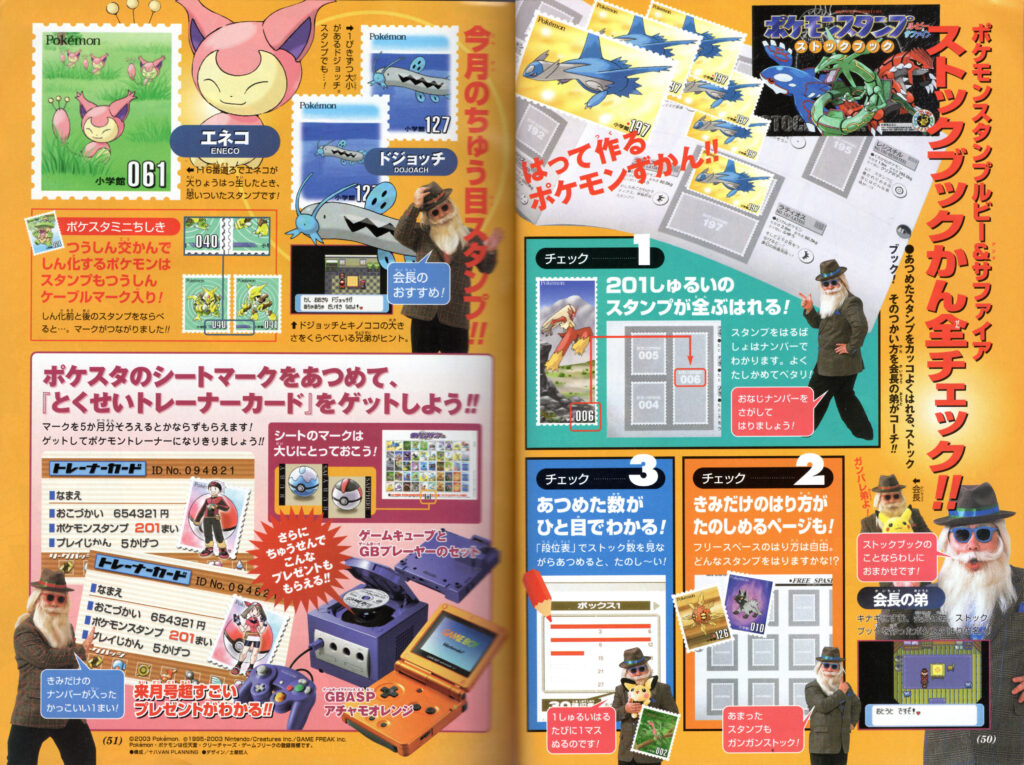
Grade-Specific Learning Magazine, Year 2, June 2003, p.50-51. Note the red versus blue trims on the brothers’ fedoras, and the Pacifidlog Town screenshot in the lower right.
Since Ruby & Sapphire was a revival campaign, one would have expected a major promotional push to put the initiative back at the forefront of all Pokéfans’ minds. But to the extent this was the case, I’ve found no evidence of it. A TV ad like Original‘s or Blue‘s is suspiciously MIA. If there was any hubbub on the famous Yahoo Kids Japan website, it wasn’t archived.1 Though its “Entertainment” section did include a permanent hyperlink to Shogakukan’s Net-kun website: https://web.archive.org/web/20030407112142/http://kids.yahoo.co.jp/the_scoop/Magazines And that flagship sister magazine to GSLM, CoroCoro Monthly, didn’t exactly shout the R&S Campaign’s arrival from the rooftops either, its sole mention (that we could find) coming in the June 2003 issue. A header that read “Five Super-Effective Major Pokémon Features”2「超こうかポケモン5大特集」 listed the stamp campaign’s release of the Groudon sheet as the #1 item to watch alongside, among others, the conclusion of the Ruby & Sapphire manga and Daisuki Club Wishmaker movie news. And that was it.
If that seems paltry, worry not. Pokémon Scoop, of which we have a big and beautiful archive here, devoted no less than a colourful two-thirds of a page to the promotion of R&S Pokéstamps. As we discussed at length in our “Kaichou” Absol article, the Daisuki Club Chairman (but not his brother) made an appearance here to sing the praises of R&S, and through several textboxes, the ever-helpful Kaichou explained in the briefest of fashions what issues of GSLM to purchase to acquire the coveted Pokéstamps, articulated the elegant design of the collectable paper specimens, and instructed readers how to apply for prizes. (Image below.) If nothing else, then, we can establish with certainty that word of the Ruby & Sapphire Campaign did exceed the confines of GSLM, though not, apparently, very widely.
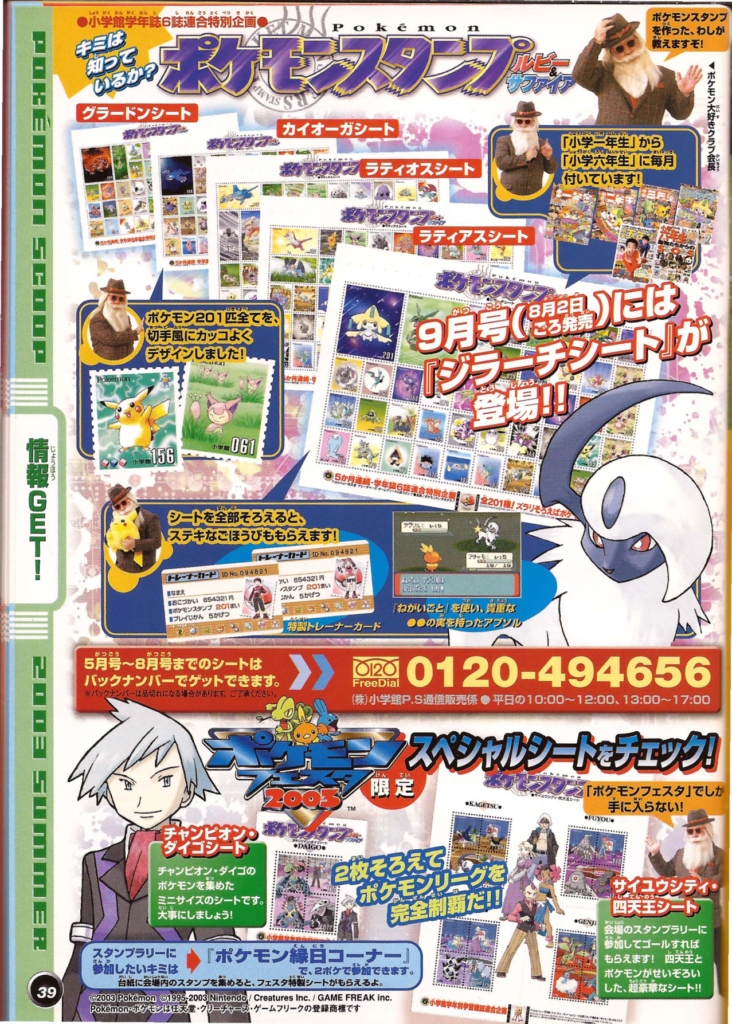
Pokémon Scoop – Summer 2003, p.39. Via Coconut LaCroix
Sheets, Stockbook, Rotation
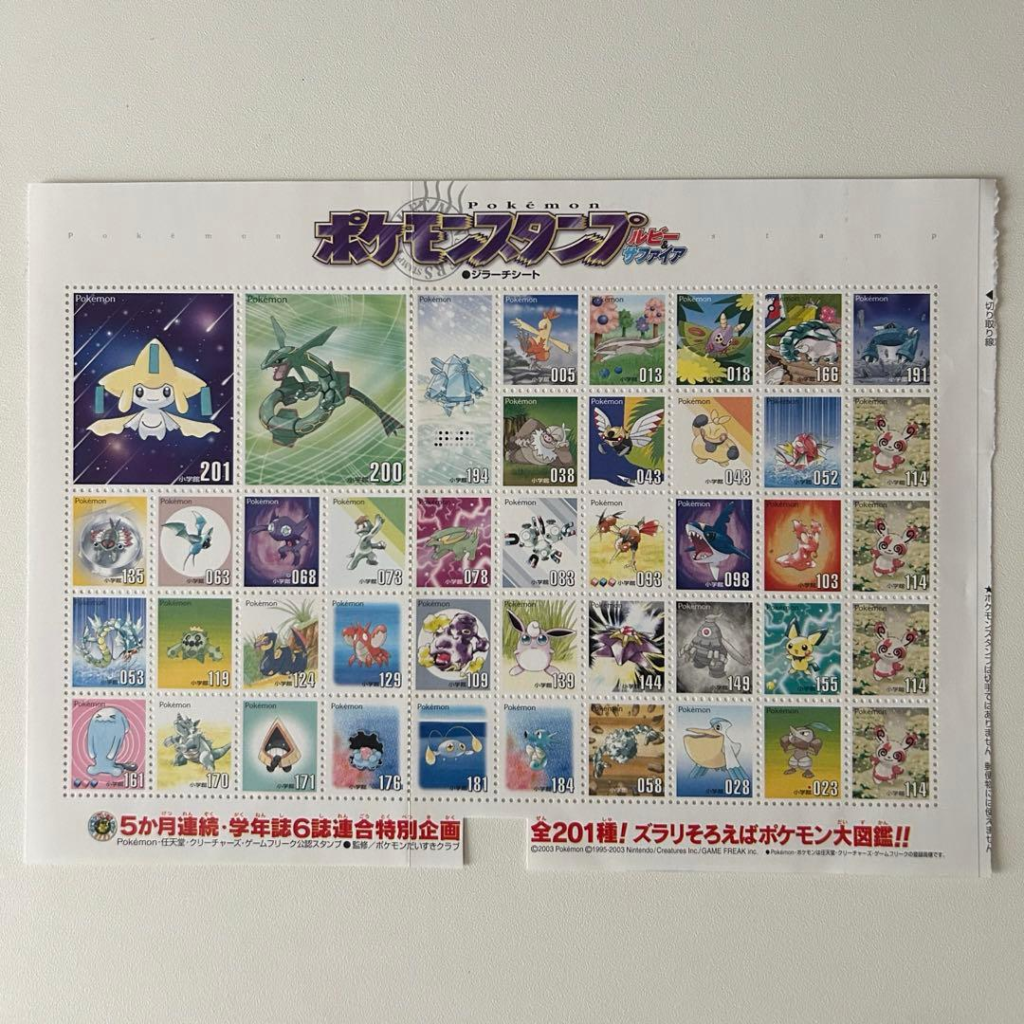
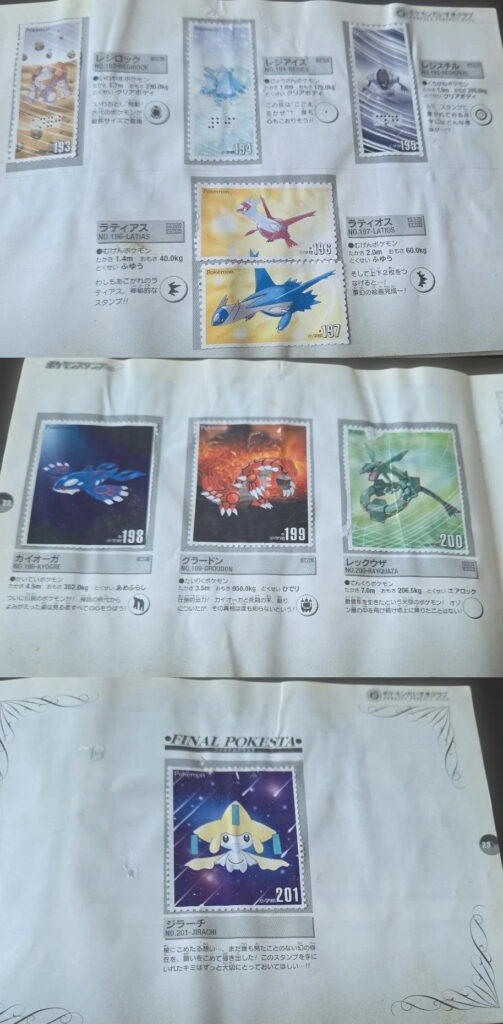
The goods themselves, then! In terms of Ruby & Sapphire Pokéstamp presentation, Shogakukan opted for a throwback to the familiar in all respects. Sheets took the well-known dimensions of 10×5 last seen during Complete. As usual, Legendary and Mythical heavyweights headlined the sheets in deviant 2×1 and 2×2 sized stamps. Between them, Kyogre, Groudon, Latios, Latias, and the pairing of Jirachi and Rayquaza locked out five unique sheets from May through September 2003. Across all sheets, the full HoennDex made its appearance, resulting in 201 unique stamps with plenty of duplicates, triplicates, and even quadruplicates (looking at you, Spinda – all with identical spotted pattern, no less). To be sure, there were cool artistic touches, such as the 2×1 “long” stamps of the Regi trio with braille subscript. But overall, the artwork vibe was classic to the point of dullness, with traditional Sugimori-like portraiture on simple backgrounds reminiscent of 1997’s Original Campaign (or Base set, for that matter). Where are my jumbo stamps, my action shots, my slice-of-life artist illustrations, my storytelling tag teams, my anything-to-make-R&S-unique? And let’s be real: Was it really necessary to print the word “Pokémon” in the top-left corner of every stamp rather than, say, the species name? If Shogakukan’s plan had been to dazzle the audience, return with a vengeance and propel Pokéstamps back into the limelight, this effort wasn’t it, which instead looked much like old wine in a new bottle. (Sure enough, the numbers would bear this out – see below).In any case, at the bottom of each sheet was found a “Club Mark” in the shape of a PokéBall variety – Dive, Dusk, and so on. Bear these in mind, because they’ll become relevant later when we discuss campaign prizes.
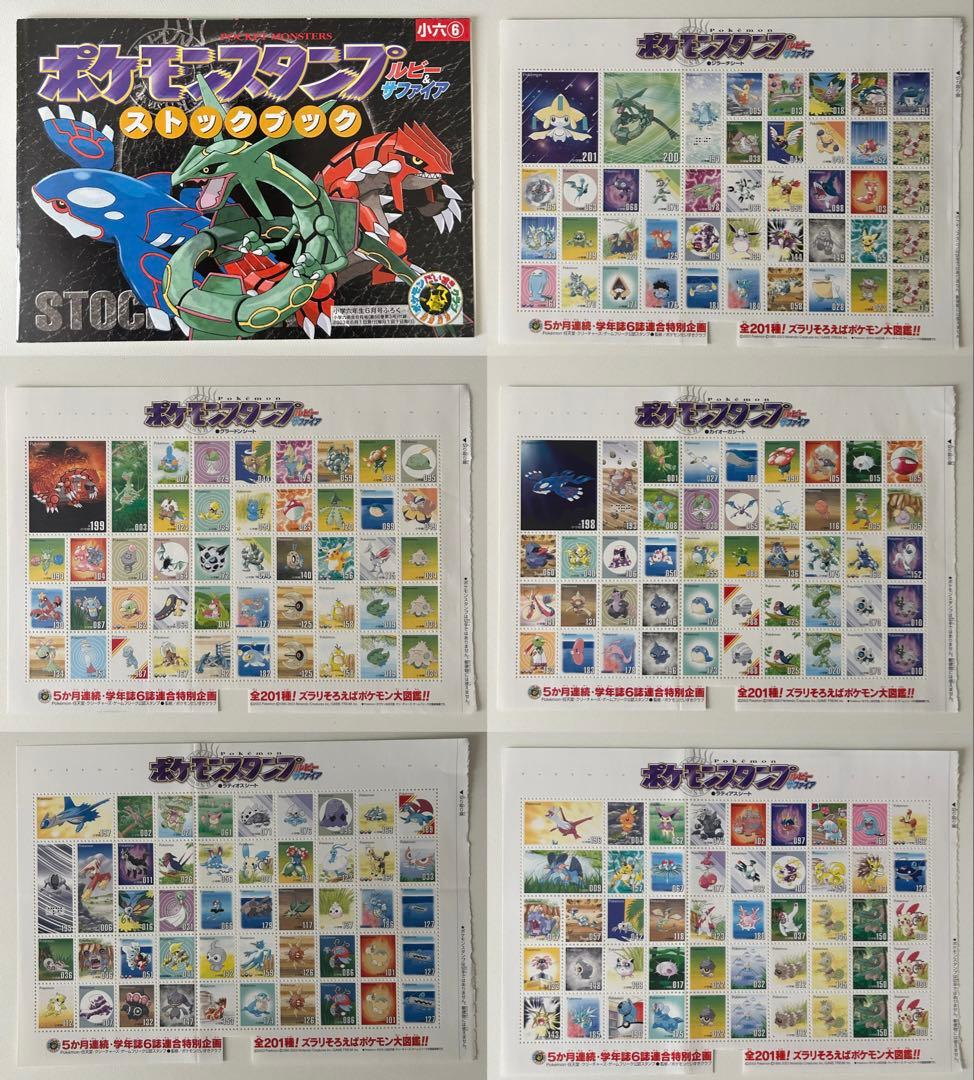
At least the stockbook was up to snuff, included as it was in GSLM June 2003 Year 1-6. Dyed a beautiful anthracite, its cover featured a large composite image of Hoenn trio Kyogre, Groudon and Rayquaza. Overleaf, stamp collectors found familiar elements, namely seven sets of colourable progress bars placed inside seven progress boxes designed to track one’s inexorable march to a full collection of 201 Hoenn stamps. Notably, the stockbook sought to emphasise the joint campaign stewardship by the “Fan Club Brothers”, ie. the Kaichou supported by his younger sibling as discussed above. The stockbook’s usual page 1 words of encouragement were now endearingly signed by both,3Loosely translated these words read: “We present to you the ultimate Pokémon collecting hobby! Do your best to collect them all!” and the Chairman’s curly graceful “Kaichou” signature was now complemented by a “brother” underneath to make for “Chairman Brothers” (かいちょうぶらっざす). Similarly, on the booklet’s final page where one’s prize Trainer Card was intended to be pasted, a goofy portrait photo of the brothers supported the usual congratulatory note.
As you would expect, the bulk of the stockbook consisted of a lightweight stamp-form Pokédex. Sporting Japanese and romanised Pokémon names, typing information, Hoenn Dex #, height, weight, flavour text Pokédex entry and – taking inspiration from the R&S games – an appropriate paw and/or footprint, it made for an even more complete catalogue of Hoenn than Gold & Silver‘s stockbook had been of Johto. If there was one area where the Ruby & Sapphire Campaign went above and beyond and truly shone, it was here, and I’d be showing off the full breadth of the stockbook in all its glory if completed books weren’t so few and far between. Instead, we make do with low-quality images of crumpled pages. Note also how, for the very first time, it wasn’t Mew who closed out the campaign, but Jirachi.
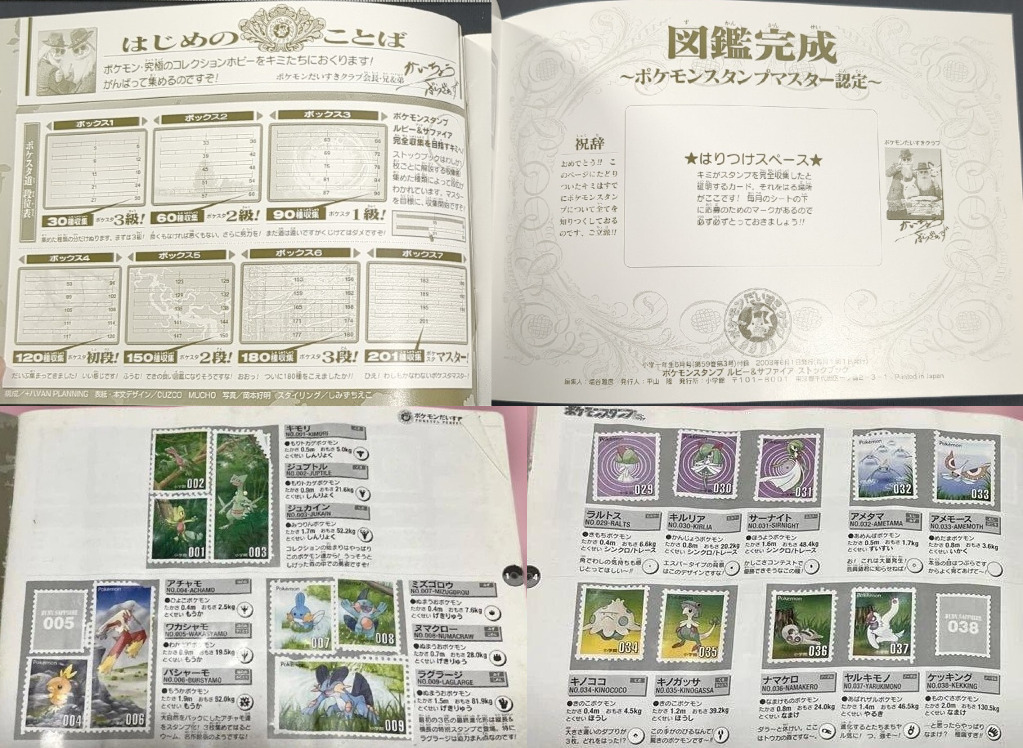
Ruby & Sapphire stockbook inside cover with progress tracker, final page to paste one’s Trainer Card, and near-complete stamp pages.
Teasing out Ruby & Sapphire’s full rotation has proven tricky. As you may know from browsing this project‘s articles, GSLM’s various grade-years commonly offered different stamp sheets each month. These patterns are our object of study, but sadly, absent the richness of data to reliably infer a rotation (e.g. Gold & Silver) and/or primary sources that spell it out for us (e.g. Original), our mapping of R&S’ five months remains tentative. Still, if past campaigns are any indication, we may establish with confidence that all of grade-years 1-6 finished the Ruby & Sapphire Campaign on a singular, identical closer. That is, the dual Jirachi-Rayquaza sheet in September 2003. It is also evident that, with only four unique rotating sheets to six participating grade-years, there was a certain amount of monthly duplication. For instance, in June 2003, both years 2 and 6 enclosed a Latios sheet. Our current understanding of Ruby & Sapphire’s sheet rotation is summarised in the table below.
Ruby & Sapphire Rotation - ©PokemonHistorian.com
| MAY | JUN | JUL | AUG | SEP | |
|---|---|---|---|---|---|
| YR1 | G | K? | Lo? | @? | J |
| YR2 | K | Lo | @? | G? | J |
| YR3 | Lo | @? | G? | K? | J |
| YR4 | @ | G | K? | Lo? | J |
| YR5 | G? | K | Lo | @ | J |
| YR6 | K? | Lo | @? | G | J |
Shortcodes are Groudon (G), Kyogre (K), Latios (Lo), Latias (@), and Jirachi (J).
Enter Net-Kun
During this rebooted stamp campaign, there was to be no novel iteration of the “POKESTA TIMES”. (Which, readers of Gold & Silver may recall, was a GSLM-based quasi news report that sought to impress readers with stampy tidbits and enhance the collection experience.) Instead, such fluff migrated from paper to the virtual environment of “Net-kun” (ネットくん), a website developed by Shogakukan ca. late 2001 to unify and present digital promotion of, and auxiliary content for, its line of Grade-Specific Learning Magazines (GSLM).4See, for example, this 2003 snapshot here: https://web.archive.org/web/20030622052453/http://netkun.com/index.htm If we study a representative example of Net-kun’s erstwhile frontpage, we can see it teeming with franchise mascots, from Hamtaro and Doraemon to, of course, Ruby, Hoenn arc protagonist from the Pokémon Adventures manga. The presence of these heavyweights should come as no surprise, for all of their manga (and many, many more hard-hitting IPs) were variously serialised in the Learning Magazines in the 1990s and 2000s, including Adventures that called GSLM home from the series’ inception in 1997.
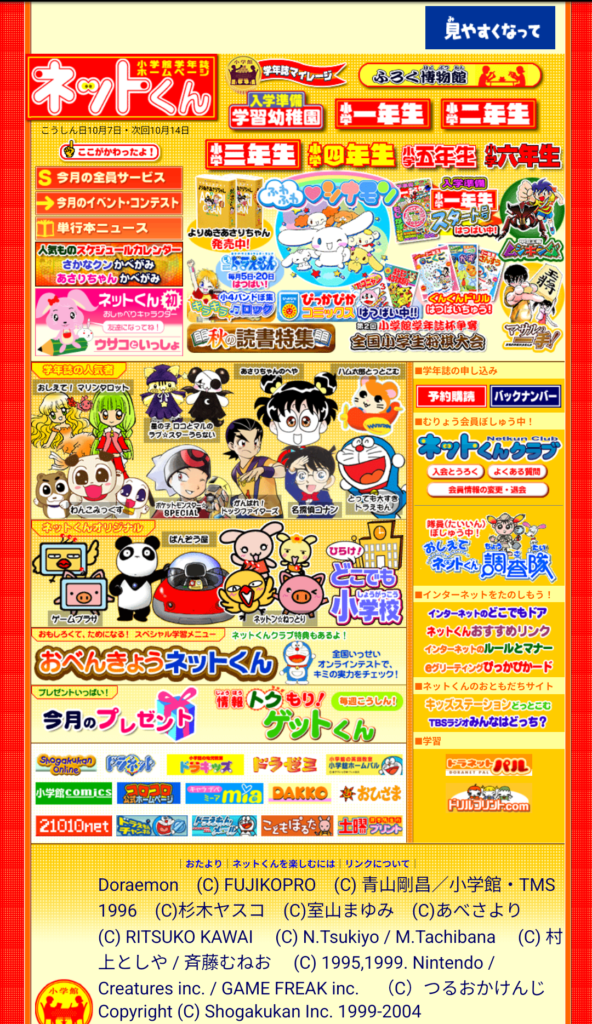
Frontpage of Netkun.com, October 12, 2004.
Throughout the Ruby & Sapphire Campaign as well as the Contest Stamps Campaign that succeeded it, Net-kun maintained a supporting section on its homepage by the name of “Pokémon Stamp Maniacs” (ポケモンスタンプマニアックス). A section that, according to one editorial Q&A on corocoro.tv (here), was “packed with special reports and secret info you won’t find in the magazines”. For whatever reason, archival crawlers didn’t start hitting Net-kun in force until 2004, with only scattered snapshots taken throughout 2003. As a result we don’t know exactly what the full breadth of the 2003 campaigns stamp maniac pages looked like.
Even so, what’s there is quite informative. Between at least June and November 2003, Net-kun published a new stampmaniac page and/or infographic every month. Sadly, none of these specifically dealt with Ruby & Sapphire. August through November were instead about the Contest sheets that we’ll get to shortly. July (here) promoted the Fiesta 2003 “Gym Leader” bonus sheet, and June did the same regarding a WHF Jirachi bonus sheet. We may assume, then, that Net-kun promotion of Ruby & Sapphire took place outside of these monthly updates.5A list of Wayback’s preserved 2003 Pokestamp pages is here: https://web.archive.org/web/20030607010406/http://netkun.com/pokesta/
Such as on the unfortunately lost “sheet” webpage (dead link) that presumably called attention to, in meticulous detail, every inch of your standard Ruby & Sapphire stamp sheet. The so-called “book” page (here) fared better. Thanks to a singular snapshot, we know that an infographic entitled “Stockbook Secrets Super Reveal” (ストックブックのひみつ超公開) told readers all about the campaign’s stamp album. Aided by images of the genuine article, the Kaichou was tasked with – supposedly – exposing the stockbook’s deepest mysteries. Which in practice were… Fundamentals, really. Super basic stuff. But I guess “simple facts” don’t sound quite as compelling as riveting secrets. In any case, the five mundane mysteries in question were:
#1 – “A super cool cover! Groudon, Kyogre, and Rayquaza—the three great Pokémon are all together! The [stockbook’s] stylish, high-end design is a real winner.”6「カッコいい表紙!! グラードン カイオーガ・レックウザの3大ポケモンそろいぶみ! 高級感あふれるカッコいいデザインが、 グーですな。」
#2 – “Paste them all to create your own original Pokédex!! The “stockbook” is a collection file exclusively for Pokéstamps. Stick all your Pokéstamps in here to complete your very own original Pokédex!”7「全部はればオリジナルポケモン図鑑に!!「ストックブック」はポケスタ専用コレクシ ョンファイル。 これに全ポケスタをはって、 キミだけのオリジナルずかんを完成させま しょう!」
#3 – “Master the Pokéstamp Ranks!! A handy rank chart that lets you see at a glance how many stamps you’ve collected. Of course, the more you collect, the higher your rank will go. Aim for Master!”8「ポケスタ段位をきわめよう!! どれだけ集めたかがひとめでわか る、ペンリな段位表。 もちろん多く 集めるほど、段位が上がっていくの です。 マスターをめざしましょう!」
#4 – “Store your items freely in the open space!! Swap items with friends, and stick any extra
stamps here. Special sheets you get at events and such go here, too.”9「フリースペースで自由にストック!!友だちとこうかんしたり、 あまったスタンプはここにはりましょう。 イベントな どでもらえるスペシャルシートもここ に。」
#5 – “Once you’ve collected them all… If you collect them all, we’ll give you an “Original Trainer Card” as proof that you’re a Master! Check out the “Gift Guide” for more details.”10「全部集めると・・・ぜんぶ集めたキミには、マスター のあかしとして、 「オリジナルトレ ーナーカード」をあげちゃいます! くわしくは 「プレゼント紹介」を 見ましょう。」
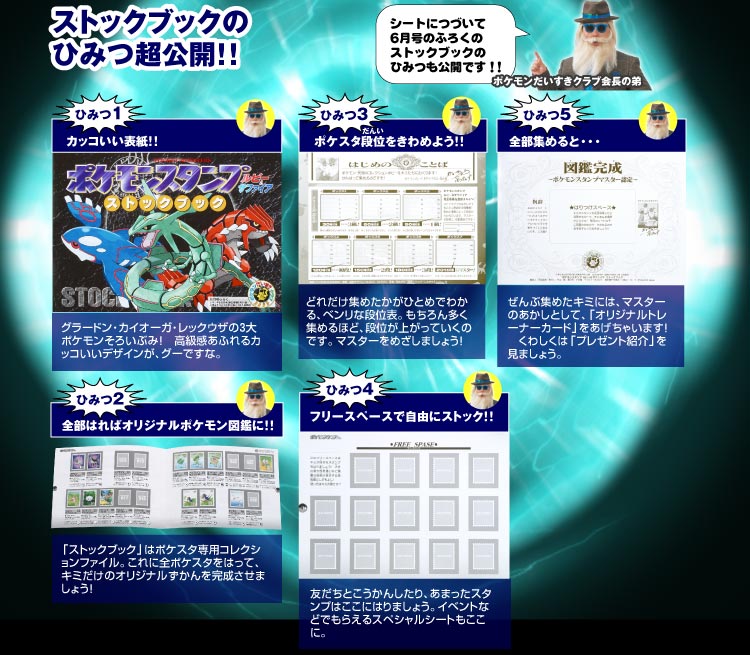
“Book” infographic.
Ah yes, the hallmark of one’s dedication to the Kaichou and his goofy projects: The desirable R&S Trainer Card and, of course, a shot at attached prizes. The “Gift Guide”, by the way, was reached via another website button hotlink (here) that redirected to a wonderful – spoiler – Absol prize infographic that you can read all about here. We, however, must now inspect…
PokéQuiz Time
A (pop)quiz! Considering Japan’s exam-sitting culture, it follows that its average citizen is no stranger to taking quizzes for either professional gain or for merrymaking pleasure. True to form, then, Net-kun duly treated its readers to a popquiz with Ruby & Sapphire Pokéstamps as the subject matter. Oh boy.
Normally, this would be where we lament the fickleness of the early 2000s internet, with much Flash content lost to time due to the imperfections and inconsistencies of early-day archival crawlers. But against all odds, this quizzy specimen lives, and to indulge your historical curiosity I’ve wasted no time reproducing it immediately below directly from the source on archive.org. It’s worth noting that as far as exams go, this Hoenn PokéQuiz was genuinely quite interesting. Not merely so for its did-you-know anorak factoidal content, but because it’s evident that real care that went into crafting it. Intricate, this quiz was the opposite of the perfunctory rushjob you might have expected. Let’s take a closer look.
“This is the legendary quiz that even many Pokémon fanatics can’t get all the answers to – it’s called “Pokémon Stamp Mania,” or “Pokesta Mania” for short! Just how much do you know? Let’s start by taking on the “Normal Class”!”11「数々のポケモンマニアも全問正解できなかったという 伝説のクイズ、それがこのポケモンスタンプマニア、 りゃくして 「ポケスタマニア」です! キミはいったいどれくらいのことを知ってますかな? まずは手始めに「ノーマルクラス」からちょうせんしましょう!」
As you might deduce from the four buttons on the quiz’ splash screen, it features four increasing difficulty levels: Normal, Super, Hyper, and Master. I’d love to walk you through all of the quiz’ content; perhaps someday, I’ll put together a fully transliterated English version. For now, however, we’ll merely sample the quiz by studying the Normal “Class” (クラス). This get-your-feet-wet entry level consisted of five questions. Which, rendered in English, translate to something like this (answers in below footnote). In order – play along if you like:
1: Which of these four Pokémon is dual type?
2: Which of these six Pokémon is dual type?
3: In this image of the 156 Pikachu stamp, what element is superfluous and not present in the R&S original?
4 Five pairs are shown – four pairs are identical, one pair isn’t. Which pair?
5 Which combination of sheet and ball is wrong?121: Carvanha; 2: Magnemite; 3: Its Victory Ribbon; 4: Zigzagoon (bottom one has a Pokérus symbol); 5: Kyogre sheet.
Well? How many did you get right? I’ll admit – Normal Class isn’t the walk in the park I thought it might be, particularly considering GSLM’s primary school audience. All in all, Normal asked a rounded set of questions that tested both general Poké-knowledge (questions #1 and #2) and observation skills (questions #3, #4 and #5). Hmm. Now I’m curious what Master Class looked like. Fine, you’ve persuaded me. Let’s take a quick gander. Will Master level be eye-wateringly difficult?
Here’s the Master tier translation, for your enjoyment:
1: Among the Pokéstamps on the right, there is one whose background changes between the pre-evolved and evolved forms. Which one is it?
2: Of the three sequences shown on the right, which one correctly arranges the stamp backgrounds from most to least common (across all sheets)?
3: Untranslatable in present form due to Japanese braille – requires transliteration. Answer is #3.
4: How many Ruby & Sapphire Pokéstamps are there in total? (Count each duplicate as one.)
5: There’s one Pokémon here whose appearance location is different from the rest. Which one is it?131: Rhyhorn; 2: Sequence #2; 3: Answer #3; 4: 221; 5. Azumarill (the others are on Route 114).
Huh! I don’t know that Master Class is necessarily more challenging than Normal Class, but it certainly involves a lot more digital paper pushing and bean counting. I think I like Normal’s questions better. With regards to question #3, the original wants the reader to find the correct sequence of three words by translating the Japanese braille on the Regi stamps. Obviously we can’t ask English-speakers to work out hiragana, let alone a braille version thereof. As the question defies simple translation, I’ve chosen to skip it here.14A makeshift English adaptation would perhaps look something like “put the stamps in order of the greatest number of braille dots”. Not the same scope, I know, but at least it works with the Regi-stamps. As a sidenote, the diversity and inclusivity orientation of this particular question is well-taken. Bravo, Pokémon.
All in all, this quiz and the stampy Net-kun pages at large were a shining example of how Shogakukan was beginning to harness digital tools to cultivate online experience-enhancing exchanges with its GSLM readership. There’s more to Net-kun’s Pokémon pages still, but we’ll leave it here for now and pick the thread back up in the context of late 2003’s R&S Contest stamp series [LINK]. In the meantime, let’s shift gears and study the prizes that awaited lucky participants.
Trainer Card
As so often with Shogakukan’s Pokéstamp campaigns, participation prizes came in two tiers: A universal prize, ie. the videogame-mimicking Trainer Card (トレーナーカード), plus a veritable cornucopia of additional Pokégoodies to which said Trainer Card formed both access point and key. Let’s start with the former.
In all grade-year issues of GSLM September 2003, budding philatelists discovered paperwork inviting participants to affix five unique “Club Marks” – one from the bottom of each month’s stamp sheet – to an enclosed application form. This form, in turn, instructed readers to provide the child’s name, guardian’s name, home address, phone number, gender, plus favourite Pokémon as well as favourite Pokémon movie. The completed application form was then intended to be glued onto a marked space on a “reply postcard” included in the same September 2003 GSLM issues. If mailed to Shogakukan between roughly August 1 and September 1 at the latest (postmark date), applicants could expect to receive a stylish Ruby & Sapphire-inspired Trainer Card in return by September 25.15Interestingly, Trainer Card delivery dates appear to have varied by grade-year. Year 4 late submitters (August 15-31), for example, would get their cards by September 25, but Year 6 late submitters got them much sooner, by September 10. The precise reason for this discrepancy is guesswork, but at a minimum, it suggests that GSLM grade-year editorial departments worked somewhat independently when it came to certain aspects of this stamp campaign. And, if for whatever reason mystified by all these moving parts, one could dial the Shogakukan hotline for assistance at 03-5371-0138 on weekdays between August 1 and September 30 between the hours of 10AM and 6PM.16Source is GSLM November 2003, Year 4, p13. See below.
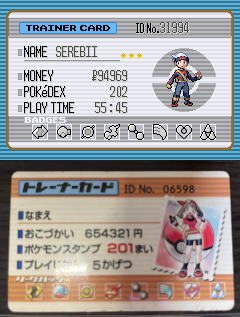
Joe’s in-game 3* Silver Trainer Card (top) versus a Shogakukan Trainer Card (bottom).
Trainer Cards which, quite wholesomely, were modelled after their in-game counterparts in both design and information. Just like in Ruby & Sapphire, there was a blank space at the top to record one’s name, next to a Hoenn-style portrait of either a boy or a girl as reflective of the stamp collector’s gender as provided in the contest application paperwork. A fictitious amount of currency was below that, followed by the campaign’s stamp completion count (201) and a listed playtime five months (5かげつ) – the length of the stamp campaign.17It’s interesting how Trainer Cards have a stamp count of 201 when all five sheets together tallied 221 stamps when accounting for duplicates. Finally, the symbols of supposedly acquired badges were at the bottom. Perhaps the most striking departure from the videogames was the Trainer Card’s colour scheme: A brownish orange where a basic R&S Trainer Card is lime green.
Besides the back of the card – which held the usual congratulatory note from the Fan Club Chairman – we’ve skipped over one critical detail so far: Each Trainer Card carried a unique ID number in the top-right. Interestingly, the Trainer IDs (TIDs) comprised only five digits instead of the usual six during previous stamp campaigns. Funnily, even promotional materials such as GSLM September and November 2003 had shown six digits, but ultimately, the leading zero was omitted. Whether this is evidence that Shogakukan full-well expected the Ruby & Sapphire Campaign to be less popular than, say, Original or Complete from the late 1990s, I’m not sure. It could simply be that the first digit was dropped for consistency with the R&S videogames. It is evident, however, that our highest known Shogakukan TID of 12837 is a far cry from the hundreds of thousands of Trainer Cards issued during each and every 1990s campaign. Whatever the case, TID matters, because not only was it the key to the distribution of campaign prizes, it’s also integral to our understanding of Shogakukan’s prize-giving mechanics.
Prizes for Thee TID
To understand the relationship between TIDs and prize counts, let’s first check out what was on offer. As GSLM September 2003 explained, Shogakukan made available a grand total of 1000 prizes ranging from Jirachi plush to GameCube systems to an enigmatic event Pokémon known as Kaichou Absol. The full array of goodies was as follows:
– World Hobby Fair 2×2 stamp ft. Jirachi, Groudon, Flygon and Absol – 490 winners
– Stamp “Kaichou” Absol event Pokémon – 300 winners
– Brand-new Pokémon Pinball: Ruby & Sapphire – 100 winners
– Nintendo GBA SP Torchic Orange – 30 winners
– NintendonGameCube Spice Orange – 30 winners
– Chunky Pikachu plush – 25 winners
– Jirachi plush – 25 winners
At 490+300+100+30+30+25+25 = 1000 prizes, the gift merch tally looked set in stone. But was it, really?
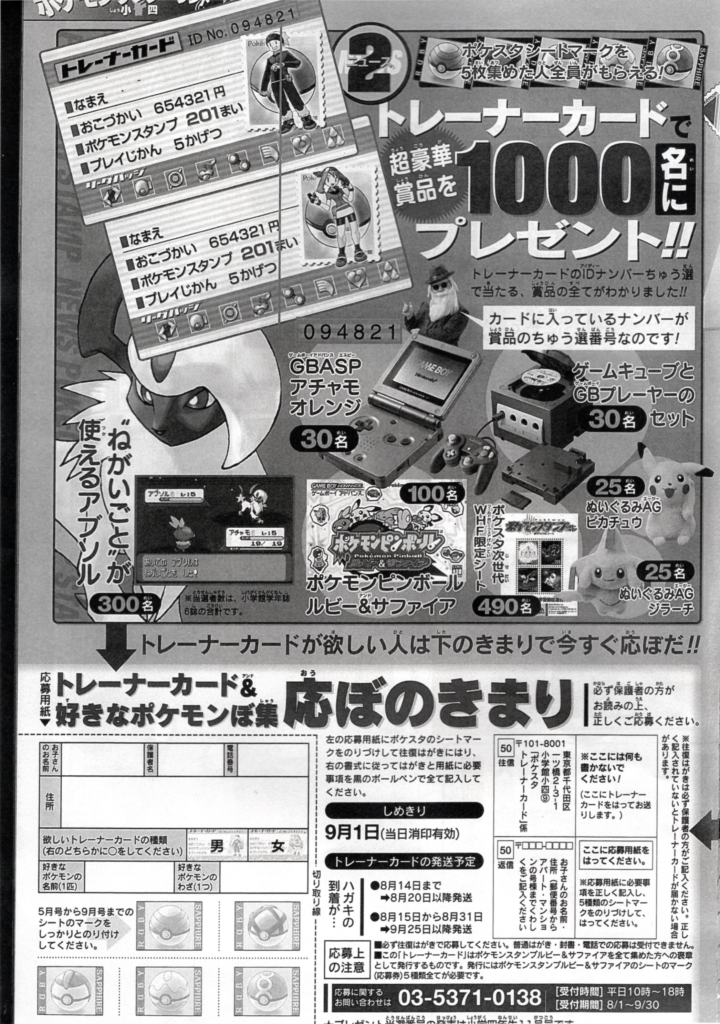
Grade-Specific Learning Magazines, Year 4, September 2003, p.15
Fast-forward two months and the feverish anticipation came to an end, for GSLM’s November 2003 issues published the R&S Campaign’s prize winners. Not by name in a winners’ list as had been common practice for virtually any GSLM promotion, but by – you guessed it – Trainer Card TID. At the bottom of, for instance, Year 4, p.13, were printed several batches of two or three numbers. But PokeHistorian, didn’t you say that an R&S TID was composed of five digits, not two or three? Quite right! Organised by prize type, these numbers <100 and/or <1000 were intended to be checked against the two or three trailing digits of recipients’ TIDs. For example, TIDs ending in 00, 25, 54, 69 all stood to win one of 490 Hobby Fair Jirachi stamp sheets. Thirty lucky IDs ending in 187 or 692 could look forward to their very own Torchic GBA SP, while owners of trailing numbers 545 and 718 all won stylish spice orange Nintendo GameCubes. And, pertinent to our Stamp Absol analysis: At the very top of the board, Absol’s winning winning digits were published: 43 and 98.18Prizes shipped around the end of October 2003. See GSLM November 2003, Year 4, p.13.
All this numerical mumbo-jumbo sheds light on a few matters. The first of which concerns the publisher’s methodology in selecting its prize winners. Absent definitive proof, the prevailing assumption had been that Shogakukan randomly picked a thousand unique five-digit TID combinations from the 10.000+ issued by, say, random number generator. Simple, right? But false. An alternate hypothesis was that the publisher utilised a weighted formula in order to ensure an equitable distribution by submission grade-year as would later be the case for Stamp Pichu [LINK]. But as we’ve seen, this theory has proven incorrect too. Elegantly immersive, Shogakukan’s digit-based solution turned otherwise meaningless TIDs into contest-pertinent pieces of information. Interestingly, in sharp contrast to the subsequent late 2003 Contest Campaign [LINK] there was no allocation correction for applicants’ gender or grade-year (hypothesis #2). Which, in turn, further suggests that the TIDs themselves were allocated chronologically on a first-come, first-serve mail-in basis and not stockpiled to be processed categorically by grade-year.19GSLM November 2003 said as much in a few critical lines near the bottom of the p.13. Loosely translated: “The number of prize winners is inclusive of all six magazines, covering grades 1 through 6. The winning numbers are identical for both boys and girls. The winning numbers are identical for all six magazines.” Obviously these insights raise the question of how prize allocation happened in the trailblazing 1990s stamp campaigns. Hopefully we’ll be able to answer this some day.
While we’re here, it’s tempting to ponder the available facts a little deeper and tie them to our understanding of GSLM print runs and circulation data. We know for a fact that among GSLM’s grade-years, Year 1 comfortably sold the greatest number of monthly copies, followed by Year 2 (on average ~65% of Year 1) and Year 3 (40-50%), then trailing off towards Year 6 (consistently some ~15-20% of Year 1).20See the Japan Magazine Association’s early 2000s GSLM circulation data reproduced here. At first glance it’s tempting to conclude, then, that the bulk of R&S prize-winners will have come from Years 1-3. Yet, how do attention spans and purchasing power factor into it? By the elongated standards of Gold & Silver, at five months, Ruby & Sapphire was a relatively compact campaign. Even so, it’s reasonable to assume a proportional dip in applications from Year 1 (and perhaps Year 2) readers due to the demands of five months of continuous participation. Not only can older kids – age 12+, in the case of Year 6 – be assumed to have a longer attention span, with age also comes the purchasing power, independence and the wherewithal to – if they so desired – game the system and buy four different grade-year magazines right at campaign’s start in May 2003 to thereby secure 4/5 Club Marks in one fell swoop. Taken together, these factors may go some way towards evening out the count between Years 1-2 and 5-6 despite the latter’s vastly poorer sales. Of course, the obvious curveball is adult participation in the R&S Campaign. Absent identity checks, there wasn’t anything stopping an older Pokéfan submitting through any given grade-year. As such, considering so many confounding elements, it’s tricky to read the tea leaves. Why couldn’t there have been a winners list? Ahh… It would have simplified matters so much.
Disappointing uptake aside, Hoenn’s stamp goodness didn’t end here. There was to be one more go-around under management of the Kaichou – a last hurrah, his swan song, before both the Chairman and Shogakukan hung it up. What am I talking about? Meet the Contest Campaign.
NAVIGATION:
Gold & Silver Campaign < > Contest Campaign
Audiovisual